Event 1
意大利参加第一次世界大战
[Italy](entity:location-recall-location-italy-85c2492cd54b)’s entry into the [First World War](entity:event-recall-event-first-world-war-ddadba2d85b1) matters in this account not only as a wartime decision but as the origin Mussolini assigns to a new political order. Looking back, he presents the country’s intervention on [May 10, 1915](entity:time-recall-time-1915-5-10-d3402d460905), as a revolution already accomplished—one that made the surviving combatants, rather than the prewar political class, the claimants to the future. The episode becomes a point of reference for the Fascist movement’s identity, its appeal to veterans, and its effort to turn the memory of war into political authority.
## Intervention Recast as Revolution
In a retrospective passage, Mussolini answers workers calling for revolution by insisting that Italy has already had one: the country was dragged into war on May 10, 1915. He then identifies the people he represents with the war itself, declaring that the future belongs to them. The formulation collapses the distinction between the historical event and the political identity built around it. Intervention is no longer merely a decision that began a war; in Mussolini’s account, it is the founding act of a new community.
That claim also gives the passage its contrast. Workers invoke a revolution still to come, while Mussolini presents the war as a completed revolution whose consequences remain active. His image of himself as able to smell the coming times casts the future as an extension of wartime experience, not a return to peace. The event is thus recalled as a precedent and a source of political legitimacy, rather than narrated through the circumstances of the decision itself.
## The Dead, the Survivors, and the Political Audience
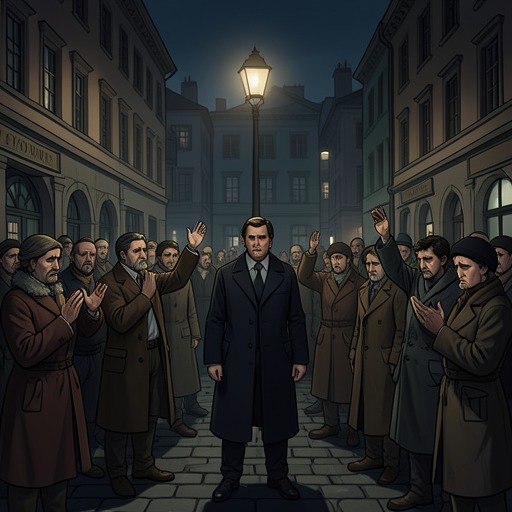
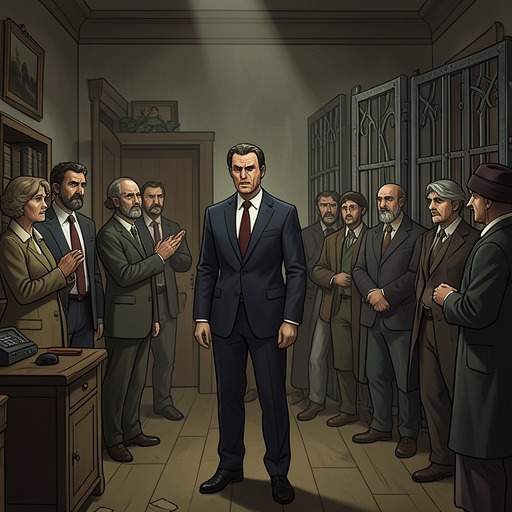
The war’s cost supplies the grim setting for that claim. The narration evokes eleven million dead and names the [Carso](entity:location-recall-location-a0a05f0f2088), Ortigara, and the Isonzo as landscapes from which the dead seem to rise. Those who gather in the meeting room are described as former soldiers and survivors, a damaged remnant who speak briefly and fall silent. They are not presented as a confident victorious public: they are bound together by losses that have made ordinary political language seem inadequate.
Mussolini nevertheless identifies this audience as his own. He describes himself as the protector of the demobilized and the lost, and reads the nearly empty room as the beginning of a public whose pulse he can still feel. The contrast between the small gathering and the immense dead gives the meeting a politics of absence: the movement’s living adherents appear to speak in the name of those who cannot return. In this account, the war’s legacy is therefore both a constituency of survivors and a symbolic community of the fallen.
The passage sets that veterans’ world against the older political class, whose liberal speakers and cautious politicians are portrayed as exhausted and incapable of facing what follows. Five million returning soldiers, it predicts, will bear down on the country’s borders. The image turns demobilization into a looming political force: men coming home from war are not simply returning to civilian life but entering a contest over who will shape the postwar nation.
## From Wartime Commitment to Fascist Program
The organizational consequences appear in the movement’s early program. At a meeting of interventionist groups in March [1919](entity:time-recall-time-1919-329d1bdc3600), Mussolini proposed validating the war and those who had fought it, opposing foreign imperialisms judged harmful to Italy, and making the war issue the basis of electoral struggle against parties and candidates opposed to intervention. The gathering approved these proposals, with cities from across Italy represented. The memory of the war had become a political test: allegiance to intervention and recognition of combatants were presented as foundations for collective action.
The later Fascist program broadened this inheritance. Mussolini described [Fascism](entity:concept-recall-concept-fascism-37baf0d2849a) as a synthesis capable of absorbing liberalism after earlier methods had been buried through violence, and called for the nationalization of Italians across regional identities. Beyond the national borders, he tied national greatness to an imperial idea; within them, he described the state as the vehicle of political unity. These later propositions do not supply further details about the 1915 decision, but they show how the movement’s account of intervention could be carried forward into a program of national consolidation and expansion.
## Afterwar Conflict and the Meaning of Mobilization
The book places this political language amid a country where mass organization and coercive action were reshaping public life. In [Bologna](entity:location-recall-location-bologna-e9b2b10db055), socialist organizations and labor bodies pressed demands that affected employers, tenants, and access to bread; in the countryside, leagues controlled hiring and agricultural work, while disputes over labor rules could bring boycotts and forced departures. These conflicts are not presented as consequences of Italy’s entry into the war alone. They do, however, establish the unsettled postwar setting in which rival movements claimed to speak for workers, peasants, and the nation.
In [Ferrara](entity:location-recall-location-970ebca292e4), [Fascist squads](entity:organization-recall-organization-fascist-squads-02305958dd0b) later organized a punitive expedition with military methods, assembling armed men and using trucks supplied by the Agrarian Association to strike several rural targets at once. In 1922, [Italo Balbo](entity:character-recall-character-2e79cde02db9) mobilized tens of thousands of impoverished farm laborers from the surrounding countryside into Ferrara, where they camped in the streets and pressed the prefect for public works. These episodes belong to a later political struggle, not to the event of 1915 itself. Their recurrence of military organization and mass mobilization helps clarify how the war’s vocabulary of action and collective discipline remained available to movements competing for power.
## Memory and Political Significance
A later account of [Gabriele D’Annunzio](entity:character-recall-character-gabriele-d-annunzio-6e66d28027db)’s address to his legionnaires gives the postwar divide a different image: 1919, he argues, would be remembered as the year of [Fiume](entity:location-recall-location-fiume-c271af61753f) rather than the negotiations at Versailles. Fiume signifies youth, life, and a future accompanied by the dead; Versailles stands for a faltering and distrustful Europe. This is not a description of Italy’s entry into the war, but it echoes the same effort to make wartime sacrifice the measure of political renewal.
The event’s significance in the book lies in this contested afterlife. Mussolini turns intervention into a revolution that has already happened, the basis for claiming the veterans and the future; the movement’s public program then makes loyalty to the war and its fighters an organizing principle. The war’s dead and survivors lend that claim its force, while the postwar conflicts show that no single movement possessed an uncontested right to speak for the nation.
Event 2
墨索里尼被意大利社会党开除
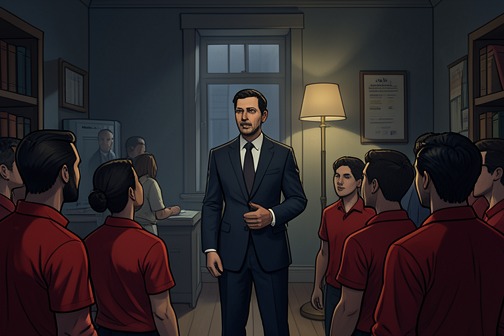
[Benito Mussolini](entity:character-recall-character-benito-mussolini-0330d40d2c3f)’s expulsion from the Italian Socialist Party in November 1914 marked the rupture between a prominent socialist editor and the movement whose supporters had once admired him. After he opposed the party’s absolute-neutrality position and advocated intervention in the war, he resigned as editor of its leading newspaper, founded a rival publication, and was expelled. The episode turned a political disagreement into an enduring break with his former comrades.
## Rise Within [Socialism](entity:concept-recall-concept-socialism-48fe77fdb8e7)
Before the split, Mussolini had moved from obscure origins to prominence within official socialism. He had served as secretary of the labor chambers in Cesena, Forlì, and [Ravenna](entity:location-recall-location-b931f601f413), then became editor of the party’s newspaper in 1912. In that role he made it a forceful and uncompromising socialist organ, and was esteemed by comrades and readers for his ability to understand and express the spirit of the proletariat.
That standing made the break especially consequential. His former admirers did not regard his change of position as an ordinary disagreement over policy: the narrative describes them as grieving over what they saw as his betrayal. The distance between his earlier authority and his subsequent expulsion gave the event the character of a personal and political severance.
## The Break Over Intervention
On October 20, 1914, after opposing the leadership of the Italian Socialist Party over its commitment to absolute neutrality, Mussolini resigned as editor. He advocated [Italy](entity:location-recall-location-italy-85c2492cd54b)’s active neutrality, a position that soon gave way to open support for intervention. The account presents the change as occurring within weeks and describes both his earlier neutralism and his later interventionism as sincere; it does not settle what ultimately caused the shift.
On November 15, Mussolini began publishing a new newspaper that promoted Italy’s intervention in the war against the militarism of the Central Powers. Its position placed it in sharp opposition to the socialist paper he had recently edited, and the controversy was directed not only at that publication but also at its principal supporters. The new paper thus made the break public and sustained it through a competing political platform.
## The Expulsion
The account dates Mussolini’s expulsion to November 24, 1914. In a later recollection, he places the rupture in the hall of the Società Umanitaria, where workers who had idolized him the day before cursed him and competed to denounce him. The scene sets the intensity of the reversal against his former standing: the party’s rejection came not from distant opponents but from comrades and supporters who had once embraced his leadership.
His socialist comrades accused him of moral and political unworthiness. The expulsion followed his opposition to the party leadership and his interventionist advocacy; it was not merely a consequence of leaving an editorial post. The change in allegiance carried a lasting social cost, as the former followers’ hostility remained vivid in his later account of the event.
## Significance and Unresolved Convictions
The episode closed Mussolini’s ascent within official socialism while opening a path built around interventionist politics and his new newspaper. His former comrades’ sense of betrayal and his own memory of their denunciations show how the split was experienced as more than an organizational decision: it severed an existing bond between a political leader and the constituency whose spirit he had once been praised for articulating.
The narrative does not present the expulsion as proof that Mussolini had simply abandoned every socialist conviction. It explicitly leaves uncertain how far those convictions changed amid the financial demands of maintaining his newspaper, his dealings with people and factions of different views, and the relentless hostility of former comrades. Mussolini, in turn, never publicly renounced socialism and continued to want—or perhaps to believe—that he remained a socialist. The break was decisive in his political trajectory, but the account leaves his inner ideological transformation unresolved.
Event 3
卡波雷托战役
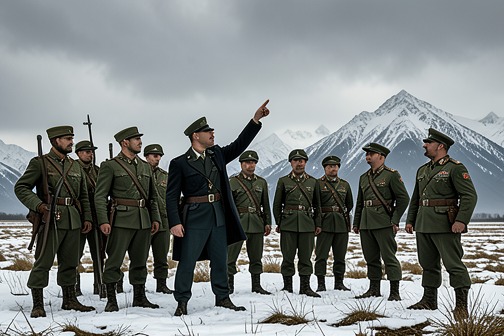
The [Battle of Caporetto](entity:event-recall-event-88c622e2df2c) appears as both a military catastrophe and a lasting political memory: in [Benito Mussolini](entity:character-recall-character-benito-mussolini-0330d40d2c3f)’s retrospective account, it marks the death throes of an era, while the later inquiry into the defeat rekindles disputes over responsibility even after [Italy](entity:location-recall-location-italy-85c2492cd54b)’s final victory. The narrative gives no account of the battle’s tactics or immediate course; instead, it emphasizes the scale of the defeat and the controversies that returned around it.
## The Defeat as a Historical Rupture
Mussolini places [Caporetto](entity:location-recall-location-6efe2fb82db4) behind him on [October 24, 1917](entity:time-recall-time-1917-10-24-f2c09a6c2db4), and characterizes it as the greatest military defeat of all time. His account describes an army of a million soldiers destroyed in a single weekend. The battle is not presented as an isolated military episode: it becomes a marker dividing one political era from another, a remembered collapse that stands behind the postwar present.
That framing gives Caporetto a double significance. It is a specific date and defeat, but also a shorthand for the destruction of the world that had preceded the postwar crisis. The narrative offers this interpretation through Mussolini’s backward glance rather than through a detailed reconstruction of events on the battlefield.
## The Inquiry and the Return of Controversy
Years after the defeat, the publication of the government inquiry into Caporetto revived scrutiny of the army’s high command. The findings renewed opponents’ arguments against the war, despite the subsequent triumphant final victory. In the narrative, military defeat therefore continues to exert force after the fighting has ended: official documents reopen questions that victory had not settled.
The controversy becomes personal as well as political. [Giacinto Menotti Serrati](entity:character-recall-character-giacinto-menotti-se-21bcf4177c8d), who had once provided Mussolini with shelter and work when he was a poor young emigrant, revived the accusation that Mussolini had founded [Il Popolo d’Italia](entity:object-recall-object-il-popolo-d-italia-b2b48dcea0f3) with secret French funding. Mussolini answered by reviving an insinuation that Serrati had been a spy. Their exchange descended into insults, old grievances, and mutual suspicion. Caporetto’s inquiry thus reactivated not only disputes about military command and intervention, but also the antagonisms of the political world that had formed around the war.
## Memory in the Postwar Narrative
Mussolini places Caporetto beside another decisive break in his own past: his expulsion from the Socialist Party in November 1914. The juxtaposition does not make the two events equivalent. Rather, it presents the military defeat and the political rupture as separate thresholds behind the narrator, helping define the distance between his former position and the postwar role he claims for himself.
The battle’s importance in this account lies partly in that retrospective placement. Caporetto is recalled not through a scene of combat but as a defeat whose meaning returns through memory, official investigation, and renewed polemic. Even after victory, the event remains unsettled: its military responsibility is debated, its political significance is reclaimed by opponents of the war, and its memory supplies a stark measure of the rupture from which the postwar order emerged.
Event 4
十月革命
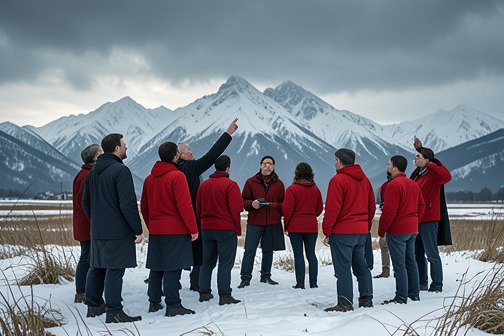
The [October Revolution](entity:event-recall-event-e4be4913f923) is presented as a turning point whose force extends beyond the seizure of the Winter Palace: it becomes a model of revolutionary power, a source of expectation among Italian workers, and, in retrospect, an image through which Italian communists confront their own political defeat. The narrative moves between the assault in 1917 and its later representations, emphasizing how an event can remain politically active long after the fighters have left the square.
## Revolutionary Context and International Reach
The revolution’s outcome is expressed first through the red flag’s triumph in [Russia](entity:location-recall-location-e36341713c23) in October 1917. By the summer of [1919](entity:time-recall-time-1919-329d1bdc3600), that victory has become a powerful point of reference beyond Russia. The flag is described as flying across at least sixteen fronts, from Vilnius to Samara and Vladivostok, spanning the Baltic, the Volga, and the Pacific. The scale of this conflict makes the revolution seem not like an isolated change of government but part of a wider struggle whose geography reaches across continents.
The account singles out [Leon Trotsky](entity:character-recall-character-leon-trotsky-571c5d8ac744)’s creation of the [Red Army](entity:organization-recall-organization-073952387f8f) in less than a year. Its importance lies not only in its existence but in the transformation of military thinking attributed to it: a fluid understanding of war, conceived across vast spaces and as a planetary theater of operations. The Red Army’s example is said to have been followed elsewhere. In the spring of 1919, [Béla Kun](entity:character-recall-character-b-la-kun-a2736b9a84d2) established the Hungarian Soviet Republic, another development that helped make the Russian victory appear reproducible to observers abroad. The revolution thus supplied both a political precedent and a military example, feeding the belief that an upheaval begun in one country might become international.
## The Assault as an Image
The narrative later returns to the revolution through photographs displayed in [Moscow](entity:location-recall-location-19aceb5ce281) offices and conference rooms. The images form a sequence rather than a single isolated record: in July 1917, troops loyal to the provisional government fire on a crowd on Via Sadovaja; in September, armed Bolshevik workers patrol the streets of Petersburg from a truck; in October, sailors aboard the Aurora prepare for combat. Together, these pictures make the revolution visible as a succession of confrontations and preparations, not simply as a victory already completed.
The central image is dated October 25, 1917. Red Guards run across a snow-covered square toward the Winter Palace, a former seat of power represented by a high stone wall. The photograph is taken from above, perhaps by someone who climbed a lamppost. Its elevated viewpoint reduces the advancing figures against the pale square, making them appear small beside the building they are approaching. Yet none seems still: their movement gathers into a near-pyramidal formation, the composition recalling the measured perspective of [Renaissance](entity:time-recall-time-11a7f887e631) painting. The scene holds opposing impressions together. The wall appears to bar the future, while the running figures seem to deny that any barrier can stop them. The revolution is rendered at once as an uncertain assault and as an image of triumphant motion.
## Italian Hopes and Political Reception
Before this retrospective viewing, the Russian example had already entered Italian socialist politics as a present possibility. At a [Milan](entity:location-recall-location-617379caf4c2) rally in July 1919, workers gathered beneath red flags after reformist leader [Claudio Treves](entity:character-recall-character-claudio-treves-0854cd58f6fd) and maximalist leader [Giacinto Menotti Serrati](entity:character-recall-character-giacinto-menotti-se-21bcf4177c8d) had spoken. [Nicola Bombacci](entity:character-recall-character-nicola-bombacci-5ddc3dca87f9), whose supporters waited for him to take the floor, began by stating that the red flag had triumphed in Russia and then drew the conclusion that they wanted Russia to be present in [Italy](entity:location-recall-location-italy-85c2492cd54b) as well. In the account, the simplicity of his opening makes the Russian victory sound like an established fact from which an Italian demand can follow.
That expectation belonged to a period of sustained revolutionary anticipation. In 1919, crowds in Milan were described as waiting for a cataclysm, while events elsewhere in Europe reinforced the sense that established governments could be overturned. For Italian workers listening to their political tribunes, the [Russian Revolution](entity:event-recall-event-russian-revolution-6444f80ee8e1) therefore meant more than a distant change of regime: it gave form to the hope that mass action might also transform their own country. The rally’s atmosphere, however, was described as more festive than mutinous. The contrast between revolutionary language and the gathering’s actual character cautions against treating expectation as proof that an Italian revolution had already begun.
## Defeat, Memory, and Competing Futures
By October 1922, the Moscow photographs have acquired a different emotional meaning for the Italian delegates who look at them. The revolution is still represented in the archive as a founding triumph, especially in the image of the Red Guards advancing on the Winter Palace. But the delegates cannot see it only from the standpoint of its victors. For them, it also carries the regret of defeat. The distance between the victorious figures in the photograph and the Italian communists’ position in 1922 turns the image into a measure of the gap between revolutionary promise and political circumstance.
Nicola Bombacci’s later position makes that tension especially clear. He recognizes the dominance of the Russian comrades within the [Communist International](entity:organization-recall-organization-communist-intern-ce17a5248ccd), yet continues to argue for following the light of the Russian Revolution. In parliament, he works to reopen trade with Russia and secure recognition of its government, finding support even among industrial magnates such as [Ettore Conti](entity:character-recall-character-ettore-conti-a5984c3698d6). The alliance of business and communism is presented as an irony produced by defeat and political necessity, rather than as evidence that their aims have become identical. The Russian Revolution remains an object of allegiance, but the practical efforts made in its name unfold through unexpected partnerships.
The event’s afterlife also includes a competing language of national renewal. Later Fascist formulations promise to overcome an old order, create a unified Italian nation, and inaugurate a new era; their mass politics likewise place crowds on the historical stage. This does not make the Fascist project equivalent to the Russian Revolution. Rather, the narrative shows that the revolutionary example helped shape a wider political vocabulary in which mass mobilization, rupture, and a promised future could be claimed by opposing movements. The October Revolution endures in the book both as a specific assault remembered through photographs and as a contested standard against which later political hopes, adaptations, and defeats are measured.
Event 5
布卡里湾突袭
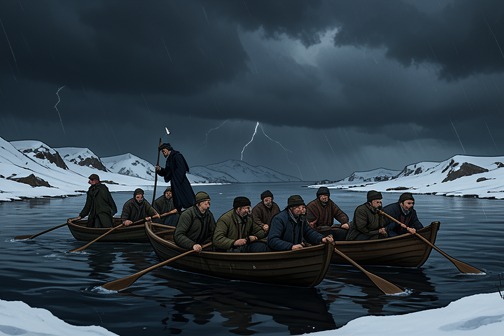
The Buccari Raid was a wartime assault by [Gabriele D’Annunzio](entity:character-recall-character-gabriele-d-annunzio-6e66d28027db) and his companions in small boats against the Austrian naval blockade at Buccari Bay. The book presents it as both a military exploit and a public act of defiance: after the defeat at [Caporetto](entity:location-recall-location-6efe2fb82db4), the raid lifted the morale of Italian troops and strengthened the image of D’Annunzio as a national hero.
## Wartime setting and purpose
The raid took place amid the crisis following Caporetto, when Italian morale had suffered a severe blow. D’Annunzio’s operation at Buccari belonged to a succession of high-profile wartime actions intended to confront the enemy directly and restore confidence. The account emphasizes its effect on Italian troops rather than providing a tactical narrative of the assault.
## The operation and its place among D’Annunzio’s exploits
D’Annunzio violated the Austrian naval blockade in Buccari Bay with small assault boats. The account places the raid alongside his attack on the port of Kotor in Montenegro and his flight over Vienna, during which his squadron dropped propaganda leaflets urging the enemy capital to surrender. These operations made him a visible participant in the war, not merely a literary advocate of it; the book describes his name as rightly included among the victors and heroes.
## From wartime acclaim to unease about peace
The raid’s public meaning outlasted the immediate operation. D’Annunzio’s wartime exploits had given him a celebrated role, but the end of the fighting threatened to deprive the poet-warrior of the purpose that had sustained him. After the Italian counteroffensive at [Vittorio Veneto](entity:location-recall-location-1ecfc8e16456), he wrote to his comrade [Costanzo Ciano](entity:character-recall-character-costanzo-ciano-3a58048bc68f) that peace felt like a curse and hoped for another great exploit before the country was pacified. His words reveal the tension between the raid’s place in a victorious war and his own fear of becoming useless once war was over.
## Narrative significance
The Buccari Raid condenses the book’s portrait of D’Annunzio: literary ambition and military action become parts of the same public identity. Its significance lies not only in the breach of the blockade, but in the morale it restored and the heroic reputation it helped secure. Yet the later prospect of peace unsettles that triumph. The operation stands as both a high point of wartime agency and part of the background to D’Annunzio’s postwar search for another decisive cause.
Event 6
Raid over Vienna
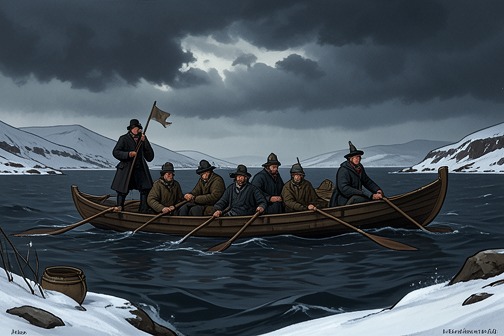
[Raid over Vienna](entity:event-recall-event-e25d904e3655) was a propaganda flight led by [Gabriele D’Annunzio](entity:character-recall-character-gabriele-d-annunzio-6e66d28027db) and his squadron during the [First World War](entity:event-recall-event-first-world-war-ddadba2d85b1). Rather than describing an attack on the city, the account emphasizes the flight’s message: posters urged the enemy capital to surrender. The episode belongs to a sequence of daring exploits through which D’Annunzio fashioned himself as a poet-warrior and a national hero.
## Place in D’Annunzio’s wartime exploits
After his friend [Giovanni Randaccio](entity:character-recall-character-giovanni-randaccio-8ae4b3f57bc9) died in an assault on the Isonzo front, D’Annunzio planned a series of sensational actions. The raid over Vienna was one of them, alongside an attack on the port of Kotor and a small-boat raid in the bay of Buccari. The account supplies no date, aircraft details, or description of the flight’s immediate reception in Vienna.
## Method and purpose
D’Annunzio flew over the enemy capital with his squadron and scattered propaganda posters urging surrender. The action carried the war into the opponent’s airspace, but its stated purpose was persuasion rather than a described bombing or other attack. The narrative distinguishes this flight from the Buccari raid, which it specifically associates with raising the morale of Italian troops after the defeat at [Caporetto](entity:location-recall-location-6efe2fb82db4).
## Significance
The episode exemplifies how D’Annunzio joined spectacle to military service. His aerial exploits extended his public image beyond the literary and political arena, making the poet’s name part of the story of Italian wartime heroism. The book presents the Vienna flight as one element in that larger self-fashioning, without detailing its operational results.
Event 7
库尔特·艾斯纳遇刺
The Assassination of Kurt Eisner, as recounted in the book, marked a sharp turn in Bavaria’s revolutionary crisis. After Eisner proclaimed the region a socialist republic, he was shot in February by Anton Graf von Arco auf Valley, a Munich aristocrat. The narrative places the killing within a wider contest over who would govern Bavaria, rather than treating it as an isolated act.
## Background and Assassination
In November, Kurt Eisner declared Bavaria a socialist republic. The book then recounts that, in February, Anton Graf von Arco auf Valley shot him. It identifies the attacker as a Munich aristocrat who had been rejected by extreme-right secret lodges because his mother was Jewish. The account does not specify a motive for the shooting or describe its immediate circumstances beyond identifying the attacker and the act.
## The Contest for Bavaria
Eisner’s death forms part of a sequence of rapidly changing political claims. On April 6, socialists competing with communists for supremacy proclaimed the Bavarian Soviet Republic under playwright Ernst Toller. After six days, Toller's government collapsed and the communists, led by Eugen Levine, took power. By setting the assassination beside these successive proclamations and changes of leadership, the narrative shows that the killing did not settle the struggle for Bavaria; political control remained contested.
## Narrative Significance
The episode appears in a compressed account of revolutionary upheaval across Europe. Its brief treatment contrasts with the successive governments and conflicts that follow, making Eisner’s assassination a hinge in the chronology rather than a fully developed scene. The later events establish the instability surrounding the new republic: competing factions claimed authority, and the Bavarian Soviet Republic itself lasted only six days under Toller before being replaced by communist leadership.
Event 8
Proclamation of the Bavarian Soviet Republic
The [Proclamation of the Bavarian Soviet Republic](entity:event-recall-event-5eade85fe750) was the April 6, [1919](entity:time-recall-time-1919-329d1bdc3600), declaration that moved Bavaria’s postwar upheaval from a socialist republic toward Soviet rule. In the book’s account, it belongs to a wider European revolutionary crisis, but its brief government also shows how quickly the struggle for political supremacy could shift from one faction to another.
## From Socialist Republic to Soviet Republic
The proclamation followed an earlier turning point in Bavaria. In November, Kurt Eisner had declared a socialist republic; in February, he was assassinated by Anton Graf von Arco auf Valley. By April, socialists and communists were competing for the supremacy left vacant by Eisner’s death. On April 6, the socialists, then fighting that contest, proclaimed the Bavarian Soviet Republic under Ernst Toller.
## A Six-Day Government
The new government’s brief tenure was marked in the account by an episode involving its foreign-affairs appointee, who declared war on Switzerland after it refused to lend Soviet Bavaria sixty locomotives. The narrative presents the declaration as an absurd measure by a government already under strain. Toller’s government collapsed after six days, and communists led by Eugen Levine took its place.
## Revolutionary Context and Significance
The proclamation appears amid a wider atmosphere of revolutionary expectation. The book describes Europe as unsettled by war and mass demobilization, while reports of upheaval elsewhere intensified the sense that political order was giving way. In this context, Bavaria’s successive governments were not a single, stable settlement but stages in an unresolved struggle between socialist and communist forces. The speed of the transition—from Eisner’s socialist republic, through the Soviet Republic, to communist leadership—makes the proclamation a short-lived but consequential episode in that crisis.
Event 9
Proclamation of the Hungarian Soviet Republic
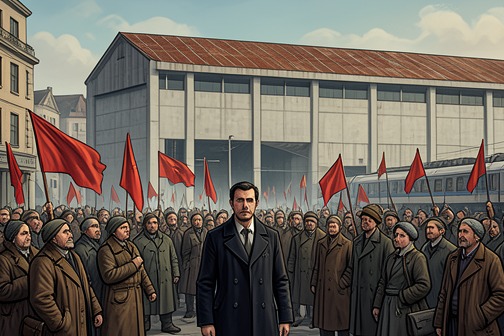
The [Proclamation of the Hungarian Soviet Republic](entity:event-recall-event-5aa340758c67) in Budapest on March 21, [1919](entity:time-recall-time-1919-329d1bdc3600), placed Hungary at the center of a revolutionary crisis spreading across postwar Europe. The new republic’s alliance with Lenin’s [Russia](entity:location-recall-location-e36341713c23) and its attempts to recover lost territory through military action made it more than a domestic political change: it became part of a volatile struggle over the settlement left by the war.
## Background in a Revolutionary Europe
The proclamation came during months of mounting expectation that revolution might overturn existing governments. In Munich, socialists had declared Bavaria a republic; a later Bavarian Soviet Republic gave way first to communist rule and then collapsed. In Budapest, Sándor Garbai and [Béla Kun](entity:character-recall-character-b-la-kun-a2736b9a84d2) proclaimed Hungary’s Soviet Republic on March 21, as workers and political movements across Europe confronted the unsettled postwar order.
The book places these developments within a climate of fear and anticipation. In [Milan](entity:location-recall-location-617379caf4c2), crowds gathered amid the expectation of a revolutionary cataclysm, while millions of returning soldiers sharpened the sense that old political arrangements were under pressure. Hungary’s new republic thus appears both as a particular political project and as one episode in a broader contest over what would replace the institutions and borders shaken by war.
## Aims and Military Action
The republic’s leaders formed an alliance with Lenin’s Russia. Their stated objective, as the narrative presents it, was to recover territories lost through defeat in the war. In pursuit of that aim, Hungarian forces invaded Slovakia and attacked Romania. The account therefore links the new government’s revolutionary alignment to a territorial struggle: its politics looked outward as well as inward, and its effort to revise the postwar settlement involved armed action beyond Hungary’s borders.
This combination of revolutionary aspiration and territorial recovery gave the proclamation a tension that the surrounding narrative repeatedly returns to. The new order invoked a political transformation, yet it also sought to alter the map produced by the war. Its international alliance and campaigns made the republic part of a wider European crisis rather than an isolated experiment.
## Collapse and Reversal
The Hungarian Soviet Republic collapsed within a few months. The narrative offers this brevity as a sharp reversal of the hopes placed in it by its supporters, including [Nicola Bombacci](entity:character-recall-character-nicola-bombacci-5ddc3dca87f9) and his comrades, who had praised the Hungarian example. It does not present the later events in Ukraine as the cause of the Hungarian collapse: instead, it sets them alongside it as evidence of how precarious revolutionary gains remained across the region.
In Ukraine, the counterrevolutionary commander Denikin allied with the Germans against the [Bolsheviks](entity:organization-recall-organization-5133e982d5e0) and approached Kiev with his Cossacks. He had already abolished the communists’ decree distributing land to peasants. The juxtaposition makes the collapse of the Hungarian republic part of a wider pattern of advance and retreat, in which revolutionary governments and their reforms could be rapidly challenged or undone.
## Place in the Narrative
The proclamation helps establish the scale of the postwar revolutionary wave against which the book traces [Italy](entity:location-recall-location-italy-85c2492cd54b)’s political upheaval. It gives concrete form to the fear that the old order might be swept away, while its rapid collapse complicates any simple story of revolutionary inevitability. For the narrative, Hungary’s brief Soviet republic is both an international precedent that Italian radicals celebrated and a reminder that revolutionary power could prove short-lived.
Event 10
San Sepolcro Square Founding Meeting
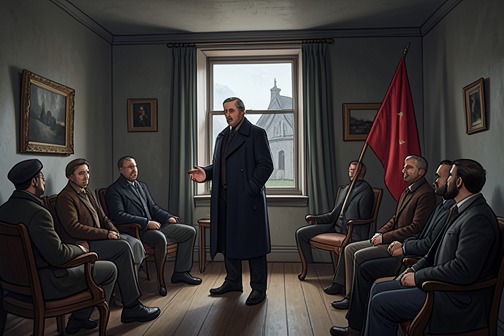
The [San Sepolcro Square Founding Meeting](entity:event-recall-event-1e85ef0f945c) was held in [Milan](entity:location-recall-location-617379caf4c2) on [March 23, 1919](entity:time-recall-time-1919-3-23-91ff8a6c3039), to form the [Fasci di Combattimento](entity:organization-recall-organization-fasci-di-combatt-e2d38bb2a0ac). Its significance lies in the contrast between the movement’s proclaimed national ambition and the meeting’s modest circumstances: a gathering announced as momentous, reduced to a small room and a sparse audience, where [Benito Mussolini](entity:character-recall-character-benito-mussolini-0330d40d2c3f) set out principles that linked the defense of wartime intervention to a new political organization.
## Setting and attendance
The first rally had been publicized for weeks in [Il Popolo d’Italia](entity:object-recall-object-il-popolo-d-italia-b2b48dcea0f3) and was originally scheduled for Teatro dal Verme, which could seat 2,000. That venue was abandoned. Rather than face the prospect of a vast, nearly empty auditorium, the organizers moved to a meeting room belonging to the Association of Traders and Merchants. The room, with its drab walls and Biedermeier chairs, looked out over a bleak parish square; scarcely a hundred men attended. The small turnout gave the gathering an air far removed from the mass politics its organizers hoped to shape.
The room’s ordinary surroundings underscored the uncertainty of the occasion. Members of the association, including a soap dealer and a copper importer, occasionally looked in, then returned to their own business. The contrast was pointed: the founders were announcing a new political force in a space where commercial routines continued almost beside them. The proposed venue and the room actually used became opposing measures of the event’s ambition and its immediate reach.
## Program and participants
The meeting brought interventionist groups together to establish regional fasci. Among those present or speaking were automobile manufacturer Enzo Ferrari and [Ferruccio Vecchi](entity:character-recall-character-ferruccio-vecchi-f1af03cf1a88), a commander of the [Arditi](entity:organization-recall-organization-ce1ea9816d56). Mussolini outlined the foundations on which the fasci’s action should rest. The program called for recognition of the war and of those who had fought it; it argued that imperial ambitions were not unique to [Italy](entity:location-recall-location-italy-85c2492cd54b), citing Belgium and Portugal, while opposing foreign imperialism when it harmed Italy. It also rejected possible Italian imperialism directed against other nations.
The program’s final point translated those positions into electoral strategy. The fasci would accept a contest at the polls centered on the war issue and oppose parties and candidates hostile to the war. After several speakers had addressed the gathering, Mussolini’s proposals were approved. Cities beyond Milan were represented, indicating that the meeting aimed not only to organize a local circle but to give the interventionist current a regional structure. The approval of the proposals supplied a shared platform, though the sparse audience showed how much organizing remained to be done.
## From a small meeting to organized action
The founding meeting’s themes acquired practical meaning as the fasci developed local organizations amid sharp conflicts over labor, land, and political authority. In [Bologna](entity:location-recall-location-bologna-e9b2b10db055), socialist organizations and labor institutions exerted strong influence, while employers and middle-class residents faced pressures generated by strikes and disputes over access to work. Across [Emilia](entity:location-recall-location-emilia-b49a9aa2ef04), socialist leagues controlled substantial parts of rural life. In [1920](entity:time-recall-time-1920-510f1fd63aa4), socialists held 223 of Emilia’s 280 municipal governments, and farmworkers, who on average had work for only 120 days a year, depended on collective placement systems and rules governing hiring and production.
These conditions formed the setting in which fascist organization expanded, but they do not make the founding meeting itself a plan for every later action. By January 1921, a punitive expedition from [Ferrara](entity:location-recall-location-970ebca292e4) was organized on explicitly coordinated lines: dozens of armed men set out in trucks supplied by the Agrarian Association to strike several rural leagues at once. The movement’s methods had developed well beyond the electoral program approved in [1919](entity:time-recall-time-1919-329d1bdc3600), even as its local action continued to present itself as a response to socialist power and a crisis of authority.
By 1922, the distance between a small founding assembly and nationwide mobilization was stark. In May, thousands of impoverished farm laborers made their way into Ferrara from the surrounding countryside; the city awoke occupied by an estimated 50,000 people. Later that year, after the Labor Alliance proclaimed a general strike to defend political and union liberties, [Michele Bianchi](entity:character-recall-character-michele-bianchi-6ec6b0301223) issued an ultimatum asserting that fascism would act in place of a state that failed to demonstrate its authority. These later episodes reveal how the movement’s organizational reach and claims to political action had changed; they should not be mistaken for decisions made at the 1919 meeting.
## Significance
The San Sepolcro meeting joined a defense of the war and its combatants to opposition against both foreign domination and a possible Italian imperial project. It also committed the new fasci to electoral struggle on the question of the war. That combination gave an interventionist gathering a program and an organizational name, while leaving its immediate scale plainly limited. The meeting’s importance therefore rests less on the size of the assembly than on the course it opened: a movement that began in a commercial association’s room and went on to build regional organizations, recruit across social conflicts, and claim an increasingly broad role in public life.
Event 11
Milan Socialist Demonstration of 17 February 1919
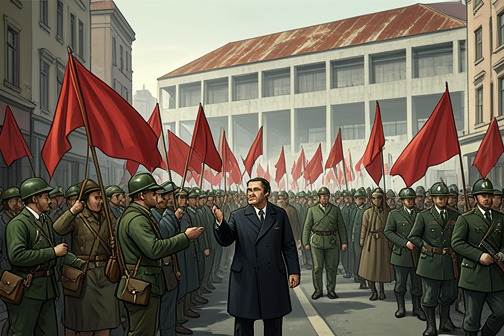
The [Milan Socialist Demonstration of 17 February 1919](entity:event-recall-event-1919-2-17-5d7bbe770047) was a mass postwar march whose antiwar demands made the prospect of revolution feel immediate to its opponents. Roughly forty thousand striking workers, accompanied by thirty bands and carrying thousands of red flags, marched to the arena. The demonstration became a point of confrontation between socialist hopes for social change and the nationalist, patriotic vision of [Italy](entity:location-recall-location-italy-85c2492cd54b) represented by [Benito Mussolini](entity:character-recall-character-benito-mussolini-0330d40d2c3f) and his supporters.
## The march and its demands
The march followed Italy’s victory over its historic Austrian enemies. In the account of the demonstration, that victory did not bring a settled peace: socialists and other observers now faced the Bolshevik revolution as a new force in European politics. The workers’ procession gave that upheaval a visible Milanese presence, turning the arena and the city’s streets into a stage for mass political action.
The demonstrators condemned the war, called for the division of land, and demanded amnesty for deserters. Wounded veterans were displayed as evidence against a war the protesters attributed to the interests of those who had directed it. They also directed their anger at uniformed officers who, until recently, had ordered them to fight. These demands joined opposition to militarism with claims about land and political accountability; the march was not simply a celebration of victory or a dispute over its symbols.
## Two visions of postwar Italy
The march alarmed a different [Milan](entity:location-recall-location-617379caf4c2): nationalist, patriotic, and largely petit bourgeois. In 1915, that constituency had supplied ten thousand volunteers for the war. To its members, the demonstration made the restored peace appear vulnerable to a revolutionary illness, and the protesters’ repudiation of the war’s meaning seemed to revive forces that victory had failed to extinguish.
The presence of women and children at the head of the procession sharpened that unease. Their anti-militarist and unpatriotic words were especially unsettling to the authoritarian, patriarchal men who had supported the war. The scene suggested a political future in which those men might no longer set the terms. As the march passed, bourgeois residents, tradespeople, and hoteliers shut their windows, lowered their shutters, and barred their doors. Their retreat into private space registered the fear of a future they could not control.
## Mussolini’s response and the demonstration’s memory
The following day, Mussolini answered with an editorial titled “Contro la bestia ritornante” (“Against the Returning Beast”). He presented the march as an affront to the war dead and pledged to defend them, even by digging trenches in the streets and piazzas. His response transformed a demonstration with demands about land, deserters, and the war into a warning about the danger of socialist mass politics—and cast resistance to that danger as a duty to the fallen.
The demonstration remained a remembered date. In a later scene, staff of [Avanti!](entity:object-recall-object-avanti-1bed44223b67), the socialist newspaper whose offices were on [Via San Damiano](entity:location-recall-location-1b391e490dc0), sing a socialist anthem in a private room and toast 17 February. The narration recalls the march as the moment when a country newly sobered by victory discovered, with dismay, a new enemy in its future: the Bolshevik revolution. This retrospective remembrance places the demonstration within a continuing contest over what the end of the war meant, rather than treating it as a passing street procession.
## A later escalation in the streets
A separate Milan demonstration on 15 April [1919](entity:time-recall-time-1919-329d1bdc3600) shows how the conflict between socialist and nationalist crowds could escalate. Tens of thousands had gathered at the arena when, without a prearranged plan, several thousand demonstrators broke away and headed toward the Duomo. The confrontation that followed was distinct from the February march, but it repeated the symbolic contrast between the two camps: women led the socialist column with a portrait of Lenin and a red flag, while the smaller counter-demonstration was headed by men accustomed to wartime killing.
[Carabinieri](entity:organization-recall-organization-carabinieri-28c84a9cf0f4) initially stood between the groups. When their cordon opened, the encounter became a brief armed clash: demonstrators threw stones and a few clubs, while officers, [Arditi](entity:organization-recall-organization-ce1ea9816d56), and Futurists fired first into the air and then toward the socialist column. The February demonstration itself was remembered for the scale of its procession and the political demands it carried; the later clash made the stakes of competing street mobilizations still more explicit.
Event 12
Milan Clashes and Burning of Avanti! Headquarters on 15 April 1919
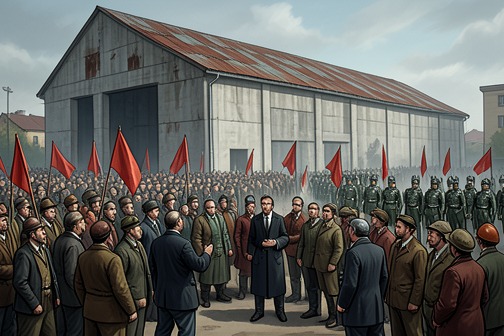
The [Milan Clashes and Burning of Avanti! Headquarters on 15 April 1919](entity:event-recall-event-1919-4-15-74c309945a09) transformed a mass demonstration into an armed confrontation and the deliberate destruction of the leading newspaper of Italian socialism. The day joined street violence to an attack on the press: after socialist marchers were routed in [Piazza del Duomo](entity:location-recall-location-4953ea4f0197), assailants burned [Avanti!](entity:object-recall-object-avanti-1bed44223b67)’s [Milan](entity:location-recall-location-617379caf4c2) headquarters on [Via San Damiano](entity:location-recall-location-1b391e490dc0). [Benito Mussolini](entity:character-recall-character-benito-mussolini-0330d40d2c3f), who had remained inside his newspaper office during the events, called the clash the first episode of civil war and ordered armed protection for his own paper.
## Background and Participants
The action unfolded amid intense expectation of upheaval. Tens of thousands of proletarians had gathered at the Milan arena on the morning of 15 April, listening to inflammatory speeches and anticipating a possible cataclysm. In the early afternoon, several thousand demonstrators broke away from the main procession without a prearranged plan and proceeded along Via Orefici toward the Duomo. The protest spilled from the stadium into the streets, carrying the sense of revolutionary urgency into the city center.
At Piazza del Duomo, [Filippo Tommaso Marinetti](entity:character-recall-character-filippo-tommaso-mar-3aac8d8bc631) addressed a mixed crowd of civilians, officers, university students, [Arditi](entity:organization-recall-organization-ce1ea9816d56), and fascists. He urged bystanders to join the counter-demonstration and rejected the possibility of remaining neutral. The contrast between the two processions was stark: socialist marchers, led by women holding a portrait of Lenin and a red flag, sang songs of liberation and called for a better life for their children. Opposite them stood a smaller group of men accustomed to wartime killing. The narrative presents their different experiences of death as a gulf separating the factions before the fighting began.
## The Clash in Piazza del Duomo
A cordon of [Carabinieri](entity:organization-recall-organization-carabinieri-28c84a9cf0f4) blocked the outlet from Via dei Mercanti, briefly holding the opposing groups apart. Once the cordon opened, uniformed officers and Arditi advanced in small groups, revolvers in hand. The fighting lasted about a minute. Socialist demonstrators threw rocks and a few clubs; the officers, Arditi, and Futurists answered with gunfire, first into the air and then toward the procession.
The marchers initially held their ground, then fell silent and scattered in panic. As people sought shelter beneath the arches of the Loggia dei Mercanti, officers and Arditi advanced and assaulted demonstrators with clubs. The scene reversed the procession’s earlier movement and sound: a singing crowd became a mass trying to escape, while the armed counter-demonstrators remained on their feet. One young man on the ground held out a few lire, apparently hoping to buy mercy. Elsewhere, an Ardito climbed the equestrian monument and stabbed a communist demonstrator. The rally ended; Marinetti later returned to the monument, bruised and exhausted, but his subsequent speech was not remembered.
## The Attack on Avanti!
After the socialist procession had been broken up, the attackers turned toward its institutional center. Avanti!, the flagship newspaper of Italian socialism, occupied a building on Via San Damiano. When the assailants arrived toward evening, uniformed soldiers were guarding it, but the defense was half-hearted; many activists on the opposing side had served as their wartime commanders. The standoff became a siege.
A rifle shot from inside the building, apparently fired in fear, killed a young military guard named Michele Speroni. A small gap opened in the cordon to let the stretcher through, and the attackers entered. Further shots came from inside, but the socialists had already escaped through a back door. The building was left undefended. Assailants looted it, poured flammable liquid through its rooms, overturned desks, wrecked typewriters and filing cabinets, and smashed the historical archive. Lithographed photographs of Lenin were thrown from the windows. The rotary presses presented a different obstacle: clubs and daggers could not readily damage the heavy machinery.
Edmondo Mazzucato, a former typographer who had worked for anarchist and revolutionary publications, stepped forward with an iron bar. He pushed it into the presses’ gears and set the machinery in motion, destroying the equipment. In the act, the former printer turned his skill against the means of production through which he had once served the revolutionary press. Half an hour later the building was in flames. Police watched beside the men who had started the fire, and firefighters were prevented from intervening so that the blaze could burn itself out.
## Political Meaning and Immediate Aftermath
That night, Filippo Tommaso Marinetti recounted the day’s events at [Il Popolo d’Italia](entity:object-recall-object-il-popolo-d-italia-b2b48dcea0f3). Benito Mussolini had not joined the street action: he had remained in his small office throughout the day, eating lunch on the stair landing and checking that his revolver was working. The account places the newspaper editor at a distance from the confrontation itself but at its political center. After hearing the report, he addressed the Arditi gathered in the courtyard: “This is a day of our revolution,” followed by, “The first episode of the civil war has taken place.”
The declaration acquired a practical consequence. An armed patrol of veterans was assigned to bivouac in the newspaper’s basement; an old Fiat machine gun was installed on the roof, and barbed-wire chevaux de frise were placed at the alley entrance. Il Popolo d’Italia was to be defended like a command center in a war zone. The measures made the day’s logic visible: the burning of a socialist newspaper was answered not by a return to ordinary political safeguards but by fortifying a rival press office.
The event therefore mattered both for what was attacked and for how the attack was interpreted. The assault joined the defeat of a socialist street demonstration to the destruction of its newspaper, while the armed protection of Mussolini’s paper carried the conflict into the organization of fascist political life. By naming the clash the opening episode of civil war, Mussolini presented street violence not as an interruption of politics but as the beginning of a revolutionary struggle.
Event 13
Italian Delegation Walkout from the Paris Peace Conference
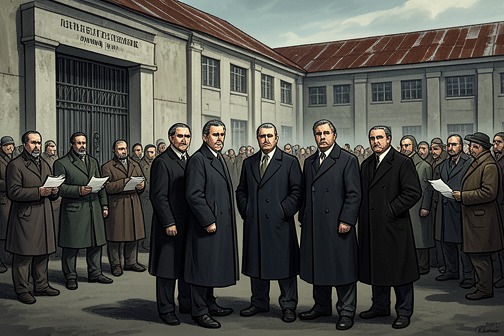
The [Italian Delegation Walkout from the Paris Peace Conference](entity:event-recall-event-979075ad833d) was a protest by Prime Minister [Vittorio Emanuele Orlando](entity:character-recall-character-vittorio-emanuele-o-249d77e8d6f8) and Foreign Minister [Sidney Sonnino](entity:character-recall-character-sidney-sonnino-a360b395bb6a) against the Allies’ refusal to meet [Italy](entity:location-recall-location-italy-85c2492cd54b)’s territorial claims. It turned diplomatic disappointment into a national spectacle, but the conference continued without the Italian representatives; their return only two weeks later exposed the gap between the walkout’s dramatic force and its practical effect.
## Claims and Grievances
The dispute centered on the settlement Italy believed it had earned by entering the war on the Allied side. A 1915 wartime agreement had promised Italy [Dalmatia](entity:location-recall-location-3ae54eb5fd16) in the event of victory. Italian nationalists also argued that the principle of self-determination, promoted by United States President [Woodrow Wilson](entity:character-recall-character-woodrow-wilson-38391917f7db), should secure [Fiume](entity:location-recall-location-fiume-c271af61753f), a border city with a large Italian majority that the wartime agreement had not included. Their formula joined the two claims, but Wilson appeared unwilling to concede either.
The immediate humiliation preceded the walkout. On April 23, Wilson bypassed Italy’s representatives and addressed the Italian people directly in a letter published in a French newspaper, explaining his refusal of both claims. The book acknowledges that his reasons might have been defensible, while emphasizing how his paternalistic tone was received: Italians felt treated not as an ally but as a junior pupil. It also recounts a rumor that French President [Georges Clemenceau](entity:character-recall-character-georges-clemenceau-a680bcc1e5a0) privately disparaged Orlando as a “vegetarian tiger.” The insult, whether public or whispered, sharpened the impression that Italy’s leaders were being patronized by the powers deciding the postwar settlement.
## The Walkout and Its Reception
On April 24, Orlando and Sonnino abruptly left the conference. Their departure was a conspicuous assertion of national dignity, and Sonnino reportedly answered a warning about the economic consequences of Italy’s isolation by saying that Italians knew how to starve. Across the country, public squares filled with demands for Fiume and Dalmatia. The walkout gave a shared focus to a widespread sense of deprivation, drawing liberals, nationalists, and fascists into a patriotic mobilization.
That unity rested on a risky wager. [Filippo Turati](entity:character-recall-character-filippo-turati-ab4f1019d6ae), the reformist leader of the Socialist Party, warned in parliament that public opinion was being raised to a pitch that would leave the government trapped if no agreement could be secured. If the negotiations failed, he argued, retreat would bring deep humiliation. His warning identified the walkout’s central vulnerability: a gesture presented as a defense of national honor could make compromise harder without compelling the other powers to change course.
## Negotiations Without Italy
The Allies continued negotiating while Italy’s representatives were absent. For fifteen days, public attention in Italy remained fixed on the Adriatic claims; in [Paris](entity:location-recall-location-657453741ed3), the victorious powers proceeded with decisions about German colonies in Africa and the former Ottoman territories in the Near East. The walkout did not halt the settlement or force the conference to wait for Italy.
The domestic mood therefore reversed quickly. The Italian delegation had left amid a surge of proud self-pity, but Orlando and Sonnino were compelled to return after only two weeks. Their return was described as repentant and urgent: they were eager not to miss the meeting with the German delegations. The spectacle of departure had raised expectations that Italy could stand alone against its allies; the return made those expectations difficult to sustain.
## Aftermath and Significance
The book presents the episode as a moral and political wound as much as a diplomatic setback. Italy’s public had been led to believe that the country would secure the promised gains, and the disappointment was intensified by the human cost of the war: the Allies’ refusals were measured against 600,000 Italian deaths. When the delegates returned without the desired settlement, the claim that those sacrifices had bought too little carried particular force. The narrative places that despair beside the arrival of the train carrying Orlando and Sonnino in Paris and [Gabriele D’Annunzio](entity:character-recall-character-gabriele-d-annunzio-6e66d28027db)’s appearance on a balcony in [Rome](entity:location-recall-location-f3877a21016f), a striking contrast between exhausted negotiation and the theatrical language of national grievance.
The walkout also belongs to a wider postwar crisis in which established political authority appeared unable to contain the expectations unleashed by mass mobilization. The returning veterans and the broader discrediting of older political figures form the book’s surrounding context; the conference episode supplied one vivid public expression of disappointment. Later fascist rhetoric would contrast a supposedly exhausted Europe of bargaining and hesitation with Fiume as a sign of youth and renewal. The walkout did not itself produce that politics, but its rapid failure helped make the language of humiliation and national rebirth available to those who presented forceful action as an alternative to liberal diplomacy.
Event 14
D’Annunzio’s Rome Speech of 6 May 1919
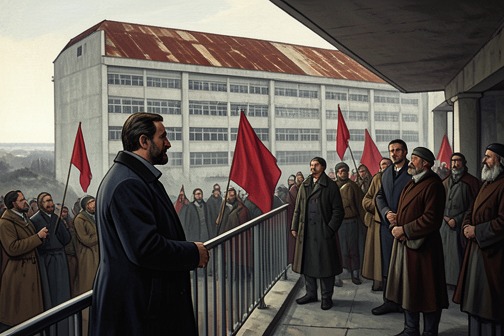
[Gabriele D’Annunzio](entity:character-recall-character-gabriele-d-annunzio-6e66d28027db)’s [Rome](entity:location-recall-location-f3877a21016f) Speech of 6 May [1919](entity:time-recall-time-1919-329d1bdc3600) transformed the grievance of [Italy](entity:location-recall-location-italy-85c2492cd54b)’s so-called mutilated victory into a collective performance of mourning and resolve. From the balcony of the city hall on the [Campidoglio](entity:location-recall-location-campidoglio-0422e3657d0f), D’Annunzio used the flag associated with his dead friend [Giovanni Randaccio](entity:character-recall-character-giovanni-randaccio-8ae4b3f57bc9) to bind the crowd’s sense of national injury to the promise that [Fiume](entity:location-recall-location-fiume-c271af61753f) and [Dalmatia](entity:location-recall-location-3ae54eb5fd16) must be returned to Italy. The speech’s force lay not only in its claims, but in the way it made an audience stand, fall silent, listen, and imagine itself already marching.
## Diplomatic grievance and the waiting crowd
By the morning of 6 May, humiliation over the peace settlement had spread well beyond nationalist circles. At the [Paris](entity:location-recall-location-657453741ed3) Peace Conference, Italy’s Prime Minister Vittorio Orlando and foreign minister [Sidney Sonnino](entity:character-recall-character-sidney-sonnino-a360b395bb6a) had walked out after the Allies resisted Italian claims. The 1915 wartime agreement had promised Italy Dalmatia in the event of victory; nationalists added Fiume to the claim, invoking the principle of national self-determination. [Woodrow Wilson](entity:character-recall-character-woodrow-wilson-38391917f7db) rejected both demands. His public letter to the Italian people, published on 23 April, made the refusal feel more than diplomatic: its paternal tone reinforced the impression that Italy was being treated as a subordinate ally. Orlando and Sonnino returned to Paris after the walkout, while the Allies continued negotiating without them.
Against this backdrop, tens of thousands gathered in [Piazza del Campidoglio](entity:location-recall-location-beddc5094122), mostly young men, many of them [Great War](entity:time-recall-time-great-war-bb7a98afe36b) veterans. They were physically intact, yet D’Annunzio’s language had taught them to understand themselves as injured by the settlement. The crowd’s stillness beneath the equestrian statue of Marcus Aurelius made that contradiction visible: men who had survived the war waited to hear how their victory could be recast as a defeat. The account presents the sense of failure and injustice as having become widely shared in the brief interval between the diplomatic rupture and the speech.
## [Randaccio’s flag](entity:object-recall-object-e8b725a9120d) as the speech’s emblem
As Orlando and Sonnino’s train entered Paris, D’Annunzio appeared on the Campidoglio balcony. His attendants spread a large tricolor over the railing. It was associated with Giovanni Randaccio, an infantry captain and close friend of the poet, who had died in an assault at the mouth of the Timavo during the tenth battle of the Isonzo. D’Annunzio had urged the assault. Now the flag, marked by Randaccio’s death, became the speech’s material center: a national symbol made inseparable from the cost of the war.
D’Annunzio wore the white uniform of a high-ranking cavalry officer and gripped the railing above the crowd. He began by recalling the previous day, 5 May, as the anniversary of two momentous departures, alluding to Garibaldi and Napoleon. His address then moved through ornate references, solemn declarations, and elaborate metaphors. The gathered people did not necessarily understand its learned allusions, but they followed its rhythm, responding to the shape and cadence of the performance. The speaker’s touch on the flag gave that performance a visible focus. He described it as having served as a pillow for a dying hero at Quota 12, at the Stone Quarry, and treated the cloth as a memorial bearing the image of the fallen.
## Silence, imagined marching, and a pledge
The speech shifted from commemoration to a call for continued national mourning. D’Annunzio asked the crowd for silence and declared that the nation’s soul was again poised in uncertainty. He presented waiting as an active posture: the people were to remain silent but standing, with Randaccio’s flag draped in mourning until Fiume and Dalmatia belonged to Italy. He extended the gesture beyond the square, asking good citizens to place their own flags in black mourning until those claims were fulfilled.
Then D’Annunzio broke the silence by asking whether the crowd could hear an army marching in the streets of [Istria](entity:location-recall-location-9f52e71f3144) and Dalmatia. The question gave the audience an imagined sound to inhabit: the steps belonged to vanished Roman legions and victorious ancestors, not to troops actually present in the square. The crowd began to march in place beneath Marcus Aurelius’s monument, its bodies moving with the rhythm the orator had summoned. The scene joined the dead, the remembered past, and a promised future in one synchronized public gesture. D’Annunzio ended by renewing the pledge to keep his flag black until both territories were recovered.
## A recurring political ritual
The speech made mourning a form of political commitment. Randaccio’s flag did not merely recall one dead man; D’Annunzio presented it as bearing the likeness of all who had died for their country. The individual loss thus became a symbol through which the crowd could imagine itself as a single national body. The address converted diplomatic disappointment into an obligation that could be repeated in homes and public spaces: keep the flags in mourning, remain vigilant, and wait for the promised recovery of territory.
The book later returns to the speech’s fusion of the dead, ritual, and political belonging. On 1 January [1920](entity:time-recall-time-1920-510f1fd63aa4), addressing his legionnaires in Fiume, D’Annunzio contrasted the defeated, fearful world represented by Versailles with Fiume as a place of youth, life, and heroic possibility, placing the dead behind the present and the unborn ahead. At the national burial of the Unknown Soldier in November 1921, the body of an unidentified fallen soldier was made to represent all the dead; the ceremony likewise gave collective form to loss. These later scenes do not erase the specific demands of the 1919 speech. They show how its imagery of sacrifice, national destiny, and public ritual recurs as D’Annunzio’s politics moves between mourning and mobilization.
Event 15
1919 Italian Cost-of-Living Riots
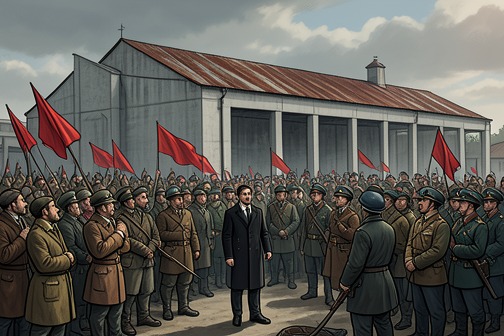
The [1919 Italian Cost-of-Living Riots](entity:event-recall-event-1919-7e454a27bbe2) were a wave of popular protest rooted in hunger and soaring prices, but their political meaning remained contested. [Cesare Rossi](entity:character-recall-character-cesare-rossi-92b80e4f71a4) dismissed them as spontaneous anger without an organized revolutionary purpose; [Benito Mussolini](entity:character-recall-character-benito-mussolini-0330d40d2c3f) voiced solidarity with the hungry while recognizing that unrest could spread without bringing a revolution any closer. The crisis thus exposed both the material pressures behind mass protest and the struggle to direct it toward a political end.
## Causes and Conditions
The riots broke out at the beginning of the month across northern [Italy](entity:location-recall-location-italy-85c2492cd54b). Inflation was rising sharply, and millions of soldiers had returned from four years at the front to find too little food and none of the prosperity and land they had been promised. Rossi considered the anger authentic, but saw no political program behind it: people were hungry, and the immediate object of their protest was often the cost and availability of food.
At afternoon meetings, he described housewives attacking vegetable-market stalls and taking tins of rolled anchovy fillets. His account stressed the ordinary, domestic scale of the disturbances: people could buy a flask of two-lira wine and go home anticipating an evening with their families. For Rossi, the scenes that alarmed the bourgeoisie were not reliable signs of an approaching revolution. He treated them instead as food-price uprisings, part of a recurring pattern in which Italian popular disturbances began outside bakers’ shops. His description minimized their revolutionary significance, even as it recognized the real hardship that produced them.
The riots unfolded amid more organized confrontations over work and subsistence. In [Bologna](entity:location-recall-location-bologna-e9b2b10db055), two labor chambers competed in revolutionary militancy, while the socialist mayor tried to keep pace with pressure to occupy elegant homes and claim apartments for tenants. Bread could be withheld from people without union cards; employers, squeezed by the conflict, sometimes preferred to sell their businesses rather than face continued risk. In the countryside, socialist leagues exerted influence across villages through unions, cooperatives, and other local organizations. These conditions were not the riots themselves, but they show how food insecurity intersected with disputes over employment, housing, and who could control economic life.
## Competing Political Interpretations
Mussolini used the columns of his newspaper, [Il Popolo d’Italia](entity:object-recall-object-il-popolo-d-italia-b2b48dcea0f3), to demand that the rich pay and to express solidarity with people rebelling against those who starved them. His public posture echoed the anger in the streets. Yet he also saw that strikes and riots were spreading into a chronic, indiscriminate disorder. Work stopped in forges and fields; nurses left the sick and gravediggers refused their work. In his assessment, the chaos was growing, but it lacked the purpose and direction that a revolution required.
The weakness of the Italian Socialist Party’s leadership sharpened that distinction. After the burning of [Avanti!](entity:object-recall-object-avanti-1bed44223b67), the party’s immense following raised one million lira in a matter of days, then was urged to return peacefully to work. Rossi and Mussolini both regarded this response as evidence that socialist leaders could not turn militant enthusiasm into a seizure of power. Their agreement did not mean they shared a settled political program: Rossi argued that the Fasci should look toward the agrarians and abandon the leftist remnants of the San Sepolcro program, while Mussolini did not accept that the movement’s identity could be resolved by such a strategic turn.
## Mussolini’s June Rally
On June 9, [1919](entity:time-recall-time-1919-329d1bdc3600), Mussolini addressed popular protest against the high cost of living at the schools of Corso di Porta Romana in [Milan](entity:location-recall-location-617379caf4c2) city. The speech was identified as the first public rally of the [Fasci di Combattimento](entity:organization-recall-organization-fasci-di-combatt-e2d38bb2a0ac). It gave the economic crisis a political stage: rather than present the problem as an abstract dispute over policy, Mussolini framed it as a question of who would pay for a nation whose coffers were empty.
He argued that people without houses, cars, banks, mines, land, factories, or capital could not be expected to replenish the public coffers. Those with means, by contrast, should contribute. In his formulation, voluntary sacrifice by the wealthy could avert violent conflict between people of the same nation; if the wealthy remained blind to the crisis and refused to give, the masses of combatants would be directed against the obstacles in their way. The argument paired an appeal to avert violence with a threat of organized force, presenting payment by the rich as the alternative to a confrontation.
The speech therefore made the riots more than a backdrop to a new political organization. It translated hunger and price anger into a demand for sacrifice from the wealthy, while leaving open the prospect that the Fasci would mobilize the combatants if that demand went unmet. The distinction Rossi drew between popular anger and revolution remained important: Mussolini could speak in the language of the hungry without claiming that spontaneous disorder, by itself, had achieved a political transformation.
## Significance and Limits
The riots revealed a gap between widespread material grievance and the capacity of established political leaders to organize it. Returning soldiers faced scarcity after promises of prosperity and land; households confronted rising prices; workers and rural communities contested access to jobs, housing, and food. These pressures helped make appeals to social redress politically potent, but the varied forms of protest did not automatically combine into a unified revolutionary movement.
Mussolini’s intervention occupied that gap. He denounced the burden borne by the poor, demanded contributions from those with wealth, and warned that refusal could bring mass action. At the same time, he recognized the difference between disorder and a directed conquest of power. The cost-of-living unrest thus became both a response to immediate hardship and a test of competing claims to represent it: the socialists’ capacity to lead their base, Rossi’s proposed turn toward the agrarians, and Mussolini’s effort to make the Fasci a vehicle for popular anger without surrendering control of its political direction.
Event 16
Italian General Strike of 20 July 1919
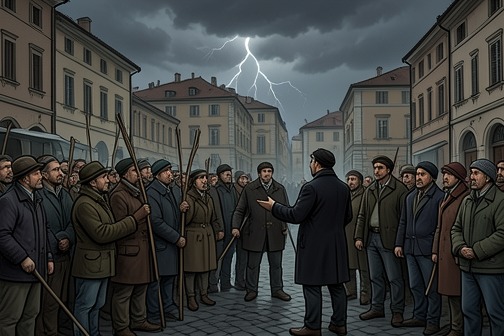
The [Italian General Strike of 20 July 1919](entity:event-recall-event-1919-7-20-b70dde1ba92e), known as the scioperissimo, was intended as a show of solidarity with Soviet [Russia](entity:location-recall-location-e36341713c23) and a protest against foreign support for counterrevolution there. Its significance in the book lies in the gap between the approaching cataclysm imagined by its participants and the limited action that actually followed. While socialist leaders presented revolution as imminent, [Nicola Bombacci](entity:character-recall-character-nicola-bombacci-5ddc3dca87f9) told workers that this particular strike was a demonstration, not the expropriating strike. The stoppage came to little, but the days around it exposed a country where even a planned protest could prompt bomb plots, political maneuvering, and expectations of insurrection.
## Causes and preparations
The call for the strike was framed as a European protest against intervention in Russia. By the eve of the action, however, the international support its organizers expected had weakened: the [French General Confederation of Labour](entity:organization-recall-organization-fa00314c7196) and British trade unions withdrew, leaving Italian workers to demonstrate in support of their Russian counterparts. Socialist newspapers nevertheless gave the event an expansive, urgent frame. The [Turin](entity:location-recall-location-turin-7d5a70373e49) edition of [Avanti!](entity:object-recall-object-avanti-1bed44223b67) announced that the red flag would triumph, while the Florentine socialist paper La Difesa urged proletarians to make imminent action decisive. The rhetoric amplified the sense that the stoppage might become more than a demonstration.
Violence was already being prepared on the opposing side. On the eve of the strike, [Cesare Rossi](entity:character-recall-character-cesare-rossi-92b80e4f71a4), formerly a leading figure in the most militant wing of a railway workers’ union, went to [Milan Central Station](entity:location-recall-location-milan-central-statio-e9ac248aae99) to retrieve ten bombs hidden there since before the war. The explosives had originally been intended for sabotage during a railway strike. Now, angered by the announced socialist stoppage, Rossi planned to use them against the offices of Avanti! and the labor union headquarters. He carried the bombs one by one to an accomplice waiting with a suitcase on the station square; the explosives were then kept in the accomplice’s home on Via Durini, near the newspaper offices.
[Benito Mussolini](entity:character-recall-character-benito-mussolini-0330d40d2c3f) stopped the plan before it was carried out. Rossi defended the proposed attack by arguing that the newspaper’s printers were militant socialists and that only enemies of fascism went to the union. The episode does not establish that the strike itself produced a bombing or a confrontation: the bombs remained hidden, and Mussolini intervened. It does show how the approaching stoppage helped turn political hostility into a concrete plan for an attack on labor institutions, and how the line between organized politics and clandestine violence was already dangerously thin.
## Mussolini’s competing course
Mussolini opposed the scioperissimo while also trying to keep open a route into electoral politics. At the first conference of the fasci of Central and Northern [Italy](entity:location-recall-location-italy-85c2492cd54b), held in [Milan](entity:location-recall-location-617379caf4c2) on 17 July, he took a hard line against the strike and against socialist agitators. The attendance was small in relation to the movement’s registered membership: no more than a dozen cities were represented, although the fasci had members in a few hundred. The conference nevertheless marked a turn toward a more forceful anti-socialist stance.
At the same time, Mussolini renewed his proposal for a pre-electoral committee with factions of left-wing interventionism. Leaders who had supported Italy’s entry into the war in 1915, despite the official socialist position, met on the eve of the stoppage in the great hall of Liceo Beccaria in Milan. Mussolini proposed a social and economic reorganization centered on workers’ welfare but free of Bolshevik influence. The gathering briefly seemed to offer a way past old divisions and even the prospect of standing together in the November elections. Thus, opposition to the strike did not mean that Mussolini had abandoned political coalition-building; he was trying to resist the socialist mobilization while assembling a different alliance.
His dealings with the authorities pointed in another direction. Acting on his instructions, [Michele Bianchi](entity:character-recall-character-michele-bianchi-6ec6b0301223) had reached an agreement with Milan’s prefect to make the fasci available for maintaining public order. The prefect disclosed a confidential government circular that urged fascist cooperation in suppressing revolutionary attempts, even by violent means, on condition that the fascists accept the authorities’ command. The liberal state was therefore prepared to use fascist organizations against the advance of the left. The strike’s approach brought these parallel strategies into view: Mussolini opposed the workers’ action, negotiated with left interventionists, and made fascist forces available to the state.
## The Milan demonstration
On 20 July, a crowd gathered at 11 a.m. outside the Labor Office on Via Manfredo Fanti, in premises made available by the Humanitarian Society. Red flags rose over the assembly. The atmosphere was described not as mutinous but as festive: workers smoked and enjoyed an unusual idle morning, while troops on horseback patrolled the surrounding streets without encountering an opposing force. The scale of the expectations surrounding the strike therefore contrasted with the comparatively calm character of the Milan gathering.
The meeting’s speakers represented different currents within socialism. [Claudio Treves](entity:character-recall-character-claudio-treves-0854cd58f6fd), the refined leader of the reformist faction, and [Giacinto Menotti Serrati](entity:character-recall-character-giacinto-menotti-se-21bcf4177c8d), head of the maximalist section, had already addressed the crowd. The workers were waiting for Bombacci, whose standing among them gave his words particular weight. Born to a humble farming family, he had been a seminarian, an elementary schoolteacher, a trade unionist, and a leader of the maximalist faction that took command of the Socialist Party after the war. His political work among farm laborers and industrial workers, including women in cotton mills, helped make him a trusted advocate for the poor.
Bombacci spoke in the patient manner of a schoolteacher. He interpreted the war as the signal that revolution had entered Europe and described the old order as approaching collapse. Russia offered the example of a revolution already accomplished; in Italy, he argued, the leaders of the party and the [General Confederation of Labour](entity:organization-recall-organization-general-confeder-955e431e75b3) could form its vanguard and army. His language gave the crowd an image of imminent transformation, and the assembly responded with enthusiasm, though its excitement was accompanied by unease about whether a new life was truly beginning.
## Demonstration, not revolution
After pausing for water, Bombacci qualified the promise his speech had seemed to make. The strike of 20 July, he explained, was meant to be a demonstration, not the expropriating strike. It might prepare the way for such a strike, but it did not constitute one. He still presented revolution as a historical necessity, likely to emerge from changing economic and political conditions, but asked the workers to wait. The clarification mattered: it drew a boundary between solidarity in action that day and the decisive seizure of power that some in the crowd had been led to anticipate.
The book makes the result plain. The scioperissimo came to nothing, and the anticipated revolution was postponed. Mussolini attributed its failure to socialist leaders’ timidity and to what he regarded as Italy’s incapacity for revolution. He contrasted the Italian summer with the Russian seizure of the Winter Palace in 1917, using the difference to mock the recurring postponement of action. This judgment is partisan, but it captures the event’s central reversal: a stoppage announced in the language of imminent decisive action ended without becoming a revolution.
The episode also leaves two opposed readings of political patience. To Bombacci, delay was a tactical distinction between a demonstration and an expropriating strike that was not yet due. To Mussolini, the strike’s failure showed that revolutionary language could not by itself produce revolutionary action. Between these positions stood the workers who had gathered in Milan: urged to expect a transformed world, then told that the decisive moment lay ahead. The strike’s immediate result was limited, but its preparation and rhetoric reveal how the postwar conflict linked mass mobilization, fear of revolution, state cooperation with fascists, and the search for political alliances.
Event 17
Battle of Vittorio Veneto
The [Battle of Vittorio Veneto](entity:event-recall-event-14bc4396b7ff) is presented as a victorious culmination of the war against Austria and as a formative experience whose meaning continued to be contested afterward. Rather than recounting the battle’s full course, the narrative approaches it through the memories of combatants, the arguments that survived the victory, and the public ceremonies that turned wartime death into national symbolism.
## A victory recalled through individual service
The clearest personal account belongs to [Filippo Tommaso Marinetti](entity:character-recall-character-filippo-tommaso-mar-3aac8d8bc631). Before the war, he had celebrated militarism and war in his Futurist writing; in 1915, he left the comforts of his home on Corso Venezia, volunteered for the Alpines, fought, was wounded, and returned to the front. His experience included defeat at [Caporetto](entity:location-recall-location-6efe2fb82db4) and, later, triumph at [Vittorio Veneto](entity:location-recall-location-1ecfc8e16456), where he was behind the wheel of a Lancia model 1Z armored car. The narrative thus connects the battle to a change in the poet’s relation to war: he had moved from proclaiming its virtues as a civilian to participating in it himself.
A second account gives the victory a more intimate, bodily aftermath. A soldier who had enlisted voluntarily in Baseggio’s unit was wounded during the fighting on Monte Pertica, a peak on the [Monte Grappa](entity:location-recall-location-monte-grappa-0f9dc9dfff1d) battlefield, in the days of Vittorio Veneto. He nevertheless refused medical care and returned to the front; afterward, his service was publicly praised by Baseggio before General Grazioli, and he received a silver medal and a military cross. The narrative identifies his stiffened left hand as a lasting consequence of the war. His account places distinction and injury together: the medals recognized his service, while his body continued to bear its cost.
## Victory did not close the argument
The battle’s status as a triumph coexists with continued disputes about how the war had been conducted. When the government inquiry into the military disaster at Caporetto was published, it revived accusations concerning the army high command’s responsibility. The final victory had not erased those questions. The narrative stresses this contrast: even years after the fighting, and despite victory, old antagonisms returned, with political opponents renewing charges and countercharges.
The battle’s memory therefore belongs not only to celebration but also to the unsettled postwar debate. In the wider account of the period, millions of soldiers return to a country where war remains part of the political agenda. The battle stands at the victorious end of their military experience, but it does not by itself resolve the social and political conflicts that follow demobilization.
## From battlefield victory to national ritual
The anniversary of victory over the Austrians later provided the setting for the burial of the Unknown Soldier. His body, selected by lot to represent the fallen, was carried across the country by special train before being buried in what the narrative describes as the most solemn ceremony in unified [Italy](entity:location-recall-location-italy-85c2492cd54b). The unknown identity of the dead soldier made the grave a collective symbol: mourners could approach it as a representative of their own lost relatives, while the ceremony gave public form to a war in which death had become collective and impersonal.
Five days after that burial, the founders of the [National Fascist Party](entity:organization-recall-organization-national-fascist-c9d1f7e3cfc5) gathered in prayer at the soldier’s grave. The juxtaposition is significant: a national commemoration of wartime loss became a site for political ritual. The book links the battle’s remembered victory to this later transformation of military memory into public allegiance, without treating the ceremony as a simple continuation of the battlefield itself.
Event 18
邓南遮占领阜姆
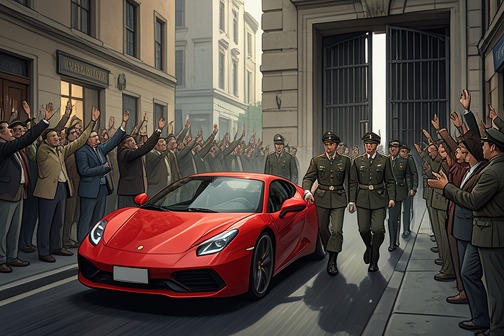
[Gabriele D’Annunzio](entity:character-recall-character-gabriele-d-annunzio-6e66d28027db)’s seizure of [Fiume](entity:location-recall-location-fiume-c271af61753f) began on [September 11, 1919](entity:time-recall-time-1919-9-11-e829ee6251c8), as a rebellion by 187 grenadiers and volunteers led by an aging poet in a red sports car. It ended with the city occupied without a shot being fired, its people welcoming the column and its council entrusting D’Annunzio with civil and military power. The episode made a theatrical challenge to the Italian state into an accomplished political fact: a wager on a single charismatic leader that drew strength from veterans’ defiance, military defections, and the public’s response, but never secured the assent of [Italy](entity:location-recall-location-italy-85c2492cd54b) as a whole.
## The Expedition’s Stakes
By September [1919](entity:time-recall-time-1919-329d1bdc3600), Fiume was controlled by an inter-Allied military garrison, while its future remained entangled in international decisions over the postwar settlement. The Allied forces included French, British, American, and Croatian contingents. The American president, [Woodrow Wilson](entity:character-recall-character-woodrow-wilson-38391917f7db), intended the city to go to the Yugoslavs; Italian rulers, in the account of the episode, seemed prepared to accept that outcome. Against this stood Italian nationalists in Fiume and soldiers who regarded the city’s separation from Italy as intolerable. The grenadiers set out in defiance of the Italian high command, which opposed a coup, and of the authority of the inter-Allied command.
D’Annunzio’s own condition made the expedition’s scale especially stark. Fifty-six years old, feverish, and barely able to stand, he put on the uniform of a lieutenant colonel in the Novara Lancers. He had spent a long period recovering in [Venice](entity:location-recall-location-519cfa9fe115) after a wartime plane crash left him blind in one eye. At the landing near his Venetian residence, a covered motorboat carried him across the lagoon; on the mainland, a flaming red Fiat Tipo 4 awaited. Its other passengers included a Sardinian Grenadier lieutenant and [Guido Keller](entity:character-recall-character-guido-keller-e35c4cef3d7b), a decorated airman whose eccentricity made him an unlikely-looking aide to an insurgent expedition. The contrast between the battered poet and the vivid car helped make the journey appear at once precarious and deliberately staged.
## The Column and the Defections
The party reached Ronchi, near the border, shortly after sunset. Its co-conspirators were waiting, but the trucks requested by phonogram did not arrive as promised. For a time, the company had the appearance of a failed undertaking: D’Annunzio slept on a makeshift bed of nailed wooden planks, while Keller left with [Tommaso Beltrami](entity:character-recall-character-tommaso-beltrami-3430e281c22b). Several hours later, about thirty surplus 15 Ter trucks appeared in the village square. The delay sharpened the gap between the expedition’s grand objective and its fragile means; the column that set off before dawn numbered only 187 rebels.
The grenadiers concealed their weapons and raised their capes to hide their insignia. They had been expelled from Fiume in late August after a clash with French soldiers, and were now returning on their own initiative, against military orders. Their cause rested not only on their own small force but on the expectation that volunteers from Fiume’s largely Italian civilian population would rise in support. The account casts their choice as an individual’s defiance of a formidable international order, while making clear how little material power the rebels initially possessed.
At Castelnuovo, four armored cars and a force of Bersaglieri were positioned to stop them. D’Annunzio parleyed with the Italian officials, and within minutes the armored cars were prepared to protect the very column they had been sent to halt. The Bersaglieri joined the rebels enthusiastically. On the road toward Fiume, the column stopped again so that officers could report to D’Annunzio, who addressed them from a small mound. Later, Lieutenant Colonel Raffaele Repetto, ordered to stop the march at any cost, rushed forward to embrace him instead. [Arditi](entity:organization-recall-organization-ce1ea9816d56) climbed onto the trucks, leaving no room for more passengers; as more joined along the way, the column had to crawl to avoid damaging its wheels. Each change of allegiance transformed the expedition’s prospects: the force that began as disobedient soldiers gathered strength from the state’s own military ranks.
## The Border and the Occupation
At the border, General Pittaluga confronted D’Annunzio in person, accompanied by two colonels and armed men. Pittaluga ordered him to turn back, accused him of setting himself above state authority and ruining Italy, and challenged his belief that he could act as if omnipotent. D’Annunzio answered not with a military advantage but with a symbolic gesture: opening his coat to expose his medals, he imitated Napoleon’s offer of his chest to the troops sent to stop him. The scene made the confrontation a contest over the meaning of service and authority as much as a test of force. Pittaluga, himself captivated by the medal’s blue ribbon and the appeal of the rebel soldier, invoked his Garibaldi-following father and grandfather. The barrier was then shattered, and the column passed into Fiume.
The rebels entered shortly after eleven in the morning. The city’s population welcomed them with intense jubilation; women in their finest clothes greeted the liberators, while laurel leaves fell from rooftops. The entry was bloodless. D’Annunzio went directly to the Hotel Europa and slept, exhausted. The episode’s reversal is central to its drama: a venture that had begun with delayed transport, hidden insignia, and a tiny following arrived not as a battle-worn conquest but as a public celebration. Fiume’s reception gave the seizure a popular image, although it did not settle the city’s disputed international status or establish that all Italians supported D’Annunzio’s action.
## Power, Proclamation, and Limits
While D’Annunzio slept, Keller proposed that the city council grant the poet full civil and military powers. The council president, Antonio Grossich, had initially received Keller with wariness, but the council agreed to entrust the administration of the contested city to D’Annunzio. The decision converted the column’s military success into authority inside Fiume. It also placed a man known for his poetic and political theatricality in charge of practical government.
The next morning, D’Annunzio wrote to Pittaluga that he had to assume military command of Italian Fiume to ensure order. With no answer from [Rome](entity:location-recall-location-f3877a21016f) to the challenge posed by the march, he took power. His first measure was to close the brothels temporarily, seeking to prevent clashes between the [Fiume Legionnaires](entity:organization-recall-organization-fiume-legionnair-ad788822854e) and French troops. The order was presented as a personal renunciation as well as an act of administration: the Commander would deprive himself of a pleasure he had treated as indispensable in order to set an example. The aesthete’s flags, flowers, and chocolates remained, but the lawmaker had entered the scene.
Four months after his vow at the [Campidoglio](entity:location-recall-location-campidoglio-0422e3657d0f), D’Annunzio addressed Fiume’s population directly and proclaimed the city’s annexation to Italy. The crowd answered with a repeated yes, and the members of the City Council approached to kiss him. The public was not simply watching a political performance; it was summoned into it as a participant. Yet the book places that triumph beside the limits of D’Annunzio’s national claim. In January [1920](entity:time-recall-time-1920-510f1fd63aa4), he described the preceding year as one defined by Fiume and passion, in opposition to the exhausted politics represented by Versailles. He chose to remain in Fiume, which he called the place where the soul was freer, even against the wishes of the Fiumani. The narrative then undercuts the spectacle: Italians had not followed him, and the poet’s authority did not amount to national consent.
The episode’s larger significance lies in how it joins military disobedience to political ritual. A small column becomes a larger one through defections; a border barrier gives way beneath a performance of heroic memory; and the city’s welcome becomes a public affirmation of the new ruler. The book sets this spectacle within a postwar Europe of mass bereavement and millions of returning soldiers, where inherited political authority seemed exhausted and a new alignment appeared imminent. Later fascist rhetoric likewise presents national unity as something to be forged from regional divisions and collective action, while its crowds and ceremonies give political belonging a visible, almost religious form. Fiume therefore appears both as a real seizure of power and as a charged model of politics enacted before an audience: potent in its symbols and immediate effects, but unable to make its leader’s claim identical with the will of Italy.
Event 19
D’Annunzio’s Proclamation of Fiume’s Annexation to Italy
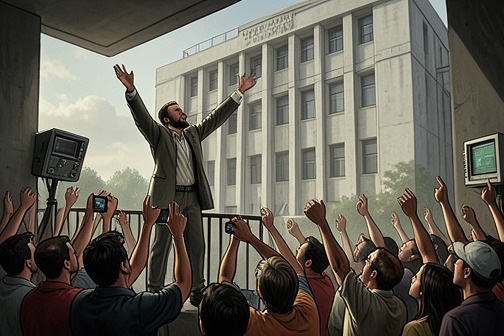
[Gabriele D’Annunzio](entity:character-recall-character-gabriele-d-annunzio-6e66d28027db)’s Proclamation of [Fiume](entity:location-recall-location-fiume-c271af61753f)’s Annexation to [Italy](entity:location-recall-location-italy-85c2492cd54b) is the moment when a staged nationalist spectacle becomes a public claim of popular consent. Speaking from a balcony, D’Annunzio asks the inhabitants to renew an earlier vow; their repeated answer is followed by his declaration of annexation. The scene gives the crowd a part in the political performance, while the following morning D’Annunzio moves from proclamation to command.
## From spectacle to direct address
The scene begins as theater: Fiume is the setting for a marvelous adventure, and D’Annunzio occupies its central role as poet and actor. Addressing the crowd from a balcony, he raises his voice above the clamor. The building’s history as a seat of Hungarian emperors lends the setting an added charge: a crowd once kept at a distance is now addressed directly by the man claiming to speak for the city.
The decisive change comes in the question, “Here before the Timavo flag, do you confirm your vow of October 30?” Antonio Grossich, standing beside D’Annunzio, reacts sharply; until that day, no speaker had directly addressed the audience in this way. The narrative describes the shift as the fall of a fourth wall: the crowd is no longer merely watching a political performance but is summoned to take part in it.
## The crowd’s answer and the annexation
The population answers with an impassioned roar, shouting “Yes!” three times. D’Annunzio then proclaims Italy’s annexation of Fiume. The sequence matters: the question calls back to the earlier vow, the repeated answer supplies a collective affirmation, and the proclamation turns that affirmation into a declaration. The members of the City Council approach to kiss D’Annunzio, and he allows them to.
The pledge had taken four months to fulfill. In the narrative, the declaration completes the promise associated with the [Campidoglio](entity:location-recall-location-campidoglio-0422e3657d0f) vow. The crowd’s response makes the moment more than a pronouncement delivered from above: D’Annunzio’s direct address stages the inhabitants’ assent as part of the event itself.
## From proclamation to command
The political meaning of the scene changes again the next morning. Awake at five, earlier than was customary for him, D’Annunzio writes to General Pittaluga that he must immediately assume military command of Italian Fiume, describing the measure as necessary to ensure order. [Rome](entity:location-recall-location-f3877a21016f) has not responded to the challenge posed by the march; D’Annunzio therefore assumes power himself.
That decision marks a shift in role. The poet and play-actor gives way to the lawmaker and commander, who will now be in charge. His first provision is the temporary closure of the brothels to prevent brawls between the [Fiume Legionnaires](entity:organization-recall-organization-fiume-legionnair-ad788822854e) and French troops. The narrative also notes the changed character of his room: flags replace its usual tapestries, while a bouquet in a crystal vase and chocolates in a silver goblet remain. The details frame command as a discipline D’Annunzio publicly imposes on himself as well as on the city.
## Political ritual in the wider narrative
The proclamation belongs to a wider pattern in which crowds, processions, and public gestures give political claims a visible form. In [Milan](entity:location-recall-location-617379caf4c2), a demonstration breaks away from a large procession and moves toward the Duomo; later, opposing columns confront one another across a cordon of carabinieri. That episode presents mass politics as a collision between groups with sharply different relationships to violence. In Fiume, by contrast, the crucial exchange is an address and a collective answer: participation is summoned through affirmation rather than through the clash of opposing columns.
Other public ceremonies in the narrative give collective feeling a similarly formal setting. The Unknown Soldier’s burial is described as a national ritual built around a body chosen by lot to represent the fallen, while [Giacomo Matteotti](entity:character-recall-character-giacomo-matteotti-b1b8c0b072bc)’s return to Fratta becomes a funeral attended by tens of thousands of mourning workers. These events are distinct from D’Annunzio’s proclamation, but their juxtaposition underscores a recurring concern: how public ceremony makes political belonging visible, and how gestures of assent, mourning, or vengeance can carry meanings beyond the immediate scene.
Event 20
First World War
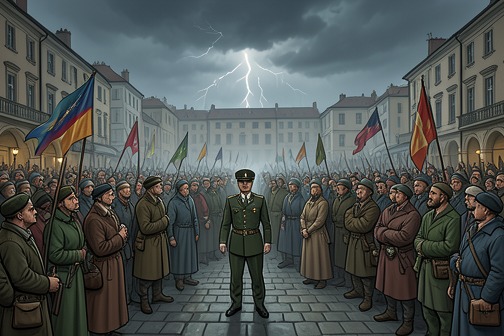
The [First World War](entity:event-recall-event-first-world-war-ddadba2d85b1) is the decisive rupture behind the book’s postwar [Italy](entity:location-recall-location-italy-85c2492cd54b): it leaves millions dead, millions of veterans returning to a country in crisis, and a political culture in which the language and organization of combat persist after the fighting. The war’s consequences are not confined to the battlefield. They enter rallies, elections, paramilitary structures, labor conflicts, and public ceremonies, making peace appear less like a settled condition than an unsettled inheritance.
## Mass Death and the Returning Veterans
The war’s scale is conveyed through the image of a continent whose public stage has been emptied by loss. The dead are associated with the [Carso](entity:location-recall-location-a0a05f0f2088), Ortigara, and the [Isonzo River](entity:location-recall-location-2f5093acb145), while the living gather as survivors and former soldiers. One passage gives the toll as eleven million dead and describes five million veterans returning across territorial borders. These figures frame the postwar crowd as a political force shaped by shared loss, dislocation, and a sense that the older political class has failed.
Veterans do not appear only as a social category. They become central to competing claims about who can speak for the nation. At a [Milan](entity:location-recall-location-617379caf4c2) rally in [1919](entity:time-recall-time-1919-329d1bdc3600), the socialist procession includes women carrying a portrait of Lenin and a red flag, while the smaller counter-demonstration includes men accustomed to wartime killing. The account stresses the gulf between the groups’ different experiences of death. When the cordon of the [Carabinieri](entity:organization-recall-organization-carabinieri-28c84a9cf0f4) opens, the confrontation shifts rapidly from opposing marches to gunfire, and the socialist singing ceases. The scene shows how the war’s violence and divisions were carried into the streets, where political opponents could be treated as enemies rather than participants in a shared civic order.
The war also shapes the language of political recruitment. In 1919, socialist workers attack rallies by people who had supported intervention in 1915. [Leonida Bissolati](entity:character-recall-character-leonida-bissolati-5c2e7ea868c2), a moderate socialist who had backed the war and volunteered to serve at the age of sixty, is prevented from speaking in the province of [Cremona](entity:location-recall-location-cremona-68fc915f0d92). In the same year, the Fascist electoral list presents its own front-line record as a qualification: eighteen of its nineteen candidates had fought, including volunteers, decorated soldiers, wounded men, and disabled veterans. Their military service is made part of the list’s public identity, linking electoral participation to the authority claimed by combatants.
## War’s Afterlife in Political Action
The book repeatedly presents postwar politics as a contest over whether the war is truly over. At the end of 1919, a plan commissioned by the new [National Fascist Party](entity:organization-recall-organization-national-fascist-c9d1f7e3cfc5) leadership proposes organizing its squads on the model of a Roman legion. The proposed structure includes squads of twenty to fifty men, larger formations of centuries and cohorts, and legions under consuls. Although ranks would be elected and local units would retain substantial autonomy, the plan identifies militarization, discipline, and hierarchy as guiding principles. Its central contradiction is explicit: a movement of elected local militants is to acquire the discipline of an army. The account concludes that, for the fascists, the war has never ended.
This continuity also appears in organized action against the rural leagues. In January 1921, a [Ferrara](entity:location-recall-location-970ebca292e4) punitive expedition is assembled using military methods: armed groups plan to strike several peasant-league centers at once, relying on surprise and trucks supplied by the Agrarian Association. The operation is not presented as a battle in the First World War, but its planning carries forward a wartime model of coordinated force. The contrast between the former soldiers’ experience and the civilian political setting helps explain how the language of combat could become a practical method of political intervention.
A different kind of mass mobilization occurs in Ferrara in May 1922. From midnight, impoverished agricultural laborers travel toward the city on foot, by bicycle, in wagons, and on barges. By morning, fifty thousand workers have assembled there. Telephone lines are cut, schools requisitioned for accommodation, and shops and businesses closed; the city is paralyzed as the countryside enters it in organized numbers. The episode demonstrates that large-scale mobilization was not limited to armed formations. In a country marked by wartime mass participation, numbers, movement, and coordinated presence could themselves become instruments of political pressure.
## [Fiume](entity:location-recall-location-fiume-c271af61753f), the Dead, and National Renewal
In January [1920](entity:time-recall-time-1920-510f1fd63aa4), [Gabriele D’Annunzio](entity:character-recall-character-gabriele-d-annunzio-6e66d28027db) describes 1919 to his legionnaires as a year defined by passion and by Fiume rather than by the negotiations at Versailles. In his contrast, Versailles signifies a Europe exhausted by suspicion and bargaining, whereas Fiume represents youth, life, and a future accompanied by the dead of the war. The speech turns the fallen into part of a political vision: memory of the dead becomes a claim that the nation can begin again. Yet the narrative immediately qualifies this vision. Italians have not followed D’Annunzio as he wishes, and his standing as a champion of youth is already undercut by events.
The Unknown Soldier’s burial gives collective mourning a national setting. On November 4, 1921, the body of an unidentified fallen soldier is carried across the country by special train and buried in a ceremony described as the most solemn in unified Italy. Chosen by lot to represent all the fallen, the unknown soldier becomes the focus of public mourning for losses that cannot be represented individually. The ceremony also gives political leaders a ritual through which to associate the nation with the war dead. Five days later, at the founding congress of the National Fascist Party, Mussolini and the party’s founders kneel at the soldier’s grave for more than half an hour. The juxtaposition of mourning and party formation makes the ceremony more than a remembrance: it shows how the dead could be incorporated into a political community and its public rituals.
## Meaning and Consequences
The war’s legacy is presented neither as a simple explanation for the rise of postwar violence nor as a conflict neatly concluded by the armistice. Rather, the book follows the ways its consequences are reactivated: veterans become political symbols, wartime experience lends authority to new movements, and military forms are adapted to domestic conflict. At the same time, the mass politics that follow the war include socialist processions, rural leagues, strikes, and labor mobilizations, not only armed squads. These movements make competing claims on the same postwar society, where food, work, property, and political liberty remain contested.
The recurring promise of national renewal depends on the same memory that exposes the war’s cost. The dead can be invoked as witnesses to a new national beginning, while their commemoration lends solemnity to a politics increasingly organized around discipline, collective display, and confrontation. By moving between battlefields, returning veterans, street clashes, proposed militia structures, and the Unknown Soldier’s tomb, the account presents the First World War as an event whose political afterlife continued to shape Italy’s public life.
Event 21
Russian Revolution
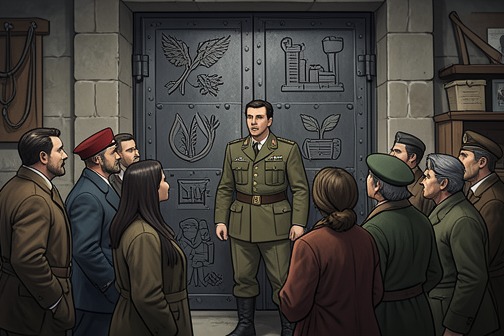
The [Russian Revolution](entity:event-recall-event-russian-revolution-6444f80ee8e1) is presented less through an account of events in [Russia](entity:location-recall-location-e36341713c23) than through its powerful and contested afterlife in [Italy](entity:location-recall-location-italy-85c2492cd54b). It becomes a standard by which Italian socialists measure their ambitions, a model for proposed councils and party transformation, and a source of authority invoked by both revolutionaries and their critics. Yet the contacts that [Nicola Bombacci](entity:character-recall-character-nicola-bombacci-5ddc3dca87f9) hopes will turn that model into practical support reveal a sharp limit: [Moscow](entity:location-recall-location-19aceb5ce281)’s representatives are chiefly concerned with relations between states, while the Italian revolutionary current is divided and uncertain.
## Revolution as a model
At a Socialist Party congress in [Bologna](entity:location-recall-location-bologna-e9b2b10db055) in early October, the maximalist majority adopted a platform inspired by the Russian Revolution, which it celebrated as a historic turning point for the proletariat. The congress revised the party’s longstanding program and appointed Bombacci secretary, placing him at the center of a movement that claimed to prepare an Italian transformation on the Russian example. The image attached to this project was the [Hammer and sickle](entity:object-recall-object-a2f59f26e22c), encircled by ears of corn: a sign of a world remade through proletarian power, presented as both new and continuous with history.
That emblematic confidence stood beside a practical hesitation. Bombacci, known as the Christ of the Workers, addressed immense crowds and was expected by some revolutionaries to lead the Italian movement toward a Soviet republic. But the book stresses that he hesitated to call for revolution. Socialist leaders disagreed about whether violence was historically necessary, whether the moment was ready, or whether attempting an uprising would invite defeat. The warning that the hammer and sickle could not frighten the dagger condensed the central disparity: revolutionary symbols and declarations confronted opponents whose experience of violence was more immediate and whose organization was better armed.
The appeal of the Russian model was not confined to a slogan or a single congress. At a Socialist Party national council in [Florence](entity:location-recall-location-706cb92b9779) on January 11, [1920](entity:time-recall-time-1920-510f1fd63aa4), Bombacci urged the immediate creation of soviets, or councils modeled on those in Russia. His proposal received 401 votes out of 440, a decisive showing that nevertheless did not settle the leadership’s doubts. [Palmiro Togliatti](entity:character-recall-character-palmiro-togliatti-4dece27ec374) regarded Italian councils as a premature and inadequate imitation, reducing them to a shadow of the Russian example. The episode captures the movement’s contradiction: strong popular and organizational support for socialist politics did not mean agreement on how, or whether, to reproduce the Russian path.
## Bombacci’s mission to Soviet representatives
Bombacci’s commitment to the revolution led him to work for the reopening of diplomatic relations between Italy and Lenin’s Russia. In late March 1920 he traveled to [Copenhagen](entity:location-recall-location-8418dcb09a35) as part of a delegation officially arranged through the National League of Cooperatives and backed by the government of [Francesco Saverio Nitti](entity:character-recall-character-francesco-saverio-n-f3bc92931cc1). The arrangement was paradoxical: the government lent support to a mission involving socialists who openly sought to subvert it. For Bombacci, however, diplomacy offered a possible opening to a larger purpose. He wanted recognition of Soviet Russia to become a first step toward an Italian revolution and hoped to discuss that prospect directly with people who had made a revolution themselves.
The meetings exposed the different purposes of the Italian delegation and its Soviet interlocutors. [Leonid Krasin](entity:character-recall-character-leonid-krasin-ff10bb00e681), responsible for revolutionary Russia’s foreign trade, told the delegation that his mandate was to secure official Italian recognition of Moscow. He had no comparable undertaking to advance revolution in Italy. Bombacci therefore put his hopes in [Maksim Litvinov](entity:character-recall-character-maksim-litvinov-4a3fa2bc7e9f), a senior Soviet representative whom he expected to understand the Italian revolutionary cause. Their meeting instead brought a blunt assessment: the Italian Socialist Party was strong, but its revolutionary faction was weak, and socialists in power would not last. The encounter turned Bombacci’s hoped-for confirmation into a warning about the distance between the party’s strength and its readiness to govern.
Litvinov also identified the Soviet government’s immediate priority as the resumption of political and commercial relations with capitalist countries. The book thus distinguishes the successful Russian Revolution from the work now confronting the revolutionary state: maintaining and restoring relations abroad. For Bombacci, Moscow had embodied a living precedent; for its representatives, recognition and practical state relations came first. The distinction did not erase the revolution’s influence, but it denied him the assurance that Italian upheaval would be an urgent Soviet objective.
## Pressure, division, and political consequence
The [Comintern](entity:organization-recall-organization-5868b042b9c2)’s demands brought the Russian example into direct conflict with the Italian party’s unity. At the January 1921 congress in [Livorno](entity:location-recall-location-livorno-07a8421fe06f), delegates confronted 21 conditions set by the [Communist International](entity:organization-recall-organization-communist-intern-ce17a5248ccd). These required the Italian party to change its name and reject as counterrevolutionaries those socialists who supported socialism without accepting revolution. The demand sharpened a division already visible between communists, centrists, and reformists. Bombacci and his supporters still believed in revolutionary action, while many of the maximalists led by [Giacinto Menotti Serrati](entity:character-recall-character-giacinto-menotti-se-21bcf4177c8d) no longer accepted it in practice, even as they continued to use revolutionary language.
A Comintern delegate, Christo Kabakciev, presented the choice as an ultimatum: those who supported the maximalists’ motion for unity would face expulsion from the International. Bombacci and the communists applauded; other parts of the theater answered with mockery and protests against outside authority. The dispute was not simply over reverence for the Russian Revolution. It concerned who could define legitimate socialism in Italy, whether international discipline outweighed party cohesion, and whether revolutionary allegiance required a break with reformists. The revolution’s authority, invoked as a model, therefore became a force dividing the movement that hoped to learn from it.
The book also places Russian revolutionary imagery in Italian public life beyond party congresses. At a socialist gathering in [Milan](entity:location-recall-location-617379caf4c2), women at the head of a procession carried a portrait of Lenin alongside a red flag, while calling for a better life for their children. In Bologna, after the new socialist mayor Enio Gnudi addressed a crowd beneath red flags, released doves circled over socialists and fascists alike. These details show how the revolution’s symbols entered processions and civic ceremonies, where they gave visible form to collective political hopes even as opposing forces contested the same public space.
## The limits of the example
The Russian Revolution’s importance in this account rests on a persistent tension between symbolic power and political capacity. It gave Italian socialists a successful precedent, a vocabulary of workers’ rule, and an organizational model. It also intensified arguments about timing, violence, international allegiance, and the limits of parliamentary politics. Bombacci’s mission made the tension personal: he sought recognition of Soviet Russia partly because he hoped to discuss Italy’s future, only to learn that the Soviet representatives’ urgent concerns lay elsewhere.
The result is neither the disappearance of the Russian example nor its straightforward adoption. Its influence is visible in party programs, proposals for soviets, Lenin’s portrait in a procession, and the Comintern’s demands. But those forms of influence meet Italian conditions that the text repeatedly marks as unsettled: a divided party, disagreement over action, and revolutionary expectations that do not themselves guarantee a revolution. The Russian Revolution remains a point of orientation—and a measure of the gap between what Italian socialists proclaimed and what they could agree to do.
Event 22
Impresa di Fiume
The [Impresa di Fiume](entity:event-recall-event-impresa-di-fiume-7e1445556cc4) was [Gabriele D’Annunzio](entity:character-recall-character-gabriele-d-annunzio-6e66d28027db)’s occupation of [Fiume](entity:location-recall-location-fiume-c271af61753f), an attempt to transform a contested Adriatic city into both a symbol of national redemption and a center for political renewal. The project fused military defiance, public ritual, and expansive political ambition, but its survival depended on food and fuel controlled from outside the city. As hardship deepened, the question of whether to accept a negotiated settlement divided D’Annunzio’s followers and brought the occupation toward its end.
## Occupation under pressure
By the spring of [1920](entity:time-recall-time-1920-510f1fd63aa4), Fiume had waited for annexation to [Italy](entity:location-recall-location-italy-85c2492cd54b) since September [1919](entity:time-recall-time-1919-329d1bdc3600) and had endured months of blockade. The narrative presents the city as dependent on supplies released or withheld by the government in [Rome](entity:location-recall-location-f3877a21016f): its daily life was sustained by an external lifeline that could be restricted at will. The crisis was measurable in the population’s circumstances. Of approximately thirty thousand residents, six thousand able-bodied adult workers were unemployed. Food was rationed, and shortages of fuel oil left the city cold and dark. Even a celebrated local tradition was curtailed: the Commander had prohibited the production and sale of the pastries for which Fiume had been known since the Habsburg era.
The hardship reached beyond household scarcity. In January, hundreds of poor children, weakened by the embargo, were sent from the port to live with Italian families willing to receive them. This so-called children’s crusade appealed to Italian family feeling, but also made visible the human cost of sustaining the occupation. The city’s revolutionary language and its material dependence existed side by side: the project claimed a future for the oppressed while its inhabitants faced rationing, unemployment, and isolation.
That contradiction did not prevent an attempt to give the undertaking a constitutional form. On March 18, 1920, D’Annunzio received a draft charter from [Alceste De Ambris](entity:character-recall-character-alceste-de-ambris-b9a9bd610e1b), the syndicalist he had called to lead his cabinet earlier in the year. The proposed constitution was presented as revolutionary, drawing on radical socialist doctrines and libertarian principles, and grounding its democratic vision in the rights of workers and individuals. Its aspirations were strikingly broad, but the city that was to embody them remained constrained by its dependence on supplies from Rome. The blooming of spring outside the palazzo therefore accompanied not a secure renewal but what the narrative describes as a false spring.
## The compromise and the public test
The Italian government proposed a modus vivendi: in exchange for ending the occupation, it would grant military honors to D’Annunzio’s legionnaires and undertake to defend Fiume with regular troops, with a view toward annexation. The proposal exposed a division within the Commander’s own circle. Younger members of his personal guard regarded it as a betrayal; more senior members of his staff considered it an honorable way out. The disagreement was not simply over terms. It set the uncompromising image of the occupation against the practical question of what could be secured for the city and its people.
D’Annunzio left Fiume for [Zadar](entity:location-recall-location-3669e0decfc0) on November 14. His arrival there was received triumphantly. He displayed [Giovanni Randaccio](entity:character-recall-character-giovanni-randaccio-8ae4b3f57bc9)’s flag before the crowd, and those gathered knelt in the mud before it. For a moment, the spectacle seemed to renew the prospect of carrying Fiume’s cause outward: plans for a march on Rome resumed in the command room, accompanied by the slogan [Marciare non marcire](entity:expression-recall-expression-marciare-non-marci-5cf9ec2ce00d), or march rather than decay. But two days later, the results of the Italian elections arrived. The Socialists had won, [Francesco Saverio Nitti](entity:character-recall-character-francesco-saverio-n-f3bc92931cc1) remained prime minister, and national pride had yielded to demands for bread and wages. The vote demonstrated that the political audience at home could not be assumed to share the Commander’s priorities.
As conditions in Fiume worsened, D’Annunzio authorized his lieutenants to reopen negotiations and left the decision to the [Fiume National Council](entity:organization-recall-organization-177f5294aa51). On December 15, after several meetings, the council accepted the government’s proposal by 46 votes to 6. The vote marked the impending close of the rebellion, but it did not settle the question in the streets. A large crowd of legionnaires and civilians, especially women, gathered beneath the palazzo balcony, denouncing betrayal and demanding that D’Annunzio appear. The piazza became an open-air forum in which the settlement was subjected to a second, public test.
D’Annunzio came to the balcony pale and carrying loose pages. Rather than deliver an oration, he read the terms aloud. The crowd answered each clause with assent or rejection. The National Council had already approved the agreement by a substantial majority; the reading gave the gathered people a direct part in affirming or contesting its provisions. The episode captures the occupation’s reliance on public performance, while also revealing its limits: popular acclamation could intensify the cause, but could not undo the city’s isolation or replace the council’s decision.
## Isolation and the unfulfilled international project
D’Annunzio’s departure to Zadar did not resolve the political fractures within Fiume. In June, after Francesco Saverio Nitti’s government fell, the city celebrated the prime minister’s removal. Yet celebration unfolded alongside the departure of the forces that had maintained order. [Carabinieri](entity:organization-recall-organization-carabinieri-28c84a9cf0f4) divisions had already left in May; at the Cantrida roadblock, [Arditi](entity:organization-recall-organization-ce1ea9816d56) surrounded them and a clash followed. Scuffles also broke out among the troops inside the city, where officers tried to restore control over volunteers. The narrative depicts a force that retained the language of military discipline while losing the stability that discipline required.
Political isolation deepened as well. [Nicola Bombacci](entity:character-recall-character-nicola-bombacci-5ddc3dca87f9) had promoted efforts to reach an agreement with the Socialists over a common acquisition of power, but those attempts failed, and the Socialists repudiated D’Annunzio. The Fiume National Council was openly hostile to him. Increasingly cut off from the world, the Commander had to wait for the morning newspapers to learn what was happening beyond the city. The contrast is pointed: a leader who had imagined a movement extending across nations was reduced to receiving news after it had already arrived in print.
The international ambition had taken institutional shape in the Fiume League, an assembly conceived by the young Belgian poet [Léon Kochnitzky](entity:character-recall-character-l-on-kochnitzky-ee21ac904d2c) and supported by D’Annunzio. It was intended to unite representatives of peoples described as oppressed and to oppose the international order associated with [Woodrow Wilson](entity:character-recall-character-woodrow-wilson-38391917f7db). Its projected constituency extended far beyond the Adriatic, encompassing European territories, peoples under colonial rule, and communities across Asia and the Americas. D’Annunzio appointed Kochnitzky foreign minister. This universal language enlarged the meaning of Fiume beyond a dispute over annexation, but it also sharpened the contrast between the imagined world of liberation and the isolated city whose residents faced shortages and whose political leadership was losing allies.
## Political meaning and limits
The occupation’s political force rested partly on ritual. The flag displayed before the crowd in Zadar and the public reading of the settlement in Fiume made political allegiance visible through shared gestures and collective response. The piazza could stage both defiance and consent; the same public setting that summoned demands for insurrection could be used to hear the clauses of compromise. Such scenes gave the undertaking a political life beyond its formal institutions, but they could not erase divisions among D’Annunzio’s guard, staff, council, and civilian supporters.
The wider political narrative places this style of public ceremony alongside the national cult of the fallen. On November 4, 1921, the Unknown Soldier was buried in a solemn ceremony attended by crowds across Italy; five days later, the founders of the [National Fascist Party](entity:organization-recall-organization-national-fascist-c9d1f7e3cfc5) knelt at the tomb in Rome. This later scene does not resolve the fate of Fiume, but it shows how political ritual and the memory of war continued to shape public life beyond the occupation itself. The Impresa’s distinctive combination of spectacle, direct appeal, and political ambition thus belongs to a broader landscape in which collective ceremony could make politics feel sacred, even as practical struggles over authority and material survival remained unresolved.
Event 23
1919 Italian General Election
The [1919 Italian General Election](entity:event-recall-event-1919-19560166cd16) was a decisive electoral defeat for [Benito Mussolini](entity:character-recall-character-benito-mussolini-0330d40d2c3f)’s Fascists and a triumphant result for the Socialists. On 16 November, the Fascist list failed to win a single seat in the [Milan](entity:location-recall-location-617379caf4c2) district, while the Socialist Party secured 156 seats nationally. The contrast between an organized, martial campaign and its meager vote revealed how little the Fascists could yet command through elections—and how sharply their political fortunes differed from the force they sought to project.
## Background and Political Repositioning
In the months before the vote, Mussolini tried to hold together his movement’s old socialist associations while seeking new allies. At a Milan conference on 17 July, he took a hard line against the threatened general strike, although only a small number of cities were represented. At the same time, he looked beyond the movement: [Michele Bianchi](entity:character-recall-character-michele-bianchi-6ec6b0301223) had reached an agreement with Milan’s prefect to make the Fascists available for maintaining public order. The prefect also disclosed a confidential government circular urging Fascist cooperation against revolutionary attempts, including violent repression under official command. The liberal state was thus opening a route for Fascist participation even as the movement remained electorally untested.
Mussolini also revived the prospect of a pre-electoral committee with factions of left-wing interventionism. At a gathering in the Liceo Beccaria, former socialists who had supported [Italy](entity:location-recall-location-italy-85c2492cd54b)’s entry into the war and radicals of the patriotic left heard him argue for social and economic reorganization centered on workers’ welfare but independent of Bolshevism. A joint November candidacy seemed possible for a moment. The Fascists ultimately entered the race on their own ticket, a choice that made the election a direct test of their independent support.
## The Fascist Ticket and Campaign
The list was assembled rapidly. Of its nineteen candidates, eighteen had served at the front; the group included volunteers, decorated veterans, wounded men, and disabled veterans. Among the prominent names were [Filippo Tommaso Marinetti](entity:character-recall-character-filippo-tommaso-mar-3aac8d8bc631) and [Arturo Toscanini](entity:character-recall-character-arturo-toscanini-44ff608baff4). Toscanini learned that he had been nominated while standing apart from an assembly in a school gymnasium. Marinetti persuaded him to accept, and he contributed 30,000 lire to the list.
The platform retained the movement’s earlier reforming program: abolition of the Senate, tax reform, a levy on great wealth, confiscation of ecclesiastical property, support for wounded and disabled veterans, and an armed nation. Its electoral symbol was a French-made [Thévenot grenade](entity:object-recall-object-th-venot-grenade-2511d2c96385), a weapon issued to the [Arditi](entity:organization-recall-organization-ce1ea9816d56) by the Italian army. The combination was revealing: the Fascists presented a program that still carried a social-reformist inheritance, but framed the ballot itself through the imagery of combat.
The campaign’s public gathering was prepared with precautions against possible attacks. Benito Mussolini summoned former republicans and anarchists from Romagna as an honor guard, among them [Leandro Arpinati](entity:character-recall-character-leandro-arpinati-504d6ebd7829). [Gabriele D’Annunzio](entity:character-recall-character-gabriele-d-annunzio-6e66d28027db) sent sixty legionnaires and authorized the recruitment of additional men using funds raised for [Fiume](entity:location-recall-location-fiume-c271af61753f). Groups also arrived from nearby cities. [Albino Volpi](entity:character-recall-character-albino-volpi-fcc25af3d38e) and other Arditi packed iron bars and grenades; organizers instructed participants to keep silent if asked to identify people who caused disruption, and told the uninvolved public to leave quickly by Via Morone if clashes occurred. The rally was to be brief and would proceed even in the rain. These preparations underscored the tension between campaigning for votes and anticipating confrontation in the streets.
## Results in Milan and [Ferrara](entity:location-recall-location-970ebca292e4)
The national Socialist result was overwhelming: 1,834,792 votes and 156 elected parliamentarians. In the Milan district, with approximately 270,000 voters, the Fascist list received only 4,657 votes. Mussolini’s own preferential vote totaled 2,427. None of the Fascist candidates was elected. The scale of the defeat was especially sharp because Mussolini had already imagined himself as a deputy from Milan; the ballot did not merely exclude the movement but dashed his personal expectation of entering Parliament.
Ferrara offered another measure of the Socialist strength in the same election. There, the Socialist Party received 43,000 votes, and the book describes three out of four voters in the province as having voted for revolution. The result anticipated the intense political contest that would follow in the countryside, but the later reversal of local power should not be confused with the national election outcome: in November [1919](entity:time-recall-time-1919-329d1bdc3600), the Socialist vote in Ferrara was commanding.
## Defeat and Its Immediate Aftermath
Mussolini privately acknowledged the result to Rachele, calling it a total defeat and admitting that not even one seat had been won. In Milan, the public response reached his household. A Socialist mock funeral procession stopped outside the family’s home in Foro Bonaparte, with people shouting that Mussolini’s body was there and striking the front door. Two additional empty coffins represented Marinetti and D’Annunzio. Rachele told her husband that she had taken refuge in the attic with the children; their daughter Edda suffered an anxiety attack.
At the newspaper offices, visitors arrived as if to pay their respects at a funeral. The image of a public burial of Mussolini’s political prospects was sharpened by the private scene around him: a stark workroom, a map of Italy marked with a tricolor flag at Fiume, a glass of milk, and an old pistol on the desk. The result had left the Fascists with no parliamentary representation, while the Socialist victory seemed to announce a new political ascendancy. For Mussolini, the election was therefore both a public repudiation and a personal humiliation. It established the distance between the movement’s militant presentation and its actual electoral reach at the end of 1919.
Event 24
1919 Socialist Deputies’ Walkout
The [1919 Socialist Deputies’ Walkout](entity:event-recall-event-1919-d7a062913a4e) transformed the opening of [Italy](entity:location-recall-location-italy-85c2492cd54b)’s new Parliament into a public refusal of royal authority. On December 1, the socialist deputies, identifiable by the red carnations in their buttonholes, remained seated while the assembly greeted King [Vittorio Emanuele III](entity:character-recall-character-vittorio-emanuele-i-45cfd86fd0a5), then rose together and left. Their exit was at once a carefully legible act of political dissent and a moment of triumph without a plan: jubilation outside the chamber soon gave way to attacks in the streets.
## A parliament divided before the ceremony
The day began beneath a monumental image of national history. In the new parliamentary hall at [Montecitorio](entity:location-recall-location-montecitorio-884403622079), socialist deputies admired Aristide Sartorio’s frieze: fifty broad canvases, set high above the semicircle of seats and filled with allegorical figures representing the virtues and history of young Italy. The lavish decoration offered a vision of national unity just as the chamber was being divided by a conspicuous new presence on the left.
The socialists had arrived early and occupied the first three sections on the left, all wearing red carnations. Returning members who had previously sat there found their places taken. Even [Giovanni Giolitti](entity:character-recall-character-giovanni-giolitti-24b78735ff0a), a dominant figure in parliamentary life for three decades, had to give up his customary seat. The account presents this change in the seating as more than a practical inconvenience: the old parliamentary arrangement no longer commanded the left, whose members arrived as a bloc and displayed their collective identity before the king’s speech had begun.
At 10:28, when a royal attendant opened the door, approximately five hundred representatives were present. The senators and deputies stood and cheered the king. The socialist sections alone stayed seated. The contrast was visible, but the applause was loud enough that their refusal initially passed unnoticed. Vittorio Emanuele III accepted the welcome and took his place on the throne; Prime Minister Nitti then invited the assembly to sit.
## The refusal and the exit
Instead, the red carnations stood. Their movement met a sudden silence. For a few moments the chamber did not know how to interpret what it was seeing, and the cuirassiers tightened their grip on their sabers. The deputies were not leaving in confusion: their collective action made clear that they would not participate in the royal ceremony or recognize the king through the usual parliamentary gestures. They turned their backs on the occasion and walked out.
[Nicola Bombacci](entity:character-recall-character-nicola-bombacci-5ddc3dca87f9) led the dissidents. Disheveled and bearded, he passed the throne, looked directly at Vittorio Emanuele III, and proclaimed a socialist republic. His personal following in the [Bologna](entity:location-recall-location-bologna-e9b2b10db055) district was so large that newspapers called him the king of preferential votes. The narrative gives the scale of the gesture in political terms: Bombacci alone, apart from the other socialist deputies, represented more than one hundred thousand Italians leaving Montecitorio. The king was left to deliver his crown speech to a half-empty chamber.
Outside, in the piazza, the departing deputies congratulated and embraced one another. Their laughter and relief suggested that, for a brief moment, the refusal had made their hope of a free and just society feel attainable. But the celebration did not settle what should follow. The account sharply reverses the image of victory: the socialists had, in its words, conquered Italy, yet did not know what to do with it. The walkout had drawn a clear political boundary without providing a shared next step.
## From public dissent to street attacks
The uncertainty was quickly met by organized violence. That afternoon, nationalist gangs hunted socialist deputies through the streets of [Rome](entity:location-recall-location-f3877a21016f), seized them by their black republican bow ties, and forced them to voice support for the king. By evening, attacks continued with the involvement of the newly formed Royal Guard, a force established to maintain public order. [Giacinto Menotti Serrati](entity:character-recall-character-giacinto-menotti-se-21bcf4177c8d), the socialist leader, was taken to security headquarters and beaten.
The socialist response was to call a general strike. The first fatal consequence recorded in the immediate aftermath came the following day in Piazza Esedra: Tiberio Zampa, a twenty-three-year-old worker in the print shop of [Avanti!](entity:object-recall-object-avanti-1bed44223b67), was killed. Factories stopped again, and [Milan](entity:location-recall-location-617379caf4c2) remained on guard with weapons at hand as expectations of revolution persisted. The parliamentary refusal had not contained the conflict within the chamber; the events that followed carried it into streets, workplaces, and the machinery of public order.
## The material world behind the gesture
The walkout took place amid a broader struggle over who could organize work and command everyday life. In Bologna, competing labor chambers and pressure to join unions sharpened conflict between workers and the middle classes; the account describes people being denied bread for lacking a union card and employers selling their businesses rather than face continuing economic danger. In the rural provinces, socialist leagues had built influence through unions, cooperatives, and local organizations. In [Emilia](entity:location-recall-location-emilia-b49a9aa2ef04), they controlled 223 of 280 municipalities, while farm laborers who could work an average of only 120 days a year depended on wages and organized hiring to survive the idle months.
Those conditions do not, by themselves, explain the deputies’ decision on December 1. They do show why the parliamentary scene belonged to a much wider contest over representation, livelihood, and political power. The red carnations made dissent visible inside the state’s ceremonial space; the immediate reprisals revealed how little protection that space could offer once opponents pursued the deputies beyond its doors. The walkout’s significance lies in that abrupt passage from a disciplined collective refusal to a vulnerable and unresolved struggle outside Parliament.
Event 25
1919 Fiume Plebiscite
The [1919 Fiume Plebiscite](entity:event-recall-event-1919-a780bda869a0) was a disputed vote on whether to accept the modus vivendi proposed by [Francesco Saverio Nitti](entity:character-recall-character-francesco-saverio-n-f3bc92931cc1)’s government. It exposed the widening divide between the [Fiume National Council](entity:organization-recall-organization-177f5294aa51)’s willingness to compromise and the public resistance rallied by [Gabriele D’Annunzio](entity:character-recall-character-gabriele-d-annunzio-6e66d28027db). When the vote appeared to favor the agreement, reports of interference at polling places shadowed its legitimacy; D’Annunzio responded not by accepting the result but by ordering the referendum annulled.
## Crisis and the proposed compromise
The vote arose as the rebellion in [Fiume](entity:location-recall-location-fiume-c271af61753f) was losing some of its momentum. On November 14, D’Annunzio had left the city for [Zadar](entity:location-recall-location-3669e0decfc0), where his reception initially seemed to revive the prospect of carrying Fiume’s cause beyond the city. But the Italian election results soon confirmed the socialists’ victory and Francesco Saverio Nitti as prime minister. The account sets this result against the material pressures facing Fiume: of 30,000 adult workers, 6,000 were unemployed. With the population feeling the effects of hardship, D’Annunzio authorized his lieutenants to reopen negotiations with [Rome](entity:location-recall-location-f3877a21016f) and left the proposed modus vivendi to the Fiume National Council.
On December 15, after several meetings, the Council accepted Nitti’s proposal by 46 votes to 6. Its decision seemed to bring the rebellion’s epic to a close. Yet the compromise did not settle the question of popular consent. As news spread, legionnaires and civilians—especially women—gathered below the palazzo balcony, denouncing the decision as betrayal and demanding that D’Annunzio address them. The episode shifted the agreement from a council decision into a contest over who could speak for Fiume.
## The piazza becomes a voting chamber
D’Annunzio appeared with loose sheets of paper and read the text of the proposed agreement aloud. Rather than deliver an oration, he submitted its clauses to the people gathered in the piazza, who answered each with approval or rejection. The contrast was pointed: the Council had already accepted the agreement by a large majority, but the public gathering presented itself as another forum of decision, where political authority was enacted through the crowd’s response.
D’Annunzio tested the crowd’s commitment by asking whether it wanted the agreement and then whether it accepted the suffering that continued resistance would entail. The response was rejection of the compromise and affirmation of resistance. He called for a referendum on December 18, inviting the people to say openly whether the arms and commitment of the legionnaires were still necessary to honor their oath. [Randaccio’s flag](entity:object-recall-object-e8b725a9120d) was unfurled, and the [Arditi](entity:organization-recall-organization-ce1ea9816d56) sang battle songs; the gathering’s enthusiasm continued late into the night. The referendum was thus framed not simply as a choice about terms negotiated in Rome, but as a public judgment on resistance and the oath associated with it.
## The vote and its annulment
On December 18, D’Annunzio waited in solitude for the result. Reports of violent incidents had reached him during the day. Legionnaires were said to have interfered with free voting in several precincts: they entered polling places, prevented scrutineers from doing their work, and tampered with ballots. Before sunset, the result appeared clear: a great majority of Fiume’s residents favored the modus vivendi proposed by Nitti. The apparent outcome ran against the resistance that the crowd had affirmed at the earlier gathering, while the reported interference made the conduct of the vote itself a matter of dispute.
D’Annunzio withdrew again. The account presents his response as a decisive reversal: he summoned his personal guard and ordered the referendum annulled, dismissing this form of democracy as a bourgeois mistake. The vote therefore did not resolve the conflict between compromise and resistance. The Council had accepted the agreement; the piazza had rejected it in advance; the ballots appeared to favor it; and the Commander then set aside the referendum. Fiume’s public decision-making had been staged as direct popular rule, but its result was not allowed to stand.
## Significance
The plebiscite’s importance lies in the sequence of competing acts of consent rather than in a settled transfer of authority. The Council’s recorded vote, D’Annunzio’s public questioning, the referendum, and the order of annulment each claimed a different basis for deciding Fiume’s future. The crowd’s participation gave the compromise a public arena, but reports of interference compromised the vote, and annulment prevented its majority from determining policy.
The event also marked a change in the rebellion’s trajectory. The agreement had offered a route toward accommodation as unemployment and exhaustion weighed on the city; the referendum briefly reopened resistance as a collective choice. Its apparent result then revealed that the Commander’s appeal to popular will had limits: when the vote went against the position he had advanced, he invalidated it. The episode leaves the rebellion not with a final act of popular assent, but with a conflict over whether the people’s expressed decision could bind its leader.
Event 26
1920 Turin General Strike
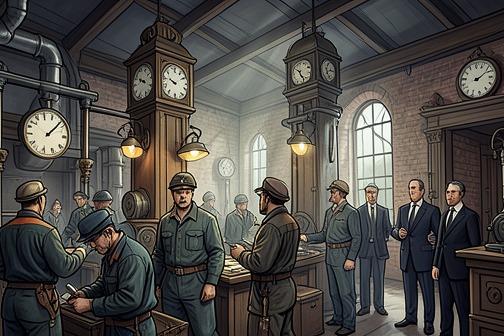
The [1920 Turin General Strike](entity:event-recall-event-1920-e8a86bb30d2a), remembered in the narrative as the “clock hand strike,” turned a government decision about daylight-saving time into a confrontation over who had the authority to set the terms of working life. At Fiat, the dispute expanded into a ten-day general strike involving 120,000 workers in [Turin](entity:location-recall-location-turin-7d5a70373e49) and its province, including 60,000 who occupied factories. Its scale made the conflict appear to herald revolution, but the hesitation of socialist leaders exposed the distance between workers’ action and the party’s political strategy.
## The clock dispute and the strike
At the end of March, the Council of Ministers extended daylight-saving time, which had first been adopted during the war. Fiat workers rejected the change, deciding that they, rather than Senator [Giovanni Agnelli](entity:character-recall-character-giovanni-agnelli-21002c8f2b96), would determine their own time. The industrialists responded with a lockout, and the conflict escalated into a ten-day general strike across Turin and the province.
The numbers gave the dispute its wider force: 120,000 workers took part, and 60,000 occupied factories to resist moving the clock forward by one hour. In the book’s telling, the issue was not simply the clock or the season. Control of time at the factory became a concrete expression of workers’ claim to authority, and the strike was understood as a test of power reaching beyond the immediate change in working hours.
## A wider crisis of strikes and revolution
The Turin stoppage formed part of an exceptional wave of labor unrest. Strikes had spread through transport and services as well as industry; railway stations took on the appearance of military encampments, and everyday life in [Milan](entity:location-recall-location-617379caf4c2) was brought close to a standstill. Turin’s factory occupations thus belonged to a national climate in which labor disputes could be read as signs of a possible revolutionary rupture.
That expectation was not matched by a unified political plan. Socialist leaders again postponed revolution, and many openly condemned the “clock hand strike.” The party’s electoral success had sharpened rather than resolved its divisions: maximalists rejected participation in power, while reformists lacked the resolve to attempt a seizure of power. The workers’ action could therefore reach a formidable scale without producing agreement among the leaders who might have turned it into a broader political offensive.
## The party’s interpretation
[Claudio Treves](entity:character-recall-character-claudio-treves-0854cd58f6fd), one of the Socialist Party’s most influential leaders, addressed the impasse in Parliament in a speech soon known as the “expiation speech.” He described revolution as something that unfolded over time rather than arriving in a single decisive day: “is an epoch, not a day.” His account cast the process as gradual, with slow erosion and sudden landslides, and anticipated years of change rather than an immediate conclusion.
Treves’s speech did not erase the frustration at the strike’s deferral of revolutionary aims. He acknowledged the strain of a prolonged process: the difficulty lay not in dying for a cause but in being kept from fully living it. Set beside the factory occupations, that formulation reveals the central tension of the Turin strike: workers acted as though the decisive hour had arrived, while party leaders treated revolution as a long historical passage.
## Consequences and significance
The strike demonstrated how a seemingly narrow workplace decision could gather wider political meaning. A one-hour change imposed from above prompted mass stoppage and factory occupation; the response showed both the strength of workers’ organization and the limits imposed by divided leadership. The conflict’s significance in the narrative lies in this contrast between collective action on the ground and postponement at the level of party strategy.
Rather than presenting the strike as a completed revolution, the book places it within an unresolved crisis. The stoppage made revolutionary possibility visible, but socialist leaders’ disagreements left that possibility unfulfilled. Treves’s image of revolution as an epoch gave the delay a historical explanation, even as the workers’ direct challenge over time registered the impatience that such delay could not settle.
Event 27
Decima Massacre
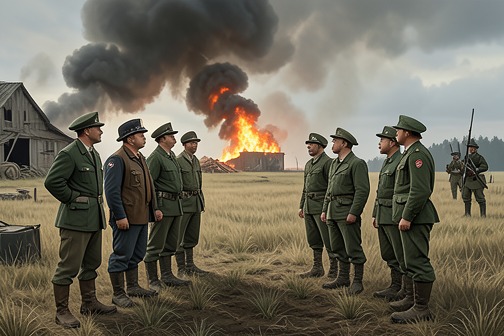
The [Decima Massacre](entity:event-recall-event-a8316df3b2bc) was a deadly confrontation between carabinieri and farmworkers at a rally in the [Bologna](entity:location-recall-location-bologna-e9b2b10db055) countryside. Rooted in a wider contest over agricultural employment and the authority of socialist labor organizations, it turned a dispute over a collective farm agreement into a political crisis: eight people died, and the ensuing strike helped spur the organization of the [Bolognese Association of Social Defense](entity:organization-recall-organization-05001c52c59b).
## Background and Agricultural Conflict
The massacre took place in Decima, a rural district of [San Giovanni in Persiceto](entity:location-recall-location-ceb35565b38f), as the struggle over agricultural agreements spread through the Bologna area. The dispute concerned not only wages but also the rules governing who could be hired and when. In [Ferrara](entity:location-recall-location-970ebca292e4), seasonal farmworkers and sharecroppers had already forced landowners to accept wage increases, worker-managed hiring centers, and a compulsory employment quota. That quota required landowners to hire five workers for every thirty hectares of arable land during the months when farm work was scarce. The conflict in Bologna began against this backdrop of organized labor action and landowners’ resistance.
The surrounding crisis had both urban and rural dimensions. Bologna’s two competing chambers of labor pressed revolutionary demands, while the countryside was dominated by socialist leagues that organized farmworkers and imposed collective rules on landowners. These arrangements could offer workers employment during otherwise idle periods, but they also intensified conflict when farmers or landowners challenged the agreements. By the time the dispute reached Decima, the agricultural concordat had become a test of authority between labor organizers, public-order officials, and the people gathered to demand its terms.
## The Rally and Shooting
At a meeting in Decima about the collective farm agreement, Sigismondo Campagnoli, sent by the [Bologna Chamber of Labor](entity:organization-recall-organization-bologna-chamber-feb8be29a46a), addressed the crowd. After discussing agricultural questions, he denounced capitalists, priests, and the [Carabinieri](entity:organization-recall-organization-carabinieri-28c84a9cf0f4), then called for revolution. The brigadier responsible for public order intervened, and Pietro Comastri, another speaker from the labor chamber, took the platform. Although Comastri initially promised a more moderate address, he soon returned to the question of revolution. The brigadier pulled him down, but the officer’s small force could not control the large, angry gathering of farmworkers.
The confrontation escalated after a soda siphon struck the wall beside the Carabinieri, sending fragments outward and causing a minor injury to a deputy inspector. The crowd surged toward the officers, who had been lined up against the farmhouse wall. No formal order to fire was needed: the Carabinieri opened fire with pistols and machine guns. Raffaele Barile fired seven shots and Giuseppe Scimmia ten. Eight people were killed and about thirty injured. Although the soldiers were said to have acted in self-defense, almost all those killed had been shot in the back; Campagnoli was killed with a bayonet.
## Strike, Self-Defense, and Political Consequences
The deaths transformed a local confrontation into a province-wide crisis. The Bologna Chamber of Labor called a three-day general strike, and for seventy-two hours public and private services stopped as workers withdrew their labor. The massacre thus widened the dispute beyond the farm agreement: the question became who could organize public life and claim the authority to defend it. For farmers, manufacturers, merchants, professionals, public employees, and homeowners, the stoppage was the final pressure that prompted them to organize independently.
On April 8, at a meeting promoted by the Chamber of Commerce, these groups established the Bolognese Association of Social Defense. A delegation carried its case to Prime Minister [Francesco Saverio Nitti](entity:character-recall-character-francesco-saverio-n-f3bc92931cc1) on April 15, denouncing what it described as the state’s failure to respond to socialist violence and declaring itself ready to act in the name of self-defense. The organization’s emergence did not settle the conflict; it showed how the massacre and strike helped turn fear of labor mobilization into a new political resource for those who felt threatened by it.
[Leandro Arpinati](entity:character-recall-character-leandro-arpinati-504d6ebd7829) stood at the crossing point between these forces. An anarchist railwayman from a poor family, he faced an offer of 100,000 liras from major landowners to defend them against the poor, while also judging that strikes and revolutionary expectations were damaging the country. His dilemma exposed the material bargain taking shape around the crisis: bourgeois supporters, previously reluctant to act, were now offering money and arms to the fascists, while fascist organizers could present themselves as a force capable of confronting labor unrest. The massacre’s aftermath therefore carried consequences beyond its immediate toll: it helped accelerate the organization of opposing camps and sharpened the struggle over who would exercise power in the countryside.
## The Agrarian Conflict Beyond Decima
The Decima killings occurred within a dispute that continued well beyond the rally. By [1920](entity:time-recall-time-1920-510f1fd63aa4), socialist leagues in [Emilia](entity:location-recall-location-emilia-b49a9aa2ef04) controlled much of the agricultural labor system: they regulated hiring, work shifts, threshing, seed supplies, and crop planting. Farmhands, who could expect to work only about 120 days a year, depended on collective rules for employment and wages; league enforcement also meant that those who accepted lower wages or broke the agreements could face boycotts, fines, or pressure to leave. In Ferrara, 81,000 people had registered with the [Leagues of Proletarian Unity](entity:organization-recall-organization-724b8b6f4b3f) by mid-May, including agricultural workers, tenants, sharecroppers, and small landowners. The scale of that organization helps explain why the dispute at Decima was more than a local clash: it formed part of a wider contest over who would govern work and rural life.
The conflict remained material as well as political. In August 1920, harvested grain lay unthreshed while landowners and farmworkers struggled over control of production. In Emilia, socialists controlled 223 of 280 municipalities, and the leagues’ reach extended from labor placement to the operation of threshing machines and the supply of seed. Farmworkers’ expectations of secure employment met landowners’ efforts to preserve control over their property; breaches of collective agreements could prompt sanctions, while the failure to find work could mean hardship during the long idle season. The book presents these pressures not as a simple aftermath of Decima, but as the continuing conditions in which the massacre’s political consequences took shape.
By 1921, fascist organizers were also acting on the countryside’s unemployment crisis. [Italo Balbo](entity:character-recall-character-2e79cde02db9) proposed occupying Ferrara with a mass mobilization to compel the government to fund public works for tens of thousands of unemployed farmworkers, while demonstrating that fascists could provide for their followers. The plan used a grievance rooted in seasonal hunger and worklessness to build political authority. In this later development, the struggle over agricultural agreements had become part of a broader contest over who could organize the rural population and claim to defend it.
Event 28
Ancona Uprising
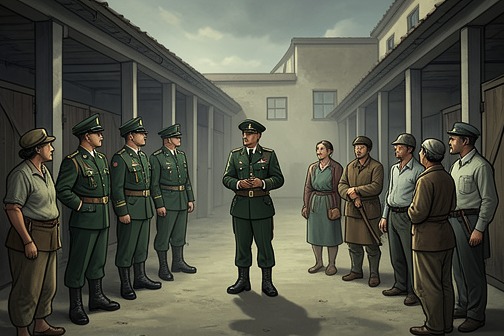
The [Ancona Uprising](entity:event-recall-event-04683a8d35be) was a military mutiny in late June [1920](entity:time-recall-time-1920-510f1fd63aa4) that drew support from the city’s working population and required force against the barracks to bring the insubordinate soldiers out. Its significance in the book lies in the convergence of army disobedience and popular unrest: the state’s military crisis appeared not as a problem confined to the ranks, but as one unfolding alongside mass political conflict.
## Causes and Setting
The immediate cause was an order to send an entire regiment of Bersaglieri to reinforce the Italian garrison at [Valona](entity:location-recall-location-0b94d504eeb6), which was threatened by Albanian rebels. The soldiers mutinied instead. The account gives no detailed explanation of their refusal, so the episode does not establish a specific motive beyond their resistance to the deployment.
The uprising occurred amid a broader postwar crisis. Elsewhere, in [Bologna](entity:location-recall-location-bologna-e9b2b10db055), labor disputes and socialist organizing had brought competing labor chambers, union demands, and pressure on employers into sharp conflict. In [Emilia](entity:location-recall-location-emilia-b49a9aa2ef04)’s countryside, socialist leagues were expanding their influence over hiring and working conditions; farmhands averaged only 120 days of work a year, making seasonal employment and wages matters of survival. These developments are not presented as causes of the Ancona mutiny, but they place it within a period when political conflict reached into both military institutions and civilian life.
## The Mutiny and Its Suppression
The working population of Ancona rose in support of the mutinous soldiers. The confrontation therefore joined the soldiers’ refusal to obey orders with a wider act of solidarity from the city’s workers. The authorities’ response reached the barracks: they had to be fired upon to get the soldiers out.
The account does not specify how many people were involved in the uprising beyond identifying an entire regiment, nor does it give casualty figures or describe the mutiny’s final settlement. What it does establish is the seriousness of the breakdown: an army unit assigned to an urgent military reinforcement refused its task, and restoring control required force against the place where the soldiers were barracked.
## Political Meaning and Aftermath
[Benito Mussolini](entity:character-recall-character-benito-mussolini-0330d40d2c3f) was dejected by the episode. He wrote to [Gabriele D’Annunzio](entity:character-recall-character-gabriele-d-annunzio-6e66d28027db) complaining of the tremendous crisis of disintegration [Italy](entity:location-recall-location-italy-85c2492cd54b) was experiencing. His response makes the uprising more than a local disturbance in the book’s political narrative: it becomes a sign, for a prominent interventionist and nationalist, that the army and the country’s postwar order were coming apart.
The evidence does not describe a direct political consequence of the uprising or claim that it caused later developments. Its force is instead in the juxtaposition it creates: at a moment when the state needed soldiers for a threatened garrison, an entire regiment refused, while workers in the city backed them. The episode exposes the fragility of military authority within a society already divided by organized political and labor conflict.
Event 29
Burning of the Narodni dom
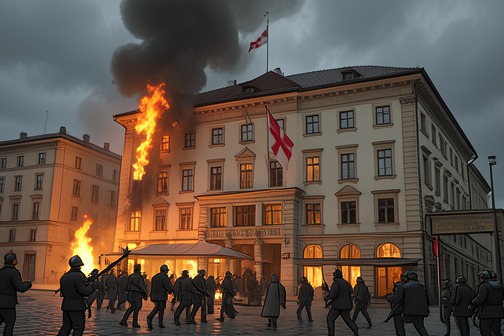
The [Burning of the Narodni dom](entity:event-recall-event-ad8172f3ac0b), also known as the Burning of the [Hotel Balkan](entity:location-recall-location-9c40c484552c), was a Fascist attack on the headquarters of [Trieste](entity:location-recall-location-d475e87ba5ac)’s Slovenian national organization in July [1919](entity:time-recall-time-1919-329d1bdc3600). Following a demonstration over the killing of two Italian soldiers in Croatia, the stabbing of a seventeen-year-old Italian boy became a rallying point for the Fascists. About an hour later, their organized assault set the Hotel Balkan ablaze. The episode showed how [Francesco Giunta](entity:character-recall-character-francesco-giunta-6162c18e8383)’s disciplined local organization could turn a borderland clash into political mobilization—and how readily [Benito Mussolini](entity:character-recall-character-benito-mussolini-0330d40d2c3f) interpreted such violence as a sign of [Fascism](entity:concept-recall-concept-fascism-37baf0d2849a)’s rise.
## Borderland politics and organization
Giunta, a Tuscan attorney and former interventionist volunteer, had served as a captain and as a legionnaire of [Gabriele D’Annunzio](entity:character-recall-character-gabriele-d-annunzio-6e66d28027db). After [Fiume](entity:location-recall-location-fiume-c271af61753f), Mussolini sent him to direct the Fascist organizations along the Slovenian border. Giunta organized them with military discipline, dividing them into units assigned to particular territorial garrisons. In Trieste, anti-socialism and Italian nationalism could be made to reinforce one another: Slovenian workers were presented as both communists and foreigners. The account describes that combination as especially conducive to Fascism taking root.
This local setting matters to the event’s sequence. The Hotel Balkan was not simply a building caught in a street disturbance; it was the headquarters of a Slovenian national organization, and its attack placed national antagonism at the center of Fascist action. The episode brought together an existing network of organized Fascists, a demonstration framed around Italian casualties, and a target associated with the Slovenian community.
## From demonstration to arson
The immediate spark came at a demonstration called to protest the deaths of two Italian soldiers in Croatia. Away from the platform, where Giunta invoked retributive justice, a scuffle between Italians and Slovenians ended with the stabbing of Giovanni Nini, a seventeen-year-old from Novara who worked as a cook at the trattoria Bonavia. The account notes that some believed he had merely been passing by. His own political involvement was uncertain; his death nevertheless became usable as a symbol, irrespective of his opinions.
After Nini was stabbed, Giunta’s Fascists left the piazza in disciplined columns. Their departure led many bystanders to suspect that the attack had been planned in advance. About an hour later, flames broke out at the Hotel Balkan. Slovenian representatives inside were besieged as improvised catapults were used against the building. The account records the arson as a rapid escalation from a demonstration and a street clash to an assault on an organization’s headquarters.
## Mobilization and political consequences
The day after the fire, a crowd overran the headquarters of Trieste’s Fascio, demanding enrollment cards. The attack had therefore been followed not only by public reaction but by an immediate influx of people seeking membership. Giunta presented the destruction of the Hotel Balkan as an electoral asset, announcing, “The Balkan is our electoral platform,” as new members arrived. The remark joined coercive action to recruitment and electoral politics: the violence was represented as a means of building the movement’s public strength.
Mussolini responded with open exhilaration, declaring, “We can say, without being bombastic, that fascism’s time has come!” The episode thus mattered beyond the immediate destruction and intimidation in Trieste. It demonstrated the political value Mussolini and Giunta assigned to militarily organized action, while revealing how the movement could combine anti-socialist appeals with hostility toward a national minority. Its aftermath offered a stark measure of that appeal: within a day, the local Fascist headquarters was crowded with people asking to join.
Event 30
Second National Congress of the Fasci di Combattimento
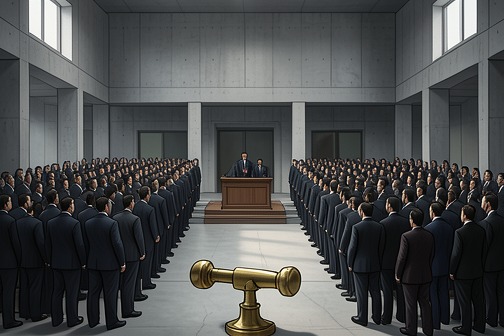
The [Second National Congress of the Fasci di Combattimento](entity:event-recall-event-b5e561474f6b) was the May [1920](entity:time-recall-time-1920-510f1fd63aa4) meeting at which the movement made its decisive turn to the political right. Across a ceremony of flags, speeches, and organizational decisions, [Benito Mussolini](entity:character-recall-character-benito-mussolini-0330d40d2c3f) and his allies repositioned the fasci: rather than remain an anti-party formation appealing to heterogeneous postwar discontent, they would seek a social base among the petite bourgeoisie and cooperate with the existing state. The congress exposed the distance between the movement’s small membership and its expanding political ambitions, while making clear that its founding program would no longer set the limits of its strategy.
## Setting and Political Context
The congress opened on the morning of May 23 at [Milan](entity:location-recall-location-617379caf4c2)’s [Teatro Lirico](entity:location-recall-location-46f984494d4f), but its central proceedings took place on May 24. [Italy](entity:location-recall-location-italy-85c2492cd54b)’s postwar conflict formed the backdrop. In [Bologna](entity:location-recall-location-bologna-e9b2b10db055), labor organizations and socialist municipal politics were associated with demands that alarmed employers and sections of the middle class; disputes over work, property, and political authority were not confined to the city. In the countryside, socialist leagues had organized agricultural workers and tenants, and conflicts over hiring and working conditions sharpened landowners’ fears. These tensions helped make the fascists’ promises of public order attractive to potential allies who had previously taken little interest in organizing against the left.
The state’s own conduct offered another opening. A confidential government circular had urged fascist collaboration in suppressing revolutionary attempts, including through force, on the condition that the fasci submit to official command. The arrangement showed that the liberal state could treat the movement not only as an opponent but as an instrument against strikes and socialist mobilization. At the congress, [Cesare Rossi](entity:character-recall-character-cesare-rossi-92b80e4f71a4) would argue for an accommodation with the regime; the circular helps explain why that political possibility was more than an abstract proposal.
## Ceremony, Membership, and a Changing Base
The opening ceremony staged unity and militant purpose. New pennants for the [Arditi](entity:organization-recall-organization-ce1ea9816d56) and the fascists were unveiled after being kept beneath pastel-colored tissue paper. [Ferruccio Vecchi](entity:character-recall-character-ferruccio-vecchi-f1af03cf1a88) received the Arditi pennant, and Mussolini received that of the fasci. Uniformed men stood in a semicircle on a stage crowded with flags, while patriotic choirs of girls performed beneath them. The pageantry projected a movement larger and more cohesive than its actual numbers warranted.
Those numbers were modest. The membership figures presented at the congress added up to 2,375 enrolled fascists across Italy: 600 in Milan, 300 in [Cremona](entity:location-recall-location-cremona-68fc915f0d92), 300 in [Rome](entity:location-recall-location-f3877a21016f), and around a hundred each in Bologna, [Parma](entity:location-recall-location-c795e98e2346), Pavia, and Verona, with smaller groups elsewhere. More than a year after the movement’s founding, the audience was not much larger than the one at its first meeting at [Piazza San Sepolcro](entity:location-recall-location-623662cb5e8c). Its composition, however, had changed substantially. Left-interventionist unionists and republicans such as [Pietro Nenni](entity:character-recall-character-pietro-nenni-1d91a22f6962) had departed; idealist nationalists had gone to [Fiume](entity:location-recall-location-fiume-c271af61753f); and the poets, playwrights, and unemployed journalists once associated with the gathering had largely disappeared. Shopkeepers, civil servants, and lower-level managers now stood among the movement’s recognizable supporters. The shift was social as well as ideological.
## The Argument for a Turn to the Right
Mussolini opened the May 24 proceedings with a measured address. Despite his recent threats against socialists and his stated determination to exact political revenge, he presented himself as no reactionary and maintained a distinction between workers and socialist leaders. He continued to claim that the movement could speak to the people. The tension between that appeal and the direction the congress was taking was immediate: Mussolini’s conciliatory language preserved a bridge to the proletariat, while others were already urging the fasci to abandon it.
Rossi supplied the sharper break. He argued that the proletariat could not replace the bourgeoisie and had become inseparable from the Socialist Party. In his view, the fasci should stop seeking a decisive confrontation with every political force and instead look to those who did not work with their hands, especially the embattled petite bourgeoisie. He advocated alignment, for the time being, with the existing regime, without making opposition to the monarchy a condition. The alliances of the movement, he argued, should depend on political circumstance. His speech converted a former revolutionary’s hostility to landowners into hostility toward the rural movement that challenged them, and the audience applauded.
Later that evening, Mussolini set out the practical implications. The fascists should support the liberal state’s reduction of its direct roles as soldier, policeman, judge, and tax collector, while encouraging cooperation between productive workers and the bourgeoisie. The existing social and institutional order was not to be wrecked: the movement should enter it and take command from within. Mussolini also dropped any binding republican commitment. Though the fasci had tended toward republicanism, he said they could retain the monarchy if circumstances required it. His appeal to the political influence of the [Holy See](entity:organization-recall-organization-665bca047a84) further marked a departure from the anticlerical attitudes associated with the movement’s earlier program.
## Organizational Outcome and Significance
The congress’s turn was reflected in its decisions as well as in its speeches. Of the nineteen members of the first central committee, ten were reelected. [Filippo Tommaso Marinetti](entity:character-recall-character-filippo-tommaso-mar-3aac8d8bc631) and Carli resigned the next day, while the nine new members came from the provinces and were all associated with the right. The outcome diminished the influence of the movement’s earlier futurist and left-interventionist elements while strengthening its provincial and conservative direction.
The closing scenes sharpen the contrast between political ambition and everyday Milan. After the meeting, Mussolini and Rossi lingered outside the theater as office employees returned to work and a fruit vendor arranged plums in a basket. Rossi pointed to the vendor as a sign of the constituency toward which the movement was now turning: the shopkeepers. The image brings the congress’s political calculation down to street level. A movement that had begun with a small and diverse following was choosing a more identifiable social base and a route into existing institutions.
By the end of the congress, little of the San Sepolcro program remained intact. The change was not simply a more conservative set of speeches: it was a reorientation of alliances, class appeal, and institutional strategy. The fascists’ willingness to work with the liberal state against the left, their acceptance of the monarchy as a possible instrument, and their pursuit of middle-class support together established the direction of the movement’s subsequent development.
Event 31
1920 Italian Local Elections
The [1920 Italian Local Elections](entity:event-recall-event-1920-704058541633) made municipal government a measure of the strength of [Italy](entity:location-recall-location-italy-85c2492cd54b)’s competing political organizations. Socialist victories in [Polesine](entity:location-recall-location-polesine-712af8871c32) and [Ferrara](entity:location-recall-location-970ebca292e4) showed how thoroughly labor leagues and party networks had taken root, but the contests unfolded amid coercion and deepening conflict. For the Fascists, the ballot box was not the chosen route to power: as the Socialist successes became clear, [Benito Mussolini](entity:character-recall-character-benito-mussolini-0330d40d2c3f) urged the movement to assert itself through other means.
## Electoral setting and political choices
Voting took place in rounds during October. The local contests came after months in which Socialist organizations had built influence in towns and the countryside, while opponents feared that the spread of revolutionary politics would upend property and social authority. In [Bologna, early fascist center](entity:location-recall-location-4cd831739ed9), the city’s strained labor politics included competing chambers of labor and campaigns that encouraged tenants to claim ownership of their homes. In the surrounding countryside, Socialist Party organizations, cooperatives, and farmers’ unions formed a dense network. Their reach made local elections more than a contest between individual candidates: they became a test of whose organizations could set the terms of public and economic life.
The countryside’s material conflicts gave that contest particular force. Across [Emilia](entity:location-recall-location-emilia-b49a9aa2ef04), Socialists controlled 223 of 280 municipalities, while rural leagues influenced hiring, work schedules, threshing, seed supplies, and planting. Agricultural workers often had only about 120 days of work in a year, making wages and access to seasonal employment matters of survival. The leagues’ ability to organize workers and enforce collective arrangements strengthened their political presence; at the same time, penalties for breaking those arrangements and hostility toward dissenters intensified local divisions. The election results therefore registered both popular organization and a social order in which political affiliation could shape everyday access to work and necessities.
## Socialist victories in Polesine
The voting results in Polesine arrived over the course of October. In the first 25 municipalities counted, Socialist candidates had won in every one. Thirty-eight municipalities remained, including [Fratta Polesine](entity:location-recall-location-fratta-polesine-7408edb7dff6), [Giacomo Matteotti](entity:character-recall-character-giacomo-matteotti-b1b8c0b072bc)’s birthplace. A Socialist victory there would give the party control of the whole province, and the early returns raised that prospect. The result appeared to promise a new political order to supporters who saw the elections as a route toward social change.
Yet the campaign and polling places also exposed the costs of political mobilization. Priests had been forced to close churches, churchgoers were attacked, and Communist squads armed with clubs patrolled polling stations. Voters were pressured to place pre-completed ballots in the urns. When Catholic deputy [Umberto Merlin](entity:character-recall-character-5efa53f9a167) was assaulted by farmers at a polling place in Lendinara, Matteotti intervened; without his aid, Merlin might have been left on the ground. The episode complicated any simple account of the Socialist advance as an untroubled expression of popular will. Merlin accused Socialist leaders of inflaming hatred and described Polesine as a place where it took courage not to be a Socialist. The election’s promise of representation existed alongside intimidation, reprisals, and fear.
## Ferrara’s decisive result
On November 3, a red flag flew from Saint Paul’s Tower at the center of Ferrara, marking a Socialist triumph in the local elections. In the countryside, the Socialist workers’ party received 10,185 votes, compared with 2,921 for all other parties combined, and won all 54 municipalities. Its hold on the province was complete. The result crowned a longer struggle: agricultural workers, tenants, sharecroppers, and small landowners had organized through the leagues, and their political strength had grown alongside their ability to coordinate work and press demands on landowners.
The victory was also staged in the city’s most conspicuous seat of historical authority. After their first council meeting in the [Estense Castle](entity:location-recall-location-estense-castle-734f5be46bf6), leaders of the farmers’ leagues and the Chamber of Labor held a banquet in its Government Room. They ate beneath a coffered ceiling in a room once associated with the ruling dynasty, with the castle doorkeeper occupying the place of honor. The setting turned electoral success into a public demonstration of changed status: institutions and spaces associated with former rulers could now host representatives of organized labor. The triumph was not merely a tally of votes; it was a claim to belong at the center of provincial life.
## Fascist rejection of the ballot
The Socialist victories did not bring the Fascists into the local contests as a conventional electoral opposition. At an October 10 meeting, Mussolini persuaded the national council of the fasci not to participate in the administrative elections. He presented the ballot box as an unsuitable instrument for a movement of fighters, arguing that [Fascism](entity:concept-recall-concept-fascism-37baf0d2849a) should distinguish itself through shootings, fires, and destruction rather than grow old in the voting booth. Meanwhile, liberals and conservatives were coalescing into a national bloc against the Socialists, supported by much of the bourgeois press. The contrast was stark: Socialists demonstrated strength through municipal victories, while the Fascist leadership rejected this electoral route and emphasized force.
As the returns arrived, new fasci were reported in provinces described as especially Socialist. [Leandro Arpinati](entity:character-recall-character-leandro-arpinati-504d6ebd7829) had organized one in Bologna, early fascist center; another had been established in Ferrara on October 10, and a fascio appeared in [Rovigo](entity:location-recall-location-ae442f3c7704) during the campaign with agrarian support. Requests for weapons or money reached the central committee in [Milan](entity:location-recall-location-617379caf4c2). The new organizers included members of the middle classes, but the movement also drew on widespread resentment, fear, and opposition to [Socialism](entity:concept-recall-concept-socialism-48fe77fdb8e7). This growth did not erase the earlier weakness of local Fascist organization; it showed that, as the political stakes sharpened, new networks and supporters were being assembled.
## Conflict beyond the election
The electoral contest formed part of a political struggle that continued through other kinds of mobilization. In January 1921, a Ferrara punitive expedition was organized on military lines, using trucks supplied by the Agrarian Association to strike peasant leagues in several surrounding communities. In May, thousands of impoverished farm laborers marched from the countryside into Ferrara, arriving in a mobilization that paralyzed the city. These later actions were not election results, but they show how the conflict over rural authority and labor organization continued after the votes had been counted.
By the summer of 1922, the Labor Alliance’s call for a legalitarian general strike framed resistance as a defense of political and trade-union liberties. Fascist leaders treated the strike as an opportunity to challenge the state’s authority, while Socialist and labor organizations attempted to act together. In this longer sequence, the 1920 Italian Local Elections stand as both a measure of Socialist organizational reach and a turning point in the contrast between electoral competition and coercive politics. Municipal victories revealed who could command votes and organize communities; the violence that accompanied and followed them showed that ballots alone could not settle the struggle over who would govern.
Event 32
1920 Factory Occupations in Italy
The [1920 Factory Occupations in Italy](entity:event-recall-event-1920-3d53eb7e389a) began with a dispute over wages and an employers’ lockout, then became a nationwide seizure of industrial workplaces by more than 500,000 workers. For about a month, workers ran factories without the usual financing, supplies, or technical direction; the occupations exposed both their capacity for collective organization and the political limits imposed on their movement. Their evacuation followed a compromise that granted economic improvements but postponed the revolution many expected.
## Causes and Background
The crisis at the [Alfa Romeo Portello plant](entity:location-recall-location-5f08f0660c2a) in [Milan](entity:location-recall-location-617379caf4c2) brought the conflict into focus. The modern factory was preparing to produce the RL, a six-cylinder sports car intended to fill a gap in the company’s range. Executives and owners anticipated a new market for the red Torpedo, while workers sought higher wages. Negotiations broke down in mid-August. On August 30, despite an appeal from Milan’s prefect, engineer Nicola Romeo declared a lockout at his factory.
The dispute unfolded amid wider labor conflict. In the [Po Valley](entity:location-recall-location-po-valley-77b96c5b60d4), peasant leagues had recently won extensive concessions over agricultural employment and working conditions. Their control of hiring, work schedules, threshing, seed supplies, and crop planting made rural labor organization a powerful force in provincial life. For landowners, the struggle concerned control of property and production; for farmworkers, who might find work for only 120 days in a year, wages and employment were bound up with survival. The spread of conflict from agricultural agreements to industrial workplaces made the prospect of a wider social confrontation appear increasingly immediate.
## The Occupations Spread
The Portello lockout was followed by FIOM’s announcement that workers would occupy the factory. Within hours, workers had entered factories across Milan, sometimes holding managers and owners inside. The following day, industrialists declared a nationwide lockout, and the [General Confederation of Labour](entity:organization-recall-organization-general-confeder-955e431e75b3) responded by extending the occupations across [Italy](entity:location-recall-location-italy-85c2492cd54b). More than 500,000 workers took control of 600 manufacturing plants. The action moved so rapidly that prefects learned of it from newspapers rather than through official reports.
The occupation reached factories from Savigliano to Bagnoli and from Monfalcone to Castellammare del Golfo, as well as [Turin](entity:location-recall-location-turin-7d5a70373e49) and Bari. In Milan, the red flag flew over Alfa Romeo; at the Isotta Fraschini firm, its founders, Cesare Isotta and Vincenzo Fraschini, were confined to their offices. Factory courtyards and workshops became places where workers lived and organized themselves. The occupations were therefore not merely a stoppage: production sites passed into workers’ hands, while employers and public officials faced an abrupt challenge to their authority.
## Work and Self-Organization
The occupied factories did not simply cease operating. Without bank financing, dependable supplies of raw materials, or the usual direction of engineers and technicians, workers attempted to keep production going. Wood-turners, milling-machine operators, pipe makers, and unskilled laborers sustained the industrial process through their own organization. They prohibited alcohol during shifts, established watches to prevent theft, and guarded machinery and materials. These practices supplied a working discipline where the ordinary structures of management and finance were absent.
For four weeks, workers demonstrated that industrial labor could involve more than operating machinery under an employer’s direction. Their effort joined production to an aspiration for control over economic life. Yet the experience also had limits: keeping factories running did not itself provide the banks, raw materials, or technical guidance on which industrial production depended. The occupations made the workers’ capacity visible, but the political decision about whether that capacity would become a broader struggle remained with the labor and Socialist leadership.
## Negotiation and Withdrawal
The question of extending the occupations into a wider political confrontation was repeatedly deferred. Turin’s labor leaders feared that moving the struggle from the factories into the streets would leave workers exposed to overwhelming force. They believed their weapons could not withstand more than ten minutes of firing. The General Confederation of Labour referred the decision to the Socialist Party leadership, which did not authorize the next step. [Giovanni Giolitti](entity:character-recall-character-giovanni-giolitti-24b78735ff0a), the prime minister, consequently pursued a negotiated settlement rather than the bloody suppression demanded by industrialists.
At a meeting in Turin’s Hotel [Bologna](entity:location-recall-location-bologna-e9b2b10db055), Giolitti secured an agreement from Agnelli, De Benedetti, and Pirelli. The employers granted wage increases and regulatory improvements, along with promises of worker control and profit sharing. Giolitti intended the latter promises to remain promises. In return, workers agreed to give the factories back. The agreement thus separated immediate economic gains from the larger political objective: workers gained concessions, while the possibility of revolutionary change receded.
The occupations’ end was not uniformly calm. In Milan, 70 percent of workers approved evacuation in a referendum. In Turin, despair and violence accompanied the final phase, including seizures of owners, exchanges of gunfire with police, nighttime ambushes, and confrontations around workers’ funerals. After a Fiat employee who had opposed the occupation and a prison guard were seized at the Bevilacqua plant, an improvised popular court sentenced them to death. Their bodies were found three days later, at dawn on September 24. The evacuation of the factories followed as the working class became exhausted and disillusioned.
## Political Meaning and Aftermath
The outcome combined an industrial achievement with a political retreat. Workers had run factories for a month and secured wage and regulatory improvements, but the Socialist leadership’s refusal to extend the struggle left the revolutionary expectation unresolved. The occupation was therefore a substantial economic victory and, in the narrative’s terms, a political defeat: the factories were returned without a transfer of political power.
The wider revolutionary horizon also narrowed. News arrived that Polish forces had halted the [Red Army](entity:organization-recall-organization-073952387f8f)’s advance toward Warsaw, further undercutting expectations of an advancing European revolution. During the occupations, [Benito Mussolini](entity:character-recall-character-benito-mussolini-0330d40d2c3f) avoided committing himself to either side. He had earlier welcomed Giolitti’s return as a means of restoring social equilibrium, met secretly with metalworkers’ union leader Bruno Buozzi in Milan on September 16, and supported workers’ struggles so long as they did not become political. He later derided the prospect of communism in Italy at a rally in [Trieste](entity:location-recall-location-d475e87ba5ac). His shifting position made the occupations a test not only of workers’ strength but also of the political opportunities created by a conflict whose opponents were exhausted and whose revolutionary outcome had again been postponed.
Event 33
1919 Bombing of the Avanti! Victory Procession
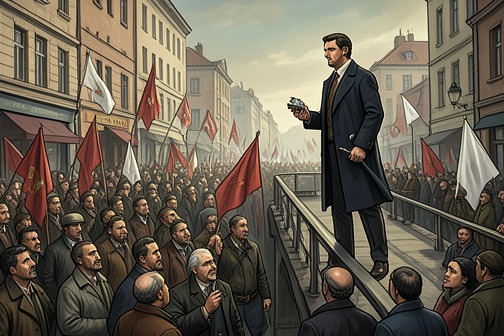
The [1919 Bombing of the Avanti! Victory Procession](entity:event-recall-event-1919-09a595e00270) was a political attack in [Milan](entity:location-recall-location-617379caf4c2) in which [Albino Volpi](entity:character-recall-character-albino-volpi-fcc25af3d38e) threw a [Thévenot grenade](entity:object-recall-object-th-venot-grenade-2511d2c96385) at socialist marchers celebrating an electoral victory. The explosion scattered the procession and turned a public demonstration into a test of the armed networks operating around the fascist movement. The subsequent police raids uncovered weapons at the [Arditi](entity:organization-recall-organization-ce1ea9816d56) Association and fascist headquarters, and [Benito Mussolini](entity:character-recall-character-benito-mussolini-0330d40d2c3f) was held briefly at [San Vittore Prison](entity:location-recall-location-3d0189e2f7a9) before being released the next day.
## Setting and Approach
The march was passing along [Via San Damiano](entity:location-recall-location-1b391e490dc0) toward [Avanti!](entity:object-recall-object-avanti-1bed44223b67) headquarters, where a rally was to take place. Thousands of people, including men, women, and children, moved through the streets with flags and songs. Volpi watched from the [Bridge of the Sirenette](entity:location-recall-location-63e83165ef9d), apart from the crowd. He carried two Thévenot grenades and a dagger; the narrative describes him as having reached the bridge by crossing the wall of Palazzo Visconti and passing through its garden, a route that took about five minutes and avoided notice from the Arditi headquarters on Via Cerva.
The account places the attack within the stark political divide surrounding the procession. Volpi saw the socialist marchers as a disorderly mass and their internationalist song as alien to [Italy](entity:location-recall-location-italy-85c2492cd54b). This is his hostile perspective, not a neutral description of the demonstrators: the procession itself is also presented as a crowd of workers and families gathered to celebrate and to express hopes for a better life. The contrast between the marchers’ collective, festive movement and the lone armed observer on the bridge gives the attack its immediate tension.
## The Attack
Volpi removed the safety pin from one grenade and threw it toward the procession. The device followed an arc into the crowd and exploded; the singing stopped, people screamed, and the marchers scattered. The narrative emphasizes the sudden change from public celebration to panic, while offering no reliable count of those killed or injured. Volpi had a second grenade, but the supplied account does not establish that he threw it.
A contemporary report published in Corriere della Sera on November 18 described an unknown assailant throwing an object from the cast-iron bridge toward the front of the procession. It said the object exploded on impact and fragments struck demonstrators at a distance of twenty or thirty yards. In the ensuing panic, some people tried to help the injured while others pursued the attacker, who disappeared into the darkness. The newspaper characterized the act as that of a fanatic and identified the weapon as apparently a Thévenot grenade. Read beside the narrative’s identification of Volpi, the report preserves the uncertainty faced by witnesses and authorities immediately after the attack.
## Raids and Arrests
On November 18, police acted on the direction of Prefect Pesce, following a telegram from Prime Minister [Francesco Saverio Nitti](entity:character-recall-character-francesco-saverio-n-f3bc92931cc1) that called for anyone keeping hand grenades to be treated as a criminal. The first raid targeted the Arditi Association headquarters on Via Cerva. Officers seized SIPE grenades, Thévenot grenades, pistols, daggers, maces, and ammunition boxes. Captain [Ferruccio Vecchi](entity:character-recall-character-ferruccio-vecchi-f1af03cf1a88), Piero Bolzon, and Edmondo Mazzucato were arrested. Volpi and other veterans suspected of involvement escaped capture by fleeing across rooftops.
Later that day, police searched the fascist headquarters at Via Silvio Pellico 16. A socialist delegation—[Claudio Treves](entity:character-recall-character-claudio-treves-0854cd58f6fd), [Filippo Turati](entity:character-recall-character-filippo-turati-ab4f1019d6ae), [Giacinto Menotti Serrati](entity:character-recall-character-giacinto-menotti-se-21bcf4177c8d), and Milan’s mayor, [Emilio Caldara](entity:character-recall-character-emilio-caldara-ffebc1116983)—had gone to the prefecture to demand that the Arditi be excluded from the city and the [Fasci di Combattimento](entity:organization-recall-organization-fasci-di-combatt-e2d38bb2a0ac) dissolved. At the offices of [Il Popolo d’Italia](entity:object-recall-object-il-popolo-d-italia-b2b48dcea0f3), agents found thirteen new revolvers, 419 cartridges, and a recently used flare gun hidden in a stove. [Umberto Pasella](entity:character-recall-character-umberto-pasella-707fdbe7ec87), Enzo Ferrari, and [Filippo Tommaso Marinetti](entity:character-recall-character-filippo-tommaso-mar-3aac8d8bc631) were arrested on accusations of threatening state security and organizing armed gangs.
Mussolini was taken to San Vittore Prison and placed in cell 40. He remained there for only twenty-four hours. On November 19, after interrogation, he was released following a telephone call from [Luigi Albertini](entity:character-recall-character-luigi-albertini-a87aea485d6b) to Nitti. Albertini, a senator and the owner and editor of Corriere della Sera, argued that freeing Mussolini would avoid making him a martyr. The brief detention therefore ended not with an extended prosecution in the supplied account, but with intervention by a prominent newspaper proprietor who believed fascism had already been weakened by its electoral defeat.
## Political Significance
The episode exposed the proximity of political demonstration and armed action in postwar Milan. The attack was carried out by one man, but the ensuing searches revealed weapons and organizational links at more than one headquarters. The scale of the march and the relative smallness of the attacker did not make the violence politically marginal: a single grenade could interrupt a mass procession, while the state’s response brought fascist offices, Arditi networks, and senior figures into the same investigation.
The events also reveal an unresolved tension in the state’s treatment of these organizations. Police seized weapons and arrested prominent fascists, and socialist representatives demanded that the armed groups be banned. Yet Mussolini’s release followed within a day after Albertini appealed directly to the prime minister. The bombing thus stands both as an assault on a socialist procession and as an early demonstration of how armed political organization, public order, and elite intervention could converge without producing a decisive break between fascism and the institutions of the state.
Event 34
Battle of Warsaw (1920)
The [Battle of Warsaw (1920)](entity:event-recall-event-battle-of-warsaw-1920-60a4c6486bc0) is presented as an unexpected defeat for the [Red Army](entity:organization-recall-organization-073952387f8f) at the gates of Warsaw, interrupting a narrative of communist expansion and sharpening the book’s account of political tension in [Ferrara](entity:location-recall-location-970ebca292e4). The battle is not described through troop movements or combat; its significance lies in the abrupt reversal and in the events with which the narrative places it alongside.
## Background and Expectations
The reference comes amid an account of rising revolutionary confidence. Russian forces are described as having conquered Kazakhstan, overthrown the Emirate of Bukhara, and advanced toward Samarkand. Against that account of momentum, the Red Army’s defeat near Warsaw arrives as a surprise rather than as the expected continuation of its advance.
## The Defeat and Its Timing
The book gives only the essential fact of the event: at the gates of Warsaw, the Red Army is defeated. It supplies no further account of the battle’s course, participants beyond the Red Army, or immediate military consequences. The event’s place in the chronology is conveyed through its proximity to the September discussion of communist activity in Asia, rather than through a specific battle date.
## Relation to the Ferrara Narrative
The defeat is placed alongside a sudden hailstorm in the fields around Ferrara, which reduced the beet harvest by a third compared with the previous year. The book also notes that hemp prices had been falling sharply since July. These developments are presented as concurrent pressures, not as consequences of the battle: the distant military reversal and local agricultural setbacks meet in the narrative at a moment when Ferrara’s political future is portrayed as uncertain. The pairing gives the battle a wider narrative function, marking a limit to revolutionary advance just as economic conditions in the [Po Valley](entity:location-recall-location-po-valley-77b96c5b60d4) are changing.
Event 35
1920 Ferrara Local Elections
The [1920 Ferrara Local Elections](entity:event-recall-event-1920-5676f92fdde7) took place amid intense Socialist organization in the province and revealed how little electoral support the anti-revolutionary parties had won by November. Their result became a striking measure of the gap between the ballot box and the expanding power of Fascist mobilization: only a month later, 14,000 people attended the funeral of three Fascists killed in a clash with Socialists.
## Background: Socialist strength in the province
The local vote followed a year in which the Socialist Party had demonstrated formidable support in [Ferrara](entity:location-recall-location-970ebca292e4). In the parliamentary election of November [1919](entity:time-recall-time-1919-329d1bdc3600), it received 43,000 votes in the province—three out of every four votes cast. Rural organization reinforced that electoral strength: Socialist leagues, unions, cooperatives, and local political groups were influential across the countryside.
The conflict was also rooted in disputes over work and control of the land. In [1920](entity:time-recall-time-1920-510f1fd63aa4), seasonal farmworkers and sharecroppers had pressed landowners to renew the collective farm agreement. The resulting settlement included wage increases, worker-managed hiring centers, and a required labor quota for landowners during the months when farm work was scarce. As the leagues extended their influence over hiring and other parts of rural economic life, the struggle reached beyond wages to the authority of landowners and the organization of the province.
## The November result
At the local administrative elections in November 1920, the bloc of anti-revolutionary parties received fewer than 7,000 votes across the province. Against the Socialist Party’s 43,000 votes in 1919, the figure records the weakness of the anti-revolutionary electoral camp. The two totals belong to different elections, but the book sets them beside one another to show the scale of the Socialist lead and the difficulty of turning opposition to Socialist influence into votes.
That weakness did not mean the political conflict had been settled at the polls. Electoral support measured one kind of power; the capacity to mobilize, intimidate, and occupy public space was increasingly another. In Ferrara, the contrast would become visible within weeks.
## A different measure of power
On December 22, about a month after the local elections, 14,000 people attended the funeral of three Fascists killed in clashes with Socialists in front of [Estense Castle](entity:location-recall-location-estense-castle-734f5be46bf6). The book presents the turnout as evidence that the balance of power was being reversed and that authority now had to be demonstrated day by day. The crowd did not erase the anti-revolutionary bloc’s poor showing at the ballot box; it showed that the electoral result could not, by itself, describe the movement’s growing street presence.
The clash was attributed to [Fascist squads](entity:organization-recall-organization-fascist-squads-02305958dd0b) from [Bologna](entity:location-recall-location-bologna-e9b2b10db055) led by [Leandro Arpinati](entity:character-recall-character-leandro-arpinati-504d6ebd7829). The discovery of grenades brought to Estense Castle by Socialists preparing to defend themselves helped the attackers shift public responsibility for the fighting. The government removed Ferrara’s prefect, and a reward of 20,000 lire was offered for information about those described in the bourgeois and Fascist press as the perpetrators of a premeditated massacre. Socialist leaders faced insults and threats, the local Socialist daily stopped publishing, and the death of a Socialist nurse in the clashes was attributed to the Popular Party.
## Significance
The elections mark a moment when electoral evidence and political momentum pointed in different directions. In 1919, the Socialist Party had dominated the vote; in November 1920, its anti-revolutionary opponents remained electorally weak. But the funeral crowd and the ensuing pressure on Socialist institutions showed how public mobilization and political violence could alter the practical balance without a corresponding electoral victory. Ferrara’s local vote therefore sits within a wider contest over who could organize the countryside, command the streets, and define responsibility for violence.
Event 36
March on Fiume
The [March on Fiume](entity:event-recall-event-eb3adc96d2fe) was [Gabriele D’Annunzio](entity:character-recall-character-gabriele-d-annunzio-6e66d28027db)’s seizure of the city with his legionnaires in [1919](entity:time-recall-time-1919-329d1bdc3600). In the book’s account, it became more than a territorial fait accompli: D’Annunzio cast [Fiume](entity:location-recall-location-fiume-c271af61753f) as a living alternative to the exhausted diplomacy of the postwar settlement, while its eventual isolation and demobilization exposed the gap between revolutionary performance and the support needed to sustain it.
## Postwar setting and the meaning of Fiume
The seizure unfolded amid the return of millions of soldiers to a country still shaped by war. The narrator depicts Europe as a stage emptied of its old political actors, with five million Italian veterans pressing back across the borders and the prospect of further conflict still present. That atmosphere helps explain why Fiume could be imagined not simply as a disputed possession but as a place where the postwar order might be remade.
D’Annunzio gave that claim a dramatic contrast. Speaking to his legionnaires on the first day of [1920](entity:time-recall-time-1920-510f1fd63aa4), he presented 1919 as the year of Fiume rather than the year of the Versailles negotiations. In his account, Versailles stood for a faltering Europe of suspicion and bargaining; Fiume, by contrast, signified youth, life, heroic action, and a future carried forward by the dead and the unborn. The march’s political force thus rested partly on its ability to turn a territorial occupation into a story of national renewal.
That story did not represent a settled consensus in the city itself. D’Annunzio chose to remain in Fiume against the wishes of the Fiumani, and the narrator punctures the grandeur of his rhetoric by observing that Italians did not follow him as he expected. Fiume could be proclaimed a freer and more vital place, yet its leader’s hold on it depended on choices that were increasingly difficult to reconcile with the people he claimed to embody.
## Attempts to widen the revolt
The possibility of extending the Fiume enterprise into a wider uprising came into view during discussions with [Alceste De Ambris](entity:character-recall-character-alceste-de-ambris-b9a9bd610e1b). De Ambris argued that rebellion remained possible and outlined a route from Fiume toward [Rome](entity:location-recall-location-f3877a21016f): naval vessels could carry troops to [Zadar](entity:location-recall-location-3669e0decfc0) and onward to Ancona, where a regiment had rebelled the previous July. He proposed making arrangements with fascists in the Marches and relied on the continuing friendship of Captain Giulietti’s seamen. These were plans, not actions shown as completed in the account.
[Benito Mussolini](entity:character-recall-character-benito-mussolini-0330d40d2c3f) rejected the premise that such a revolt could succeed. He pointed to the strength of the northern socialist movement and to the fighting in [Bologna](entity:location-recall-location-bologna-e9b2b10db055), insisting that the political situation there made a march on Rome untenable. The exchange revealed a strategic divide: De Ambris treated Fiume as a potential starting point for a popular revolution, while Mussolini was concentrating on the balance of power within [Italy](entity:location-recall-location-italy-85c2492cd54b) and refused to commit the [Milan](entity:location-recall-location-617379caf4c2) fascists to D’Annunzio’s cause.
Mussolini’s distance was also expressed through policy. Through prefect Lusignoli, he conveyed to [Giovanni Giolitti](entity:character-recall-character-giovanni-giolitti-24b78735ff0a) that the government had a clear path to repress the Fiume legionnaires if necessary, while the fascists of Milan would not intervene. In this account, the movement’s later political calculations outweighed solidarity with the occupation. D’Annunzio’s spectacle could command attention without securing the support of the forces that might have helped it spread.
## Isolation and demobilization
The occupation’s diminishing prospects were reflected in a long list of departures. Maffeo Pantaleoni urged D’Annunzio to desist; Admiral Millo reaffirmed his loyalty to the king and broke with him; and General Ceccherini and Colonel Siani left, objecting to the legionnaires’ lack of discipline. D’Annunzio refused to surrender absolute power, describing its retention as the one pleasure left amid his boredom. The episode exposes the tension between the occupation’s language of collective liberation and the concentration of authority in its commander.
The confrontation ended under pressure rather than in the triumphant expansion De Ambris had imagined. During the final week of fighting, bombing continued in Fiume, killing one civilian and wounding several others. On December 28, General Ferrario refused to negotiate terms for the legionnaires’ surrender and threatened heavier bombardment; citizen representatives urged D’Annunzio to yield. He handed the powers conferred on him in September to the mayor and the people of Fiume. The narrator adds a telling qualification: through the week of fighting, D’Annunzio had hardly left his study and had not joined his legionnaires on the firing line.
On December 31, an agreement was signed at Abbazia for the legionnaires’ total demobilization from the city. The ending reversed the image of Fiume as a launch point for a new political future: its armed force was to be dismantled, and the city’s immediate fate no longer rested with D’Annunzio’s command. Yet the event’s symbolic life outlasted the occupation. In the book’s telling, Fiume remained a stage on which war, sacrifice, national renewal, and political authority could be made to appear as one—and on which the limits of that performance became visible when its promised allies failed to arrive.
Event 37
Bologna Massacre of 1920
The [Bologna Massacre of 1920](entity:event-recall-event-1920-fb11fdd95e26) erupted on November 21 during the inauguration of [Bologna](entity:location-recall-location-bologna-e9b2b10db055)’s newly elected socialist municipal council at [Palazzo d’Accursio](entity:location-recall-location-palazzo-d-accursio-7ffb825d39f4). A ceremony meant to mark the transfer of civic authority became a lethal confrontation among socialists, fascists, security forces, and armed men inside the council building. Ten people died and fifty were wounded. The episode ended the elected council’s tenure and exposed how political violence could overwhelm the institutions meant to contain it.
## A ceremony under armed watch
The confrontation had been anticipated. On November 18, socialist deputy Niccolai denounced the spread of fascist violence in Parliament, while the press debated whether public opinion welcomed a reaction to socialist conduct. Rumors circulated that socialists had stored bombs at Palazzo d’Accursio for the council’s inauguration. Bologna’s prefect and police chief knew a single incident might set off a clash. Police chief Poli even went to the fascist headquarters to negotiate terms: the fascists would not attack provided the great bell was not rung and the red flag was not displayed until the newly elected mayor appeared to thank voters.
The authorities assembled a substantial force. After requesting 1,200 additional troops and 800 [Carabinieri](entity:organization-recall-organization-carabinieri-28c84a9cf0f4) to reinforce 400 royal guards already available, officials saw 900 infantrymen, 200 cavalry, 800 Carabinieri, and 600 royal guards converge on the historic center on November 21. The piazza was closed at its entrances and secured by a cordon. The measures presented the inauguration as a public-order operation, but the sheer scale of the deployment also registered the expectation of violence.
Palazzo d’Accursio, a crenellated seat of civic power overlooking [Piazza Maggiore](entity:location-recall-location-piazza-maggiore-7ea36766d5f7) beside the basilica of San Petronio, became the day’s focal point. Around 2 p.m., a couple of thousand socialist delegates entered the piazza, within the number agreed with police. A small group of fascists was already there, near the Restaurant Grande Italia, while royal guards watched the palace entrance and armed socialist guards appeared on its balconies. The scene held the opposing groups within sight of one another, divided by a police cordon and the terms of a fragile agreement.
## The confrontation begins
At about 2:30 p.m., a red flag appeared on the Torre degli Asinelli, contrary to the agreed conditions. [Leandro Arpinati](entity:character-recall-character-leandro-arpinati-504d6ebd7829) led fascists from their headquarters toward the piazza; a small number entered through an opening made for cavalry and sang their anthems at the edge of the socialist crowd. The council session began at 3 p.m. Its new mayor, Enio Gnudi, a railway worker and communist, delivered his inaugural address without incident and paid tribute to the [Russian Revolution](entity:event-recall-event-russian-revolution-6444f80ee8e1).
About half an hour later, Gnudi leaned from the balcony of the Red Room to greet the assembled crowd. Red flags surrounded him. He released doves from a cage, and they circled above socialists and fascists alike, their tails marked with small red flags. The scene briefly offered an image of civic celebration across the divided crowd. Then a shot came from the Restaurant Grande Italia.
That shot set off a breakdown of the cordon. Twenty-six fascists from [Ferrara](entity:location-recall-location-970ebca292e4) pushed through with clubs. Gunfire came from the Restaurant Grande Italia, was returned from the palace balconies, and was also fired from the Neptune fountain. The crowd scattered, many rushing into the palace courtyard. The planned security arrangements had failed to keep the confrontation outside the building; people gathered there for shelter instead found themselves at the center of the crisis.
## A fatal mistake inside the palace
From the balconies, the armed socialist guards saw their comrades moving into the courtyard and mistook them for fascists attacking the building. They threw five grenades. Their mistaken identification turned the courtyard into a place of death for people on their own side. Meanwhile, councilors inside the chamber heard the detonations and saw fallen people through the windows, without understanding how the violence had unfolded. Socialist councilors accused the minority councilors of killing their comrades. Nationalist attorney Aldo Oviglio responded by putting his revolver on the table and denying that he was killing anyone.
The chamber, already crowded with members of the public, local police, armed guards, and officials, became another site of violence. An unidentified socialist militant stood up, aimed at the unarmed men he believed responsible for the deaths outside, and fired. [Giulio Giordani](entity:character-recall-character-e2d7223eae58), a nationalist councilor and former soldier who had received a silver medal and lost a leg, was killed instantly. In life he had not been a fascist; after his death, he became one in the political account of the massacre. Attorney Biagi was slightly wounded, while attorney Cesare Colliva, bleeding, made his way toward the exit. The identity of the militant who fired was never established by police or disclosed by party leaders.
## Political consequences and the meaning of the episode
Accounts also placed Arpinati at the scene, but they conflicted: some said he incited the fascists to attack near the Neptune statue; others said he entered the courtyard with a gun. The narrative distinguishes these rumors from the toll it reports as certain: ten dead and fifty wounded. This uncertainty about individual responsibility did not undo the consequences. The violence destroyed the credibility of the socialist military organization and damaged the party’s reputation. Arrests and scandal overcame the democratically elected municipal council, whose members resigned en masse. A commissioner appointed by the prefect took over the city government.
The massacre’s political reversal was stark: the ceremony of an elected council ended with that council removed from office, while the armed confrontation supplied competing sides with material for accusation and blame. The deaths in the courtyard were caused in part by socialist guards mistaking their own comrades for attackers; the killing of Giordani followed a different, retaliatory misjudgment inside the chamber. The day therefore cannot be reduced to a single encounter between two clearly separated camps. The narrative’s emphasis on mistaken identity, conflicting reports, and the collapse of civic authority shows violence spreading through a crowd in which even the people seeking safety could be treated as enemies.
The event also belongs to a wider postwar landscape in which former soldiers and revolutionary crowds were imagined as rival forces pressing upon a weakened political order. Earlier clashes in [Milan](entity:location-recall-location-617379caf4c2) had already shown how demonstrations could turn into armed encounters. In Bologna, that danger reached the municipal seat itself. When the elected council fell and a prefect-appointed commissioner replaced it, the massacre marked the beginning of a new political season: not simply because the streets had become a battlefield, but because the institutions of local democracy had proved unable to survive the violence around them.
Event 38
Ferrara Castle Clashes of 1920
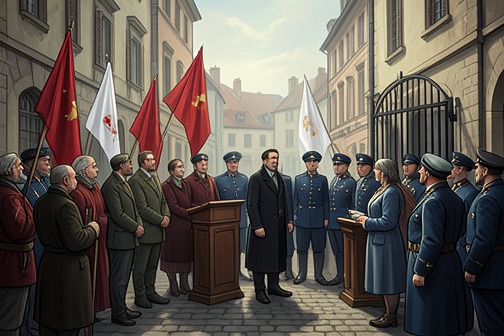
The [Ferrara Castle Clashes of 1920](entity:event-recall-event-1920-ee31f3527202) unfolded amid a fierce contest over political authority in [Ferrara](entity:location-recall-location-970ebca292e4), where socialist organizations had built substantial influence in both town and countryside. The clash left three Fascists dead and also claimed the life of a socialist militant nurse. Its aftermath did more than assign blame: through official action, public messaging, and funeral ceremony, the deaths became resources in a struggle to reverse the province’s balance of power.
## Background: A province under pressure
By [1920](entity:time-recall-time-1920-510f1fd63aa4), Ferrara’s rural economy was deeply shaped by socialist leagues. Farmhands, tenants, and sharecroppers organized through unions and cooperatives, while league-controlled labor placement and working rules constrained landowners’ control over hiring and cultivation. Many seasonal workers could find only about 120 days of employment a year, making wages and access to work matters of survival. The leagues’ authority extended into the economic life of the province, and breaches of their rules could bring social exclusion or penalties.
Political strength was visible at the ballot box as well as in the countryside. The Socialist Party had won 43,000 votes in Ferrara in the November [1919](entity:time-recall-time-1919-329d1bdc3600) parliamentary election, while anti-revolutionary parties received fewer than 7,000 votes in the November 1920 local elections. In the city, competing labor chambers and a radicalizing political climate placed additional pressure on employers and the middle classes. Fascist organization, meanwhile, was neither settled nor entirely united: on December 17, Olao Gaggioli resigned as secretary of Ferrara’s fascio, protesting Mussolini’s break with [Gabriele D’Annunzio](entity:character-recall-character-gabriele-d-annunzio-6e66d28027db) and the influence of agrarian interests.
## The clash at [Estense Castle](entity:location-recall-location-estense-castle-734f5be46bf6)
Violence broke out alongside a rally convened by Ferrara’s socialist mayor. A procession of nurses carrying red flags was moving toward the rally when shots were fired toward a counter-demonstration led by about fifty Bolognese Fascists under [Leandro Arpinati](entity:character-recall-character-leandro-arpinati-504d6ebd7829). The account does not establish who fired first. It reports that shots may also have come from the battlements of Estense Castle, where police later recovered grenades, and that at least three Fascists were left dead. The episode thus began amid immediate uncertainty over the sequence of fire and the responsibility for the confrontation.
The discovery of grenades at the castle became central to the public account of the violence. The narrative identifies the Bolognese [Fascist squads](entity:organization-recall-organization-fascist-squads-02305958dd0b)’ aggression as the cause of the clash, but notes that the grenades—brought there by socialists preparing to defend themselves—gave the attackers an opening to shift responsibility. The evidence therefore distinguishes between the course of events as described and the explanation promoted afterward: possession of weapons at the socialist stronghold helped recast the confrontation as a premeditated assault on the Fascists.
## Blame, repression, and unequal mourning
The government in [Rome](entity:location-recall-location-f3877a21016f) removed Ferrara’s prefect, making him the scapegoat for the crisis, and offered a reward of 20,000 lire for information identifying the alleged killers. Socialist leaders, including the mayor and figures associated with the Chamber of Labor, faced insults and threats in public. The local socialist newspaper La scintilla suspended publication, while the death of Giovanni Mirella, a socialist militant nurse killed in the clashes, was even attributed to the Popular Party. These outcomes marked a retreat for the local proletarian front as well as a contest over whose losses would be publicly recognized.
The three Fascist dead were Natalino Magnani, a nineteen-year-old member of the [Bologna](entity:location-recall-location-bologna-e9b2b10db055) fascio; Giorgio Pagnoni, a farmworker from Gaibana; and Franco Gozzi, a Bersaglieri lieutenant on leave and an early Fascist organizer in the province. Their deaths were presented as sacrifices for liberty. At their funeral, speakers emphasized the small number of local Fascist circles Gozzi had managed to establish and contrasted the few Fascists’ exposure to danger with the province’s 192 reported barn fires attributed to the Reds during 1920. The ceremony did not offer equal public remembrance to the socialist dead: the narrative records instead how the Fascist dead were honored while Mirella’s death was displaced in the political account.
## Funeral as political mobilization
The funeral’s solemn forms—speeches and religious observances—made mourning into a public claim. The dead were not treated as figures whose political meaning ended with burial; they were invoked to vindicate the living and sustain Fascist commitment. That ritual gave the dead a continuing place in the movement’s present and helped present a small local force as courageous, embattled, and entitled to political authority.
The reversal in Ferrara’s political balance was visible within a month. Although three out of four voters in the province had supported the Socialist Party in the 1919 election, 14,000 people attended the December 22 funeral of the three Fascists killed in the clashes. The scale of attendance was treated as evidence that power had to be confirmed publicly and repeatedly. In January 1921, Ferrara Fascists organized a punitive expedition against rural leagues with armed groups, simultaneous targets, and trucks supplied by the Agrarian Association. The later operation was distinct from the December clash, but it shows how quickly the conflict moved toward organized rural violence. The castle confrontation and its funeral thus belong to a broader transformation in which deaths, disputed blame, and public ceremony helped turn political weakness into a claim for forceful control.
Event 39
Bloody Christmas Fighting in Fiume
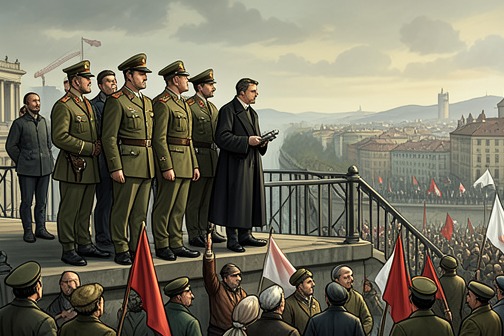
The [Bloody Christmas Fighting in Fiume](entity:event-recall-event-45d24df94699) was the armed confrontation that ended [Gabriele D’Annunzio](entity:character-recall-character-gabriele-d-annunzio-6e66d28027db)’s attempt to hold the city against the Italian government and the settlement imposed by the Treaty of Rapallo. It began with ultimatums and a blockade, became a fight between Italian forces on both sides, and concluded with D’Annunzio relinquishing his authority and the legionnaires agreeing to leave. Its bitter contrast was between the language of national brotherhood and a conflict in which the state used force against men who claimed to be defending [Italy](entity:location-recall-location-italy-85c2492cd54b)’s honor.
## Ultimatums and a narrowing choice
In early December [1920](entity:time-recall-time-1920-510f1fd63aa4), General [Enrico Caviglia](entity:character-recall-character-628cc8021756), commanding the contingent sent from [Rome](entity:location-recall-location-f3877a21016f) to enforce the Treaty of Rapallo, ordered D’Annunzio to evacuate the towns of Veglia and Arbe, which his forces had occupied in defiance of the treaty. On December 20, Caviglia issued a further ultimatum: within forty-eight hours, the legionnaires were to return inside the borders of the [Fiume](entity:location-recall-location-fiume-c271af61753f) territory recognized by the treaty. At the same time, the government imposed a blockade by land and sea. The pressure made the dispute immediate: D’Annunzio could accept the limits established by the agreement or resist the state’s effort to enforce them.
D’Annunzio answered with three proclamations in twenty-four hours. In appeals to sailors and soldiers, he urged resistance and invoked the bond between Italians, even as he warned of the possibility of death. The language made the crisis a test of loyalty: the troops ordered to besiege Fiume were being addressed as brothers by the people they had been sent to confront. In [Milan](entity:location-recall-location-617379caf4c2), [Benito Mussolini](entity:character-recall-character-benito-mussolini-0330d40d2c3f) publicly opposed the blockade and argued that the Fiume Regency should be recognized, presenting recognition as a way to end the dispute without annexation. Yet at a secret meeting of the fasci central committee on December 24, he described Fiume as a secondary issue and said that the movement’s future lay in domestic rather than foreign policy. His position exposed the difference between public solidarity with D’Annunzio and the priorities of an organization trying to establish its political direction.
## The attack and the defense
Italian regular troops began their attack at five o’clock on the afternoon of December 24, after the committee meeting in Milan had ended. In Fiume, news of the offensive reached the command room around six. D’Annunzio did not immediately issue an order to fire; it took Major Vagliasindi, a legionnaire inspector, about an hour to obtain one. By then, the first legionnaire garrisons near Cantrida had been surrounded and captured by troops of the [Italian Royal Army](entity:organization-recall-organization-italian-royal-ar-5cf2d5426183). The delay placed the Commander’s earlier declarations of readiness to die beside the practical difficulty of directing the defense once the attack arrived.
The first assault was rapid, but it did not settle the battle. Legionnaires had been ordered not to engage and fell back toward the last defensive line around the city. Appeals to the advancing troops to stop short and avoid a grave disaster were ignored. After D’Annunzio’s order came, the defenders reinforced breaches in the line and counterattacked. By nightfall on December 24, they had re-established the line around Fiume. On [Christmas](entity:time-recall-time-christmas-a573265d0167) Day, Caviglia held the attack in a truce until dawn on December 26, while the army commander, General Ferrario, had ordered that artillery be used more heavily when operations resumed.
At 6:50 a.m. on December 26, regular troops attacked again, concentrating on the central sector. The assault failed; the legionnaires held their positions, counterattacked, captured a cannon, and took prisoners. By midday, the prospect of entering the city had become a question of whether doing so would require a massacre. Caviglia then ordered Admiral Simonetti, commanding the battleship Andrea Doria off the port, to fire on military targets in the city.
## Bombardment, surrender, and demobilization
After drafting a proclamation, D’Annunzio appeared withdrawn again and went out onto the balcony of the command building. The ship’s gunner could see him through a telescope from about 800 yards offshore. Shortly after D’Annunzio returned inside, two shells struck the building’s facade; one hit near the study window. The blast injured him slightly and led officers to carry him out of the room. The attack ended any remaining expectation that the confrontation could be settled without force reaching the city itself.
D’Annunzio’s response turned from apparent detachment to anger. He ordered an attack on the battleship Dante Alighieri, which was in Fiume’s port, but that order was not carried out. Rumors spread that he had been killed; he was alive, and issued a proclamation rejecting the idea that he would continue offering his life for a country that had not risen in Fiume’s defense. The episode brought his public pose of sacrifice into conflict with a more immediate question: whether continued resistance would expose the city and its inhabitants to still greater danger.
Bombardment continued over the following forty-eight hours, though it was not heavy. One civilian was killed and several were wounded. On the morning of December 28, Ferrario refused to negotiate surrender terms and threatened to intensify the bombing. Fiume’s citizen representatives appealed to D’Annunzio to give up his powers. He did so, transferring the authority granted to him on September 12 to the mayor and the people of Fiume. During the week of fighting, he had rarely left his study and had not joined the legionnaires on the firing line. The Commander who had repeatedly invoked heroic death ended the confrontation by acknowledging that he could not impose ruin and death on the city.
At 4:30 p.m. on December 31, an agreement was signed in Abbazia providing for the legionnaires’ total demobilization from Fiume. The fighting had not produced the national uprising D’Annunzio had sought: appeals to Italian solidarity did not prevent Italian troops from attacking, and support elsewhere was limited. The episode thus marked both the end of his armed defiance and the limits of its political reach.
## The meaning of a failed spectacle
The conflict closed a year that D’Annunzio had described to his legionnaires as one of passion, associating Fiume with youth, life, and a future carried forward by the dead and the unborn. That rhetoric made the city an emblem of renewal against what he portrayed as the weakness and compromise of postwar Europe. The outcome was more constrained: a blockade, military attack, civilian casualties, surrender of authority, and demobilization. The distance between the promise of a new beginning and the actual end of the regime is central to the event’s significance.
The book also places Fiume’s defeat against the broader political use of mass ritual and national symbols. The Unknown Soldier’s burial in November 1921 would turn an unidentified fallen soldier into a public focus for collective mourning, while fascist leaders gathered at the tomb in a scene presented as political religion. That later ceremony does not undo the Christmas fighting; it sharpens the contrast between honoring the dead through national ritual and the earlier failure to prevent Italians from fighting one another. At Fiume, the language of brotherhood could not reconcile D’Annunzio’s claim to represent Italy with the authority of the Italian state.
Event 40
Livorno Split
The [Livorno Split](entity:event-recall-event-8c61aace2251) was the January 1921 rupture of the Italian Socialist Party, when its communist faction left the party congress and founded the [Italian Communist Party](entity:organization-recall-organization-italian-communis-c2efde5e0e86). The division made a dispute over revolutionary strategy into an organizational break: [Moscow](entity:location-recall-location-19aceb5ce281) demanded the expulsion of reformists, while the majority refused. The congress unfolded amid a growing political emergency, but its delegates spent two days debating party unity and doctrine even as fascist squads were attacking socialists elsewhere in [Italy](entity:location-recall-location-italy-85c2492cd54b).
## Background and stakes
The congress opened in [Livorno](entity:location-recall-location-livorno-07a8421fe06f) on January 15, 1921, in the [Teatro Goldoni](entity:location-recall-location-teatro-goldoni-95180a19e68b). Interim president Giovanni Bacci began with a remembrance of the [1919](entity:time-recall-time-1919-329d1bdc3600) Spartacist insurrection. Francesco Frola then read an address from the [Communist International](entity:organization-recall-organization-communist-intern-ce17a5248ccd)’s Executive Committee, a severe attack on reformist socialists and on those unwilling to expel them. In the book’s account, that intervention marks the start of the Italian proletariat’s tragedy: the demand for unity was immediately entangled with the conditions imposed for belonging to the international communist movement.
Those conditions had been set out at the Communist International’s previous July congress in 21 theses. To remain in the International, Italian socialists were required to change their party’s name and reject as counterrevolutionaries comrades who believed in socialism but not revolution. The requirement placed [Giacinto Menotti Serrati](entity:character-recall-character-giacinto-menotti-se-21bcf4177c8d)’s maximalist majority in a difficult position. It continued to use revolutionary language, but, after the failed factory occupations, many in that majority no longer believed a revolution was imminent. [Nicola Bombacci](entity:character-recall-character-nicola-bombacci-5ddc3dca87f9) and his supporters, by contrast, remained committed to it.
The party’s strength made the impending division more than a dispute among a small circle of theorists. In the November elections, socialists won majorities in 2,162 municipalities. The party had 156 parliamentarians and 216,000 members organized in 4,300 sections, a structure that had tripled in two years; [Avanti!](entity:object-recall-object-avanti-1bed44223b67) circulated more than 300,000 copies daily. The contrast was stark: outside the congress, the socialist movement remained extensive, while inside the theater, factional discord was already threatening to split it.
## The congress and the walkout
The seating arrangement gave the conflict a visible geography. Delegates of the communist fraction, representing 58,000 electors, occupied the upper left tiers. The centrist delegates, representing 100,000, sat in the orchestra, while the reformists, with 15,000 votes, occupied the right tiers. The arrangement did not settle the question before debate began, but it placed the competing constituencies in view of one another as the congress considered whether the party should meet Moscow’s conditions.
On January 16, Christo Kabakciev, the Bulgarian Communist International delegate, delivered a final warning: the situation was revolutionary, and siding with the reformists would obstruct it. He declared that Moscow would expel those who supported the maximalists’ motion to preserve party unity. Bombacci and the communists applauded. Other delegates answered with sarcastic cries rejecting the authority of outside emissaries. The exchange exposed the essential dilemma. For the communists, refusing Moscow’s demand risked abandoning the revolution; for their opponents, accepting it meant allowing an international directive to dictate whom the Italian party could retain.
The break came when [Amadeo Bordiga](entity:character-recall-character-amadeo-bordiga-a25c42cf0ef7) went to the rostrum and instructed the communist delegates to leave. They walked out singing the Internationale and assembled at the [Teatro San Marco](entity:location-recall-location-teatro-san-marco-72ae35db6322), a few hundred yards away, where they founded the Italian Communist Party. The setting made the new party’s beginning markedly different from the formal congress they had left. The theater had uneven flooring, no seats or benches, tattered curtains, and a roof torn open to the rain. After certifying their party cards with the hammer and sickle, the founders remained standing for hours beneath the leaking roof.
## [Ferrara](entity:location-recall-location-970ebca292e4) and the competing emergencies
The congress’s argument over revolutionary unity took place alongside a different, immediate conflict. [Giacomo Matteotti](entity:character-recall-character-giacomo-matteotti-b1b8c0b072bc) left Livorno before daybreak on a regional train to [Florence](entity:location-recall-location-706cb92b9779), continuing by local and regional trains through [Bologna](entity:location-recall-location-bologna-e9b2b10db055) to Ferrara. He had to forgo speaking at the congress because he was going to assume leadership of Ferrara’s Chamber of Labor. Its secretary and the mayor had been arrested following the December 20 incidents. His journey turned the congress’s abstract debate over political strategy into a contrast with the practical demands facing socialists outside the hall.
Matteotti arrived in Ferrara at noon and was taken to a planning meeting. Within an hour, disturbances and a crowd of demonstrators had gathered. He refused the protection of a car and walked toward the Chamber of Labor with a police patrol around him. The account describes him being attacked on the way and a fascist club striking him through the cordon. The following day, socialist baker Ettore Borghetti was killed by a gunshot as he left a meeting at the Chamber. Meanwhile, Matteotti asked the prefect to remove his police guard, insisting that his club-bearing comrades could protect him. The episode underscores what the congress’s speeches largely did not address: fascist action was already shaping the conditions in which socialists had to organize.
## Aftermath and political significance
The split did not resolve the question of how socialists should resist fascism. By the time Nicola Bombacci went to Moscow with an Italian Communist Party delegation in October, that party itself had divided into two wings. [Angelo Tasca](entity:character-recall-character-18c5eaffab9a) led a minority prepared to meet with socialists if they expelled reformists; Bordiga’s majority opposed a united front. The [Bolsheviks](entity:organization-recall-organization-5133e982d5e0) favored a merger to create a stronger proletarian bloc against fascism, but Bordiga maintained that democracy and fascism were effectively indistinguishable. [Leon Trotsky](entity:character-recall-character-leon-trotsky-571c5d8ac744) emphasized the distinctiveness of Italian fascism, including its mobilization of the petite bourgeoisie against the proletariat, but Bordiga remained unmoved by the distinction.
Bombacci continued to support a united front and opposed the Bordiga faction’s doctrinal refusal to cooperate with socialists. At the [Rome](entity:location-recall-location-f3877a21016f) congress in February, he argued against that political purism. His position brought ostracism and mistrust from his own comrades, followed by his removal from the party’s central committee. He wrote to Grigori Zinoviev to lament what he called his political assassination. The consequence of Livorno was therefore not only the separation of communist and socialist organizations; the argument over whether to preserve unity by compromise continued within the new communist party.
The book later returns to Livorno as the point at which the tragedy of the Italian proletariat began. That judgment rests on the contrast between formidable organizational strength and political fragmentation, and between debate over revolutionary doctrine and violence already unfolding in Ferrara. The congress’s walkout created a new party, but it also left the socialist movement divided at a moment when fascism was expanding its capacity for organized action. The split is presented not as an isolated procedural disagreement, but as a decisive fracture whose consequences persisted in the struggle to form a common response.
Event 41
Florence Events of 1921
The [Florence Events of 1921](entity:event-recall-event-1921-d28bb2cda96d) were a sequence of bomb violence, political murder, worker mobilization, street fighting, and military repression from February 27 to March 1. The immediate causes remained disputed: a bomb exploded beside a procession, but no one identified its thrower. The killing of railway-union secretary [Spartaco Lavagnini](entity:character-recall-character-9795a71b3c58) then helped transform uncertainty and fear into a citywide confrontation. By the end, the army had broken working-class resistance, while [Fascist squads](entity:organization-recall-organization-fascist-squads-02305958dd0b) moved through the city under the protection of state forces.
## The bomb and the murder
The crisis began with a call for an armed Fascist assembly at the headquarters on Via Ottaviani. A bomb had exploded at the corner of [Palazzo Antinori](entity:location-recall-location-palazzo-antinori-0132cf06f56b) during a political procession. Its participants had been attending the inauguration of a student group’s pennant; other people were leaving Mass and heading toward the pastry shops. The explosion killed two people before they reached hospital and left dozens wounded, some gravely. Reports attributed the attack variously to people identified by black republican ties or red carnations, or to anarchists. The identities of those responsible were not established in the account, even as the blast was immediately folded into partisan accusations.
The city’s response intensified the disorder. [Carabinieri](entity:organization-recall-organization-carabinieri-28c84a9cf0f4) fired without a clear target, and a member of the public was shot during the turmoil surrounding the ambulance carrying a fallen colleague. Meanwhile, about a hundred Fascists gathered at Via Ottaviani. Many squads were away conducting raids in nearby towns, leaving the city headquarters with only a portion of the movement’s forces. In the hours that followed, a squad of roughly thirty men marched through the streets carrying revolvers. When it passed a funeral procession, its members halted and gave a military salute; the display of weapons made the passage a demonstration of organized force as much as a march.
Near six in the evening, three members of the squad entered the railway workers’ union building on Via Taddea. They found Lavagnini alone in his office, seated at his desk and working on written drafts. He was the union’s secretary and the editor of Azione comunista, and was regarded as a prominent figure by Tuscan revolutionaries. He was unarmed. The account describes his killing as deliberate and carried out at close range. A later scene at the founding of the Fascist National Party identifies Italo Capanni as the man who killed him, connecting the violence in [Florence](entity:location-recall-location-706cb92b9779) to the movement’s subsequent public political life.
## A city divided and brought to a halt
Lavagnini’s murder split Florence along a social and geographic fault line. During the night, residents barricaded working-class districts and the outskirts on the left bank of the Arno, from San Frediano to Scandicci, fearing an attack. The army occupied the opposite bank, wary of an uprising. Four 65 mm cannons were positioned in Piazza Vittorio, police blocked the bridges, and movement through the city became dangerous. The account presents the division not as a simple separation of neighborhoods but as a confrontation between a population expecting repression and armed authorities preparing to impose control.
The murder also triggered a broad work stoppage. Railwaymen halted trains at Rifredi, Campo di Marte, and San Donnino stations. Tram conductors joined them, followed by electricians and workers in other sectors. Water, gas, electricity, trains, and trams were cut off, and shops closed. The disruption carried the conflict beyond the streets: the city’s ordinary services and commercial life stopped as workers responded to Lavagnini’s death.
Fascists did not emerge from their headquarters until around noon. After lunch they attempted to enter San Frediano, but had to cross by the more distant San Niccolò bridge and return by the steep approaches of the Viale dei Colli. In Piazza Tasso, residents resisted with whatever objects were at hand and shots were fired from windows. The Fascists took cover and could leave only after an armored police vehicle arrived. The failed raid showed that squad strength alone could not overcome the barricaded districts; their access would depend on the intervention of state forces.
## Army intervention and reprisals
After the initial attack failed, the police requested army intervention. The 84th and 69th infantry units, accompanied by Bersaglieri, entered the Oltrarno by the Santa Trinita and Carraia bridges. Armored cars forced barricades, but resistance continued. The troops advanced house by house, while Fascists followed behind the army and police. The distinction between official repression and squad violence therefore blurred in practice: state forces opened the districts, and Fascists used the resulting access to carry out reprisals and attack opponents’ organizations.
The fighting continued into a second night. Crowds waited for news of wounded relatives and friends at Borgo Ognissanti, the Vespucci hospital, and beneath the arcades of Santa Maria Nuova. On the morning of March 1, combat resumed at Ponte a Ema, where women and children had been sent to safety in the hills. Artillery was used to break the defense there. At Santa Croce, fighting lasted five hours. By evening the troops returned to the city in a triumphant procession, singing Mameli’s anthem, displaying red flags taken from the communists and a portrait of Lenin, with mimosa flowers strewn over the cannons and their carriages.
The army’s role went beyond clearing barricades. Fascists devastated the headquarters of opposing associations while police and soldiers served as a shield. The Army Corps supplied them with 120 muskets and three crates of SIPE grenades transported on a 15 Ter truck. At the Chamber of Labor hall on Via Tintori, Fascist squad member Pirro Nenciolini set fire to benches, registers, and red flags. These acts made the outcome institutional as well as military: labor organizations and their records became targets after the resistance had been subdued.
## Significance and aftermath
The events exposed how an unresolved act of political violence could become the pretext and setting for a wider assault. The bomb’s perpetrator remained unknown, but accusations were rapidly attached to supposed enemies; Lavagnini’s killing was followed by the shutdown of services, armed defense of working-class districts, and the entry of troops and squads. The sequence matters because the Fascists’ eventual freedom of action did not arise from an uncontested victory in the streets. They first encountered resistance and then advanced behind the army and police, whose intervention changed the balance of force.
The account’s later identification of Capanni as Lavagnini’s killer sharpens the contrast between violence and political spectacle. At the Fascist National Party’s founding, Capanni appeared in a public moment of reconciliation, lifting [Benito Mussolini](entity:character-recall-character-benito-mussolini-0330d40d2c3f) onto the presidency table. The later ceremony did not erase the Florence killing; it placed its perpetrator inside the movement’s emerging institutional story. Florence thus became both a site of coercive struggle and a point of reference for the political order built through that struggle: the city’s barricades were broken, labor institutions attacked, and the boundary between squad action and state authority left visibly compromised.
Event 42
Empoli Massacre of 1921
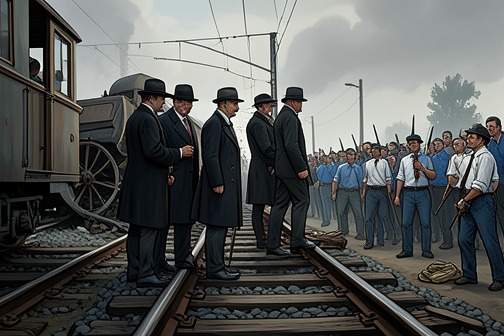
The [Empoli Massacre of 1921](entity:event-recall-event-1921-d63b15247adb) was a violent confrontation in [Tuscany](entity:location-recall-location-5aab1681c149) on March 1, when men sent to restore rail service during a strike were ambushed. Nine people died and dozens were injured. In the book’s account, the episode is more than an isolated clash: it shows how a dispute over transport and the fear of a Fascist incursion could turn into a deadly encounter, then be folded into competing claims about political violence and retaliation.
## Strike and Fear of an Incursion
The immediate setting was a railway strike by Bolshevik railway workers that had halted trains. Navy stokers were sent to [Florence](entity:location-recall-location-706cb92b9779) to run them. The book presents the ambush as driven by the Bolshevik masses’ fear that a punitive Fascist incursion was coming. The confrontation therefore took shape around both a practical attempt to resume rail service and the expectation of further political violence.
That fear belonged to a wider postwar climate of instability. Elsewhere, the narrative describes millions of returning soldiers pressing against the old political order and insists that the years after the war had not brought a settled peace. This background helps place Empoli within a country where strikes, armed mobilization, and fears of revolutionary or Fascist action increasingly met in the same contested public space; it does not, by itself, establish a direct cause for the ambush.
## The Ambush and Its Human Cost
The stokers were attacked in Empoli as they were being sent to keep the trains moving. The account records nine dead and dozens injured. It also describes terrified peasants as attacking the sailors, conveying the panic and severity of the encounter without presenting it as a planned military engagement. The railway strike was not merely a backdrop: it was the condition that brought the stokers into the area and made the attempt to restore service a flashpoint.
The incident’s violence stands in sharp contrast to the ordinary function of the men involved. They had been sent to operate trains, yet became casualties in the struggle over whether rail traffic would resume. That reversal gives the episode its particular force in the narrative: a labor stoppage and a feared punitive expedition converge on people caught between the two.
## Retaliation and Political Meaning
In the surrounding account, [Benito Mussolini](entity:character-recall-character-benito-mussolini-0330d40d2c3f) repeatedly frames violence as a harsh historical necessity rather than an end in itself. He describes retaliation after socialist violence as something that will be delivered forcefully, and presents the making of violence more controlled or “surgical” as a political aim. The Empoli deaths thus appear within a widening cycle in which each side’s actions are used to justify what follows.
The book does not describe a settlement or a discrete political consequence at Empoli. Instead, it stresses how the incident could be absorbed into the argument for further retaliation. Its significance lies in that connection between local catastrophe and national political language: the deaths register the human cost of escalating conflict, while the surrounding rhetoric recasts such violence as an instrument for restoring order.
Event 43
Diana Theatre Bombing
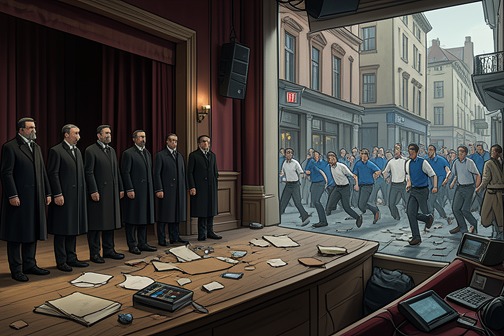
The [Diana Theatre Bombing](entity:event-recall-event-43a1fdd4ecfa) struck [Milan](entity:location-recall-location-617379caf4c2)’s [Kursaal Diana](entity:location-recall-location-kursaal-diana-2357f5e37163) during a performance in late March 1921, killing twenty people and wounding eighty. The blast turned an evening of popular entertainment into a citywide crisis. The ensuing dispute over responsibility and the five-day delay before the funeral gave the tragedy consequences beyond the theatre: fascists used the mourning procession to display discipline and claim public space in a working-class city.
## The explosion at the theatre
The bomb appears to have exploded at the end of the first act, while the mazurka was being performed. The account places it near the performers’ entrance on Via Mascagni. The damage obstructed that street, and the stage and nearby areas were left strewn with debris. Royal Guard patrols cleared a route toward Via Melzo as firefighters worked at the scene and a small unit of Bersaglieri took up a position outside the damaged entrance.
The blast was first registered beyond the theatre itself. At [Margherita Sarfatti](entity:character-recall-character-margherita-sarfatti-689ef8caa983)’s palazzo on Corso Venezia, a porcelain cup trembled and cracked before the roar reached the windows. The street outside initially seemed deserted. Within minutes, crowds were running from Porta Venezia toward the city center. Their movement carried news of the disaster without a clear account of what had happened: people pointed back toward its source, while the night remained strikingly quiet.
The nearby clinic at Porta Venezia filled with dead and seriously injured victims. Other casualties were transported to more distant treatment centers, and residents opened their homes to those needing care. The scene drew relatives, emergency workers, and reporters. The newspaper accounts recorded the destruction and the identities of victims; among the dead was Leontina Rossi, a five-year-old girl. These reports made the scale of the attack visible to the city even as its cause remained contested.
## Blame and political repercussions
The narrative associates the bombing with anarchist militancy, noting that Errico Malatesta, the movement’s historical leader, was imprisoned in Milan and had been on hunger strike in protest. Small bombs had also been exploding in the city. Some survivors claimed that an anarchist had thrown the device toward the stage, but the account dismisses that identification as almost certainly mistaken. It nevertheless reports that investigators identified militant anarchists of the extreme left as responsible. It supplies no detailed reconstruction of the bombing or proof of an individual perpetrator, leaving a distinction between the investigation’s attribution and the unreliable eyewitness claim.
The attack may also have been directed at [Benito Mussolini](entity:character-recall-character-benito-mussolini-0330d40d2c3f). He knew the theatre and had visited the area to meet police chief Giovanni Gasti, who lived in an apartment above the adjoining Hotel Diana Majestic. The account presents Mussolini as a likely intended target, not as a confirmed one. That possibility sharpened the political meaning of the explosion: fascists summoned to the scene quickly turned from the victims to demands for retaliation against their established opponents.
The offices of [Avanti!](entity:object-recall-object-avanti-1bed44223b67), labor-union headquarters, and the anarchist paper Umanità nova were among the proposed targets. In the days that followed, fascists attacked the offices of Avanti! and the anarchist newspaper. The violence therefore extended beyond the theatre, taking the form of reprisals against political institutions associated with the left. The bombing became part of a cycle in which an act attributed to political extremists was answered by fascist attacks, while the victims’ public commemoration became a further arena of conflict.
## A disputed public funeral
The funeral procession took place on Easter Monday, five days after the bombing. The bodies had remained in the morgues while Milan’s authorities and civic groups disputed who should organize the ceremony. The socialist municipal government offered to pay for the funerals, but delegations from citizen associations opposed socialist participation, regarding socialists as supporters of the terrorists. The government eventually intervened through the prefect and called for state funerals. Only the Italian tricolor, draped in mourning, was to be carried.
At the Cimitero Monumentale, fifteen priests blessed the coffins in the Famedio chapel before the procession continued toward the cathedral. Mounted [Carabinieri](entity:organization-recall-organization-carabinieri-28c84a9cf0f4) and the 3rd Savoy cavalry led the cortege. The first coffin to leave the crypt was that of Leontina Rossi, decorated with white ribbons. The ceremony made the children and other victims objects of public mourning, but agreement over its form had required negotiations even after the killing of civilians.
## From mourning to fascist spectacle
Behind the coffins marched a column of two thousand fascists, arranged in platoons and moving at a measured pace. The procession followed recent efforts to drill the squads in closed formation. Their appearance in ordered ranks contrasted with their earlier difficulty maintaining formation on the steps outside their headquarters. Mussolini marched at their head in a black shirt, as the squads passed through Milan under the Italian flag and the observance of the crowd.
The fascists had already retaliated against political opponents, but the funeral gave their presence a different public setting: they appeared not only as perpetrators of reprisals but as an organized body accompanying the dead. The account stresses the novelty of a blackshirt parade in Milan, a working-class city known as red, and treats the respectful reception as a sign of the changing balance of public power. The bombing’s aftermath thus joined grief to political display. A mass funeral that might have been organized by the socialist municipality instead became a state ceremony, while the disciplined fascist column made its own claim to represent order and vengeance.
Event 44
Occupation of Fiume
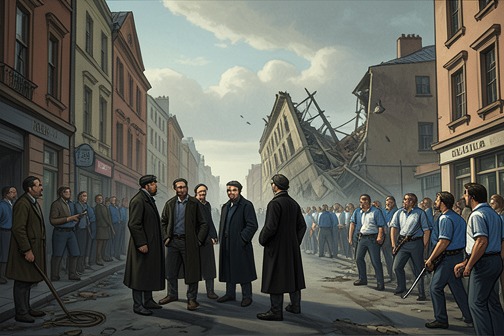
The [Occupation of Fiume](entity:event-recall-event-fiume-745e9010b699) matters not only as an act of seizure but as a political image that outlived the event itself. In the book’s account, [Gabriele D’Annunzio](entity:character-recall-character-gabriele-d-annunzio-6e66d28027db) turns [Fiume](entity:location-recall-location-fiume-c271af61753f) into the counterpoint to a faltering Europe, while later Fascist commemorations recast the occupation as a source of collective identity and militant spectacle. The evidence emphasizes that symbolic afterlife more than the operation’s military details.
## The Occupation and the Postwar Crisis
The occupation belongs to a postwar landscape marked by mass dislocation and expectations of further upheaval. The returning veterans, described as millions pressing back into a Europe emptied by the war, seemed to signal that the old political order could not simply resume its former course. At the same time, socialist demonstrations and clashes in [Milan](entity:location-recall-location-617379caf4c2) showed how quickly public procession could become confrontation. These scenes provide the unsettled context in which the seizure of Fiume could be made to signify a break with ordinary politics.
The book does not give a detailed account here of how the occupation was carried out. Instead, it presents Fiume through the meanings attached to it afterward: a place claimed as the setting for a new political life, and an affront to the settlements being negotiated by victorious powers. That emphasis makes the occupation legible as both a concrete seizure and a contest over who could speak for [Italy](entity:location-recall-location-italy-85c2492cd54b)’s postwar future.
## Fiume as D’Annunzio’s Counter-Image
On January 1, [1920](entity:time-recall-time-1920-510f1fd63aa4), addressing his legionnaires, D’Annunzio called [1919](entity:time-recall-time-1919-329d1bdc3600) the year of Fiume rather than the year of the Versailles negotiations. In his contrast, Versailles stood for a Europe weakened by suspicion, bargaining, and fear; Fiume stood for youth, beauty, life, heroic action, and a future carried forward by the living and the unborn. The language made the occupied city more than a territorial claim: it became an emblem of renewal set against a supposedly exhausted political world.
That ideal was already strained by events. D’Annunzio chose to remain in Fiume against the wishes of the Fiumani, while the narrative observes that Italians had not followed him and that his standing was waning. The tension between the grand promise and the limited support matters: Fiume could remain powerful as a political myth even as the poet’s immediate project lost momentum. Its significance depended less on a settled national consensus than on its capacity to dramatize a desired alternative.
## Anniversary, Ritual, and Armed Organization
The occupation returned as a commemorative date on September 12, when [Italo Balbo](entity:character-recall-character-2e79cde02db9) and [Dino Grandi](entity:character-recall-character-dino-grandi-18ba4a3ce3a9) assembled three thousand squadristi and marched in military formation from Romagna toward [Ravenna](entity:location-recall-location-b931f601f413). The occasion joined the sixth centenary of Dante’s death to the second anniversary of the occupation. For the first time in this account, Balbo succeeded in having all the participants wear the black shirt as a uniform. The march therefore made the anniversary visible as an organized show of force, not merely a retrospective salute to D’Annunzio.
The spectacle sharpened a political dilemma: whether [Fascism](entity:concept-recall-concept-fascism-37baf0d2849a) should become a party or an army. The answer proposed was a party able to turn immediately into a militia, binding political organization to readiness for violence. The occupation’s anniversary thus became part of a later effort to give militant action a common calendar and public form. The account does not say that the occupation itself created this organization; it shows how its memory could be enlisted while the movement was developing one.
## A Contested Legacy
Fiume’s appeal rested on a promise of national rebirth, but the book sets that promise beside the movement’s changing politics. By 1921, Fascism had shifted from its earlier revolutionary, socialist, anticlerical, and republican beginnings toward a conservative, monarchical party allied with the ruling class. [Pietro Nenni](entity:character-recall-character-pietro-nenni-1d91a22f6962), once a friend and political companion of [Benito Mussolini](entity:character-recall-character-benito-mussolini-0330d40d2c3f), had moved to the opposing side; in March 1921 he defended the newspaper whose destruction he had once applauded. The contrast reveals how far the political alignments associated with the postwar moment had changed.
The occupation’s afterlife also appears in the later fusion of politics and ritual. At the founding of the [National Fascist Party](entity:organization-recall-organization-national-fascist-c9d1f7e3cfc5), Mussolini’s account of the future joined national consolidation, empire, the state, and the masses in a single program. Around the same period, the burial of the Unknown Soldier gave collective form to the memory of war dead, while Fascist founders knelt at the tomb in [Rome](entity:location-recall-location-f3877a21016f). These are not further episodes of the Fiume occupation; they show the broader political culture in which the occupation’s language of sacrifice, collective destiny, and renewal could resonate.
The book consequently presents the Occupation of Fiume as an event whose importance exceeds the sparse description of its immediate course. D’Annunzio made it a rival image of the postwar settlement; later militants turned its anniversary into a disciplined public display. Between those uses lies the central tension of its legacy: the promise of a new political beginning could survive even as the movement that borrowed its symbols changed direction.
Event 45
Bologna Massacre at Palazzo d’Accursio
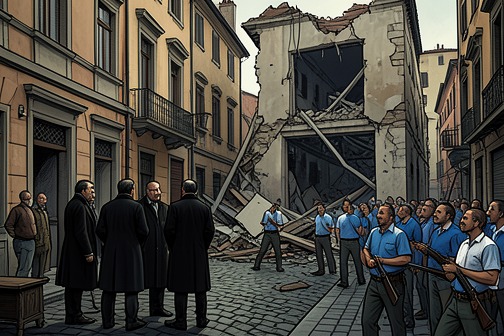
[Bologna Massacre at Palazzo d’Accursio](entity:event-recall-event-2e61ec0ea7e5) is a named episode of political violence in the book’s account of [Italy](entity:location-recall-location-italy-85c2492cd54b)’s postwar conflict. The surrounding passages trace the widening divide between socialist demonstrations, [Fascist squads](entity:organization-recall-organization-fascist-squads-02305958dd0b), and a state increasingly unable to contain armed political action, but they do not narrate the massacre itself or establish its immediate participants, sequence, or toll.
## A Climate of Street Conflict
An earlier confrontation in [Milan](entity:location-recall-location-617379caf4c2) provides a distinct example of the tensions surrounding mass politics. In April [1919](entity:time-recall-time-1919-329d1bdc3600), a socialist procession swelled into the streets, while a smaller opposing cortege included officers, [Arditi](entity:organization-recall-organization-ce1ea9816d56), and Futurists. A cordon of [Carabinieri](entity:organization-recall-organization-carabinieri-28c84a9cf0f4) separated the groups; when it opened, stones and clubs came from the socialist column and gunfire from the opposing side. The brief clash shows how demonstrations could become encounters between opposing political forces, but the account presents it as a separate event, not as a scene from [Bologna](entity:location-recall-location-bologna-e9b2b10db055).
## The Squads and Political Bargaining
The narrative later depicts the Fascist movement’s internal struggle over whether to pursue a pacification pact with the socialists. At a congress, the squadristi shouted as though they were directing events, although [Benito Mussolini](entity:character-recall-character-benito-mussolini-0330d40d2c3f) and [Dino Grandi](entity:character-recall-character-dino-grandi-18ba4a3ce3a9) had already reached a private agreement: the pact would be abandoned in exchange for the creation of a Fascist Party. The assembly’s apparent drama therefore concealed a political decision made elsewhere, and the peace effort was effectively buried.
## Violence and the Weakening State
In a later account of the liberal state’s crisis, the government’s attempt to constrain armed Fascist organization is shown failing against the movement’s own declarations. After the government issued a circular restricting weapons and treating Fascist paramilitary groups as illegal formations, [Michele Bianchi](entity:character-recall-character-michele-bianchi-6ec6b0301223) asserted that party sections and combat squads were inseparable; the directive was published in [Il Popolo d’Italia](entity:object-recall-object-il-popolo-d-italia-b2b48dcea0f3). Rather than arrest the organizers, the government issued another circular complaining that its public-order instructions had not been obeyed. This wider pattern supplies a context for the massacre’s place in the narrative: political violence was not an isolated rupture, but part of a conflict in which state authority and the boundaries between party and armed force were under pressure.
## Narrative Significance
The book sets such violence against competing promises of national renewal. [Gabriele D’Annunzio](entity:character-recall-character-gabriele-d-annunzio-6e66d28027db) presented [Fiume](entity:location-recall-location-fiume-c271af61753f) as youth, life, and a future built in the presence of the war dead; Benito Mussolini later described [Fascism](entity:concept-recall-concept-fascism-37baf0d2849a) as a force that would remake the nation and bring the masses into a new political order. The contrast is consequential: the language of rebirth and unity coexisted with a political landscape divided by armed confrontation. Bologna Massacre at Palazzo d’Accursio belongs to that landscape, although the passages presented here do not supply the event’s specific narrative details.
Event 46
1921 Italian General Election
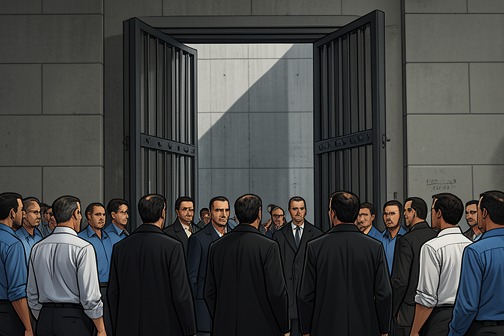
The [1921 Italian General Election](entity:event-recall-event-1921-c45be69329f8) made the fascist movement a parliamentary force without making it a parliamentary movement. Through [Giovanni Giolitti](entity:character-recall-character-giovanni-giolitti-24b78735ff0a)’s national-bloc alliance, fascist candidates entered the Chamber even as their armed political organization remained intact and their leaders continued to challenge the institution they had joined. The election’s significance lay in that contradiction: a route into government opened through ordinary electoral procedures, while violence and anti-parliamentary politics shaped the conditions in which the vote was contested.
## Background and the National Blocs
Giolitti sought to strengthen his government by gathering traditional anti-Bolshevik parties into national blocs. The alliance offered fascists access to electoral lists and Parliament; in return, Giolitti hoped to tether their lawlessness to the constitutional order and use them against the socialist left. Yet the alliance was neither effortless nor uniformly accepted. [Luigi Albertini](entity:character-recall-character-luigi-albertini-a87aea485d6b), senator and publisher of a major liberal newspaper, had resisted fascist participation in the blocs. His eventual appeal to readers to accept the alliance, however distasteful, signaled how far political accommodation had advanced. By then, even this influential liberal opposition had yielded ground.
On April 7, the day the Chambers were dissolved, the central committee of the fasci voted to join Giolitti’s blocs. [Dino Grandi](entity:character-recall-character-dino-grandi-18ba4a3ce3a9) was among those who supported the decision; the [Milan](entity:location-recall-location-617379caf4c2) fascio confirmed it the following evening. The choice was presented within the movement as a necessary compromise rather than an abandonment of its aims. [Benito Mussolini](entity:character-recall-character-benito-mussolini-0330d40d2c3f) argued that political life required contacts and transitions, and treated compromise as a form of practical wisdom. Giolitti and Mussolini nevertheless approached the arrangement from opposing directions: Giolitti hoped to restrain fascist violence by incorporating the movement, while Mussolini intended to exploit disorder as evidence that only he could restore order.
The bargain exposed a fault line inside fascism. Its squad leaders remained fiercely hostile to Parliament and dismissed the importance of winning a handful, or even dozens, of seats. Mussolini reassured them that entering the Chamber did not mean abandoning the movement’s purpose: they could use Parliament as a platform from which to speak against it. Electoral participation thus became another instrument in an anti-parliamentary strategy, not proof that the strategy had changed.
## Campaign Violence and Social Conflict
The vote followed a period of intense conflict in which political organization, economic demands, and coercion overlapped. In [Bologna](entity:location-recall-location-bologna-e9b2b10db055), revolutionary labor bodies competed for influence, and socialist municipal politics reflected pressure to answer more radical demands. Across the countryside, socialist leagues organized agricultural workers and exerted control over hiring, wages, and other working conditions. In [Emilia](entity:location-recall-location-emilia-b49a9aa2ef04), socialists controlled 223 of 280 municipalities, while the peasant leagues’ reach extended into the practical administration of rural economic life. These conditions formed part of the political landscape in which anti-socialist mobilization gained force; they do not, by themselves, explain the votes cast.
The fascist campaign itself ended in a storm of violence. On election day, fatal clashes were reported in Biella, Novara, Vigevano, Mantua, Crema, Padua, Lecce, Foggia, and Syracuse. The toll was twenty-nine dead and 104 wounded in a single day. The narrative links the bloodshed not only to intimidation but also to political attraction: thousands of new sympathizers were drawn to the disciplined ranks of fascist supporters, including small landowners prepared to fight. The ballot box was described as if violence had purified it. That interpretation makes the election’s democratic form inseparable from the coercive atmosphere surrounding it.
The movement’s capacity for organization was also visible in the countryside. In May, thousands of impoverished farmworkers converged on [Ferrara](entity:location-recall-location-970ebca292e4) from scattered farms, travelling on foot, by bicycle, in wagons, and on barges. The crowd included about fifty thousand people, and the city’s ordinary activity was halted as fascist detachments controlled the column and its arrangements. This mobilization was not the election result, but it showed the scale and discipline the movement could command amid the same period’s political contest.
## Results and Mussolini’s Victory
The election did not produce a simple defeat of the left or an overwhelming mandate for the national blocs. Socialists remained the leading party, with 25 percent of the vote. Communists received 3 percent and republicans 2 percent; the Popularists retained 20 percent. Democrats, liberals, nationalists, and their smaller allies together reached only about 47 percent, below what Giolitti had hoped to achieve. The results therefore showed a fragmented political field, not a consolidated parliamentary majority capable of easily restoring stability.
Fascist candidates nevertheless made a striking entry. After prolonged negotiations with Giolitti’s representatives, [Cesarino Rossi](entity:character-recall-character-91b8795cefaa) had secured places for eighty fascist candidates on the national lists. At least forty were elected, often near the top of their lists. Their number remained small beside the hundreds of socialist or liberal deputies, but many were young men under thirty and squad commanders. Their presence brought an organized force associated with armed street politics into the Chamber, making their election more than a routine expansion of parliamentary representation.
Mussolini’s personal result made the breakthrough unmistakable. He headed the list in Milan with 197,000 votes and in Bologna with 173,000, and ranked third among the ten leading candidates elected nationally. His success contrasted sharply with the political isolation and electoral humiliation evoked elsewhere in the narrative: the man once reduced to 4,000 votes now stood at the head of major lists. The election offered him a public measure of power, as well as a means to present fascism as a movement with a national constituency rather than merely a street presence.
## Parliamentary Entry and Its Limits
The election opened the [XXVI Legislature of the Kingdom of Italy](entity:time-recall-time-xxvi-legislature-of-the-ac14d76fd4df), which the narrative presents as the last legislature of a declining parliamentary order. The fascist deputies were still few, and the blocs themselves were internally divided. Giolitti had sought to make fascists governable by drawing them into constitutional politics; instead, their arrival sharpened the instability of an already fragmented Chamber. Electoral inclusion had not dissolved the movement’s independent organization or its capacity for coercion.
The contradiction persisted after the vote. In December, Prime Minister [Ivanoe Bonomi](entity:character-recall-character-87432be97504) tried to restrict the use of truncheons and treat them as weapons requiring licenses, while also declaring fascist paramilitary formations illegal. [Michele Bianchi](entity:character-recall-character-michele-bianchi-6ec6b0301223), the newly elected secretary general of the [National Fascist Party](entity:organization-recall-organization-national-fascist-c9d1f7e3cfc5), countered by declaring party sections and combat squads inseparable. The directive was published openly. The sequence revealed the limits of the hope that parliamentary representation would by itself moderate fascist methods: electoral success coexisted with an assertion of armed party power, while the state struggled to enforce its own restrictions.
Later scenes of political crisis make the election’s institutional irony clearer. When Benito Mussolini entered the Chamber as head of government in November 1922, the hall was crowded with spectators and applause, while the recent [March on Rome](entity:event-recall-event-f817683ad1d8) was already being remembered as bloodless despite nineteen people having died in [Rome](entity:location-recall-location-f3877a21016f) during the preceding fifteen days. The election did not alone produce that outcome, but it had already made parliamentary access part of fascism’s political repertoire. Its lasting importance lies in the way it joined ballot-box legitimacy to organized violence and anti-parliamentary purpose, leaving the formal institutions in place even as the forces using them worked to weaken their authority.
Event 47
Sarzana Incident
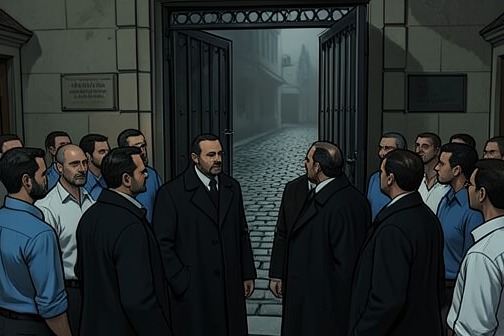
The [Sarzana Incident](entity:event-recall-event-abd62c4978b3) was a violent confrontation on July 21, 1921, in which a Fascist expedition intended to free [Renato Ricci](entity:character-recall-character-8066f489f88d) and strike at his opponents instead met armed state forces and hostile peasants. Its significance lay not only in the deaths and retreat that followed, but in the reversal it exposed: a movement accustomed to attacking unarmed opponents with local official complicity could falter when trained forces resisted. The encounter also sharpened [Benito Mussolini](entity:character-recall-character-benito-mussolini-0330d40d2c3f)’s fear that Fascist violence was isolating the movement and threatening its political survival.
## A countryside already on edge
The expedition emerged from a prolonged local conflict. [Sarzana](entity:location-recall-location-4920330c3a3d) had been tense for months, with armed men ready to gather when unfamiliar faces appeared. Renato Ricci, a Fascist leader in the Carrara area, had been arrested after another failed attempt to enter a stronghold of his opponents. He and members of his squad had been surrounded by [Carabinieri](entity:organization-recall-organization-carabinieri-28c84a9cf0f4) in the dry bed of the Magra. The immediate purpose of the expedition was to secure Ricci’s release; its wider intention was retaliation against the people resisting Fascist control.
The confrontation belonged to a larger postwar landscape in which political alignments were hardened by mass mobilization, economic conflict, and the return of millions of veterans. The book describes a society crowded with demobilized men and haunted by the expectation of further upheaval. In rural areas elsewhere, socialist leagues could regulate hiring, wages, and agricultural work, while employers and landowners feared losing control. This broader conflict helps explain the intensity of the period, but the evidence does not identify those conditions as the specific cause of the Sarzana peasants’ resistance.
## The expedition approaches Sarzana
At about one in the morning, [Amerigo Dumini](entity:character-recall-character-amerigo-dumini-c67af1da031c) waited with a companion at a beach cabana near Avenza. Around five hundred Fascists had assembled on the shore, arriving by train, bus, and improvised transport from nearby towns. Many were sixteen or eighteen years old. News reached the leaders that peasants in the surrounding countryside were alert and had obtained revolvers, hunting rifles, and rudimentary bombs made by miners accustomed to working with explosives.
The column had no settled operational plan, and many of its members did not know one another. It moved along the coast and then followed the railway line toward Sarzana. A night train slowed and stopped when it encountered the marchers before continuing; one member of the column fired at it. The shot announced their approach. At about 5:30 in the morning, they reached the station, where the city seemed quiet. Dumini called the group to order and had the gate opened onto the square.
## The confrontation and retreat
A line of about fifteen Carabinieri stood at the far end of the avenue. Their machine guns had been left in the rear of parked vans, and the Fascists had expected the authorities to be friendly, as they had often been during punitive expeditions. That expectation failed. At about six, Dumini tried to negotiate, presenting conditions for Ricci’s release and for retaliation against the local opposition. The Carabinieri rejected them.
The Fascists advanced in disorder, confident that they would prevail. The Carabinieri took position, prepared to use their weapons. A shot was followed by firing from both sides, and the front of the advancing column was hit. The leaders and the Carabinieri captain managed to halt the exchange and resume negotiations, but the encounter had already changed the column’s direction. Confronted with resistance they had not anticipated, many Fascists fled over hedges, ditches, and walls, dispersing into the countryside.
Armed peasants were waiting among the brush. They pursued members of the retreating column and killed some of them; others were left dead in the countryside. Royal guards arrived after the first shots and searched the area. The surviving Fascists took refuge inside the station, where some of the youngest recruits huddled beneath benches and called for help. Dumini nevertheless obtained Ricci’s release. The remaining members of the expedition were escorted to a special train and sent back toward the places from which they had come. The account gives no reliable total for the dead.
## Political consequences and significance
News of the massacre reached [Rome](entity:location-recall-location-f3877a21016f) that same night. Before addressing a meeting of the national council, Benito Mussolini spoke privately with [Cesare Rossi](entity:character-recall-character-cesare-rossi-92b80e4f71a4) and interpreted the deaths as a threatening omen for the movement. His immediate political response was to propose a pacification pact with the socialists. The timing mattered: [Giovanni Giolitti](entity:character-recall-character-giovanni-giolitti-24b78735ff0a) had fallen, and [Ivanoe Bonomi](entity:character-recall-character-87432be97504) had succeeded him. Mussolini feared that Bonomi might unite moderate socialists and Catholics in a front capable of isolating the Fascists. He argued that continued violence could help create precisely that opposition.
The Sarzana defeat gave that calculation force. In Mussolini’s reading, the rout of five hundred Fascists by fifteen Carabinieri showed how differently the squads fared against trained state forces than against unarmed, disorganized opponents. It also indicated that the police were no longer reliably accommodating Fascist action. The spectacle of the expedition’s collapse made the movement’s dependence on intimidation—and the limits of that method—hard to ignore.
Mussolini consequently called for a sharp retreat from individual violence and punitive raids, along with scrutiny of members’ criminal records, the removal of recent recruits from command, and investigations into harmful actions. These measures did not erase the movement’s violent record; they represented an effort to contain its political costs and restore room for negotiation. In the book’s account, the Sarzana Incident is thus both a local armed reversal and a turning point in the struggle over whether [Fascism](entity:concept-recall-concept-fascism-37baf0d2849a) could discipline its squads without surrendering the coercive power on which its expansion had relied.
Event 48
1921 Fascist-Socialist Pacification Pact
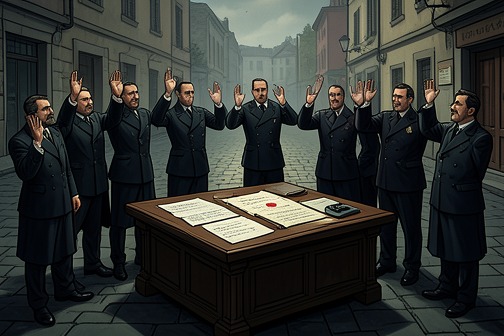
The [1921 Fascist-Socialist Pacification Pact](entity:event-recall-event-1921-a7c506838d9f) was [Benito Mussolini](entity:character-recall-character-benito-mussolini-0330d40d2c3f)’s attempt to contain the violence that had strengthened the Fascists while threatening to make them politically untenable. Signed in [Rome](entity:location-recall-location-f3877a21016f) on August 3 by representatives of Fascist and Socialist parliamentary groups and the [General Confederation of Labour](entity:organization-recall-organization-general-confeder-955e431e75b3), it committed both sides to stop violence and prosecute those responsible. Its collapse exposed the gap between Mussolini’s efforts to negotiate from the center and the provincial Fascist leaders whose power rested on continuing confrontation.
## Background and political purpose
The pact emerged amid a crisis of violence and isolation. After the [Sarzana](entity:location-recall-location-4920330c3a3d) massacre, Mussolini feared that [Fascism](entity:concept-recall-concept-fascism-37baf0d2849a)’s own methods could bring about its destruction. The episode had demonstrated that the squads, accustomed to attacking unarmed and disorganized opponents with the authorities’ complicity, could be routed by a small force of trained [Carabinieri](entity:organization-recall-organization-carabinieri-28c84a9cf0f4). Meanwhile, the provincial squadristi had already boycotted Mussolini, and a Fascist national council led by [Roberto Farinacci](entity:character-recall-character-roberto-farinacci-2da81f7e737e) and [Dino Grandi](entity:character-recall-character-dino-grandi-18ba4a3ce3a9) had rejected pacification. A force of 1,500 squadristi had also occupied Treviso and set fire to the headquarters of Catholics, populists, and republicans.
Mussolini saw a political danger in the possibility that [Ivanoe Bonomi](entity:character-recall-character-87432be97504) might unite Catholics with moderate Socialists. Such a coalition could isolate the Fascists after squad violence had helped weaken the maximalist Socialists. The pact was therefore both a pledge to stop violence and a bid to break that isolation: Mussolini argued that the movement had to abandon its work of extermination before its opponents could form a united front against it.
## Signing and terms
The agreement was signed on the evening of August 3 in the office of Chamber president Enrico De Nicola. Mussolini’s was the first signature on the list. The signatories undertook to cease all types of violence immediately and to prosecute offenders. Representatives of the Fascist and Socialist parliamentary groups took part, alongside Baldesi, Galli, and Caporali, representing the General Confederation of Labour.
Accounts circulated that Socialist leaders refused to shake hands with Mussolini after the signing, though the narrative treats that detail as possible malicious gossip. The opposition from provincial Fascist leaders, by contrast, was unmistakable. The document could record a formal commitment between parliamentary representatives, but it could not ensure that the local squads would accept the commitment as binding.
## Rejection by the provincial Fascists
Less than forty-eight hours after the signing, Fascists from [Tuscany](entity:location-recall-location-5aab1681c149), Veneto, and [Emilia](entity:location-recall-location-emilia-b49a9aa2ef04) denounced the pact at an assembly. Mussolini answered by disparaging them as provincial and unable to grasp a wider political world; in an article, he cast himself as a father correcting a wayward son. Grandi countered that the movement’s true father was [Gabriele D’Annunzio](entity:character-recall-character-gabriele-d-annunzio-6e66d28027db) and that authentic Fascism had been born in [Bologna](entity:location-recall-location-bologna-e9b2b10db055), in the violence surrounding [Palazzo d’Accursio](entity:location-recall-location-palazzo-d-accursio-7ffb825d39f4), rather than in [Milan](entity:location-recall-location-617379caf4c2). [Italo Balbo](entity:character-recall-character-2e79cde02db9) likewise rejected reconciliation, arguing that the struggle with [Socialism](entity:concept-recall-concept-socialism-48fe77fdb8e7) could end only through the eradication of one side.
These responses revealed that the pact was not simply disputed as a practical truce. Its opponents contested who had the authority to define Fascism and whether the movement could remain Fascist while suspending violence. Mussolini, backed by [Cesare Rossi](entity:character-recall-character-cesare-rossi-92b80e4f71a4), accused Emilia’s Fascism of serving the agrarians and threatened either to expel its leaders or to leave himself. The agreement’s brief life thus sharpened the conflict over the movement’s direction rather than reconciling its factions.
## Bargain and aftermath
At the Fascist congress, Mussolini’s public defense of the pact concealed a decisive private bargain. The previous day, he and Grandi had reached an agreement: Mussolini gave up the [Pacification Pact](entity:rule-recall-rule-pacification-pact-81357fad491b) in exchange for the establishment of a national Fascist party. The delegates who shouted and argued over reconciliation believed themselves to be deciding the movement’s future, while the central political choice had already been made between the two leaders. Peace with the Socialists was buried, and the congress became the setting for the creation of the [National Fascist Party](entity:organization-recall-organization-national-fascist-c9d1f7e3cfc5).
The new party’s program extended well beyond a promise to restore order. Mussolini described Fascism as a synthesis capable of absorbing liberalism through violence, sought to make Italians into a single national people, invoked imperial expansion, and declared that the Fascists were the state. The sequence gives the pact its significance: it briefly offered a route from squad violence toward political accommodation, but the bargain that replaced it converted the crisis into an opportunity to consolidate the movement under a national party while leaving the underlying conflict unresolved.
Event 49
1921 Fascist March on Ravenna
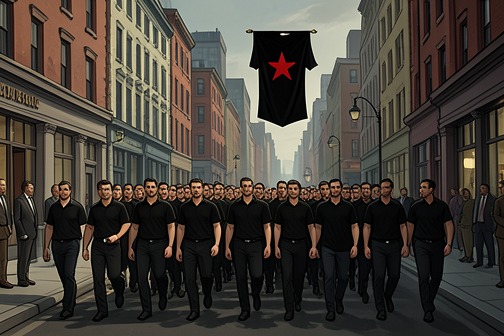
The [1921 Fascist March on Ravenna](entity:event-recall-event-1921-6e06838f043d) turned a political defeat into a public demonstration of organized force. On September 12, [Italo Balbo](entity:character-recall-character-2e79cde02db9) and [Dino Grandi](entity:character-recall-character-dino-grandi-18ba4a3ce3a9) assembled three thousand squadristi for a march from Romagna toward [Ravenna](entity:location-recall-location-b931f601f413). Its columns, ranks, and newly standardized [Blackshirt uniform](entity:object-recall-object-c60ca388e4ad) gave visible form to a question then dividing the movement: whether it would become a party capable of restraining squad violence, or an army built to wield it.
## Political Stakes
The march took place amid efforts to secure a pacification pact between Fascists and Socialists. The local squad leaders worked to sink the agreement and succeeded; Dino Grandi and his followers in [Bologna](entity:location-recall-location-bologna-e9b2b10db055) had already decided to oppose it. The dispute was not simply over reconciliation. [Benito Mussolini](entity:character-recall-character-benito-mussolini-0330d40d2c3f) was arguing that governing the country required a political party able to contain the movement’s violence, while the armed squads remained a force with their own leaders and momentum.
The regional setting sharpened that conflict. In Bologna, revolutionary labor organizations and Socialist influence were powerful, while in the countryside the leagues imposed rules over hiring and working conditions. In [Emilia](entity:location-recall-location-emilia-b49a9aa2ef04), Socialists controlled 223 of 280 municipalities, and the leagues’ authority extended into the organization of work, threshing, and the supply of seed. The march drew its men from areas where control of political life and the rural economy was fiercely contested. The account presents this as context for the mobilization, not as proof that any single local dispute caused it.
## The March and Its Organization
Balbo and Grandi brought together three thousand squadristi on the road from Romagna to Ravenna. The force was divided into two columns of 1,500 men: one associated with [Ferrara](entity:location-recall-location-970ebca292e4) and the other with Bologna, with representatives from Reggio. Each column was arranged into companies and platoons, with a captain at the head of each rank. This organization made the march more than a gathering of supporters: it presented the squads as a force capable of moving and acting in military formation.
The date joined two commemorations: the six-hundredth anniversary of Dante’s death and the second anniversary of the occupation of [Fiume](entity:location-recall-location-fiume-c271af61753f). The march thus connected national cultural memory with the movement’s recent history of action beyond ordinary political channels. The book had already cast Fiume as an emblem of youth and a new beginning in contrast to the weariness and bargaining associated with postwar Europe. The march’s anniversary setting gave the display a resonant political calendar, although the evidence does not describe a specific ceremony or speech at Ravenna.
## Uniform and Political Meaning
For the first time, the Blackshirt uniform appeared on this scale as the common dress of the marching squads. The account notes that black shirts had ordinarily been worn by workers in Romagna; in the march they became the uniform of the revolutionary soldier. A familiar regional garment was thereby recast as a badge of collective political discipline. Uniformity helped make a dispersed movement look like a single army.
That transformation made the march a practical answer to the pacification debate, even as it intensified the dilemma facing the movement. The question was framed as whether to form a party or create an army. The proposed way out was a party that could convert itself into an army, turning members into soldiers when violence was required: a party-militia. The Ravenna mobilization did not settle that institutional problem, but its columns and uniform made the military alternative unmistakable.
## Consequences and Significance
The march demonstrated that the squadristi could be assembled at scale and coordinated across provincial lines. Its disciplined appearance stood in tension with Mussolini’s effort to build a party capable of governing: the stronger the squads looked as an army, the harder it was to treat their violence as something a political organization could simply limit. The movement’s subsequent party project would seek a broader national doctrine, but the march exposed the armed force that any such project had to accommodate.
Its significance therefore lies both in what it displayed and in the question it left open. Three thousand men, arranged by company and platoon and wearing a shared uniform, made political allegiance legible as military organization. The march marked a stage in the movement’s conversion of postwar mobilization into a durable political form, without resolving whether that form would ultimately be governed as a party or operate as an army.
Event 50
1921 Burial Ceremony for Italy’s Unknown Soldier
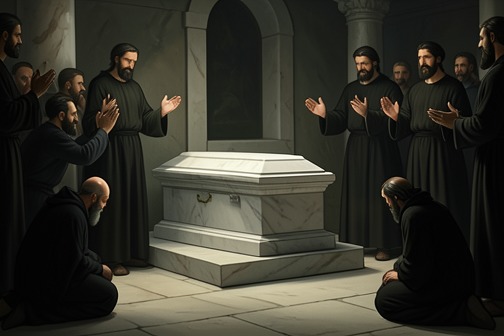
The [1921 Burial Ceremony for Italy’s Unknown Soldier](entity:event-recall-event-1921-4eb42750b862) transformed an unidentifiable war dead into a national symbol. Held on November 4, the anniversary of victory over the Austrians, it gave collective form to the losses of a war in which death had become, in the book’s account, mechanical and impersonal. Its marble coffin offered [Italy](entity:location-recall-location-italy-85c2492cd54b) an altar for remembering the dead—and, soon after, a site at which Fascist politics would take on the gestures of religion.
## A body chosen to represent the dead
The Unknown Soldier’s body had traveled the length of the peninsula by special train, greeted by cheering crowds along the route. It was selected by lot from the remains of fallen soldiers, making the ceremony the first in Italy to place an unidentifiable serviceman at the center of a national commemoration. No name or individual history could distinguish him from the others; that anonymity was the point. He stood for all those who had died.
The burial was described as the most solemn ceremony held in unified Italy. Its scale rested not only on public spectacle but on private recognition: for the first time, people could pray at the grave of the Unknown Soldier as though before the resting place of their own dead. The unidentified body thus joined personal bereavement to a national act of remembrance.
## The tomb as a national altar
The ceremony’s central image was the marble coffin, presented as a fitting altar for a war in which killing had become a mechanical operation and death a collective, impersonal experience. The tomb gave that abstraction a focus. A single unknown body could represent the multitude precisely because it belonged to no one identifiable family alone, yet could be approached as if it belonged to each mourner.
That symbolic transformation did not erase the cost of the war; it organized grief around a shared national figure. The soldier’s anonymity made the dead present without restoring their individual stories. In the ceremony’s logic, the grave could hold both the intimate loss of a loved one and the public memory of a people’s sacrifice.
## Fascist appropriation of the ritual
Five days later, as the founders of the [National Fascist Party](entity:organization-recall-organization-national-fascist-c9d1f7e3cfc5) gathered in [Rome](entity:location-recall-location-f3877a21016f), the Unknown Soldier’s tomb entered a further political drama. While Fascist blackshirt squads from the north, beyond the control of political leaders, provoked brawls in the city’s popular districts, the party’s founders knelt in prayer before the unnamed soldier for more than half an hour. The contrast placed disorder and discipline side by side: violence continued in the streets even as the leaders performed a solemn act of collective devotion.
The kneeling made explicit what the burial’s altar imagery had made possible: politics could be staged through forms associated with religious observance. The ceremony had made the unknown dead a focus of national mourning; the Fascist leaders’ later vigil placed their movement within that sacred landscape. The book presents this moment as evidence that, for the founders, politics was becoming a religion.
## A contested memory of sacrifice
The burial’s significance lies in the tension between its broad memorial purpose and its later political use. The chosen soldier represented the dead without distinction, offering mourners a common place for grief. The Fascist vigil, by contrast, attached that shared symbol to a movement whose adherents were divided between political leaders and militants acting beyond their command.
The Unknown Soldier’s tomb therefore served more than one function in the narrative. It was a national memorial to impersonal mass death, a surrogate grave for private loss, and a setting where political belonging could be enacted through ritual. The ceremony did not settle the meaning of sacrifice; it created a powerful symbol over which competing forms of public memory could gather.
Event 51
Third National Congress of the Fasci and Founding of the National Fascist Party
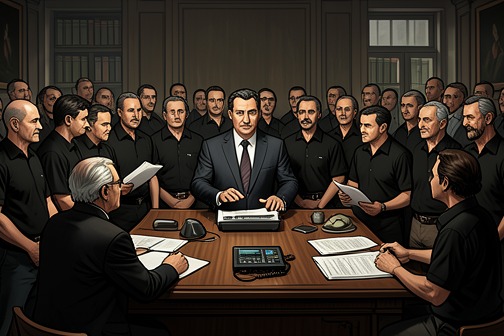
The [Third National Congress of the Fasci and Founding of the National Fascist Party](entity:event-recall-event-211ff916a05f) took place in [Rome](entity:location-recall-location-f3877a21016f) from November 7 to 9, 1921. Its decisive achievement was not simply the creation of a party: [Benito Mussolini](entity:character-recall-character-benito-mussolini-0330d40d2c3f) used a dispute over peace with the socialists to reconcile rival Fascist leaders, redirect the assembly toward organization and program, and convert a movement sustained by squad violence into a national political force. The reconciliation depended on an agreement made before the delegates knew it had been reached, while the violence that had helped bring the movement to prominence remained close at hand.
## Background: a movement built on conflict
The congress met amid unresolved postwar upheaval. The book’s account presents veterans returning in their millions to a political world whose old leaders seemed exhausted, while the prospect of renewed conflict continued to shape public expectations. It also sets the movement’s appeal against the dead and disillusionment of the war: earlier, Benito Mussolini had described the returning soldiers as a population of survivors for whom the established political generation had lost its authority. The promise of a new political beginning therefore drew on a real rupture, but also framed that rupture as a demand for discipline and collective action.
The tensions were material as well as rhetorical. In [Bologna](entity:location-recall-location-bologna-e9b2b10db055), labor organizations and socialist institutions exerted strong influence over civic and rural life; in [Emilia](entity:location-recall-location-emilia-b49a9aa2ef04), peasant leagues organized work, hiring, and agricultural production. A government circular had meanwhile urged Fascist collaboration in maintaining public order against revolutionary attempts, subject to official command. After deaths in a rural clash, the [Bolognese Association of Social Defense](entity:organization-recall-organization-05001c52c59b) formed and appealed to Prime Minister Nitti, arguing that the state had failed to contain socialist violence. Such developments helped make [Fascism](entity:concept-recall-concept-fascism-37baf0d2849a) appear to some landowners and middle-class groups as a force of defense, even as its independent armed squads challenged the state’s claim to control political violence.
The congress’s immediate internal conflict concerned the pacification pact with the socialists. Some delegates wanted discussion of the agreement shelved; others opposed any accommodation. [Dino Grandi](entity:character-recall-character-dino-grandi-18ba4a3ce3a9), leader of the dissidents, received a stronger ovation than Mussolini when the assembly opened. The divided response showed that the movement’s leaders could not assume their authority would settle the dispute by itself.
## The bargain behind the reconciliation
Before the public confrontation, Mussolini and Grandi had met secretly. Their understanding exchanged the pacification pact for the establishment of a Fascist Party. The delegates who spent the congress arguing over the pact were therefore, without knowing it, contending over an issue already set aside by the two leaders. The apparent open contest concealed a prior political bargain: the question was no longer whether the congress would preserve the pact, but how the new party would be constituted.
Mussolini entered the assembly after Grandi’s dissident faction had been warmly received. His public position appeared flexible: he would not insist on a vote about the pact, but would fight on all fronts if the congress chose to vote. He returned the decision to the delegates and shifted attention toward what he described as more pressing questions, especially the movement’s program and the creation of a party. This maneuver removed the pact as the immediate test of loyalty without requiring the assembly to resolve the deeper disagreement over violence and political compromise.
The change in emphasis worked. Once the pact had effectively been sacrificed, the disagreement that had divided the hall lost its power to hold the delegates apart. Grandi called for a solid Fascist bloc and left the stage; the crowd rose in a prolonged ovation. He then embraced Mussolini at the presidential table. Delegates followed, forming a chain of embraces around Mussolini, who was lifted onto the table. The physical reconciliation turned a private agreement into a public spectacle of unity, while the crowd’s excitement displaced the unresolved social conflict outward, toward the movement’s opponents.
## Founding the party and defining its program
The scene of reconciliation also exposed the connection between party-building and squad violence. The man who lifted Mussolini onto the table was Italo Capanni, identified in the account as the killer of [Spartaco Lavagnini](entity:character-recall-character-9795a71b3c58). The [National Fascist Party](entity:organization-recall-organization-national-fascist-c9d1f7e3cfc5) was born amid an embrace between factional leaders and the presence of a participant in political murder. The new organization did not mark a clean break from the movement’s violent methods; it gave the divided movement a shared political form.
The following day, Mussolini spoke for three hours, setting out a program that presented Fascism as a synthesis capable of absorbing and superseding rival political traditions. He argued that violence had buried older methods and that the movement would complete the nationalization of Italians: regional identities were to give way to a single Italian identity. Beyond national unity lay an imperial ambition, which he linked to the idea of national greatness. He also abandoned the movement’s earlier anticlerical posture, placing the Roman Church within this imperial vision.
His account of state and society was similarly expansive. Mussolini declared that Fascists were the state, while describing the economy in terms of classical liberalism. On the question of the masses, he rejected both the idea that political history belonged only to individual heroes and the claim that the masses could act without an interpreter. Fascism, he said, would serve and educate the masses, but discipline them when it judged them to be wrong. He further made the health of the national bloodline a political concern. Taken together, these positions joined national uniformity, imperial power, mass mobilization, state authority, and population management in a single program.
Mussolini also presented himself as willing to disappear within the new organization so that the movement could assume responsibility collectively. That declaration sat uneasily beside the congress’s personal devotion to him and the program’s reliance on a leader who claimed the role of interpreter for the masses. The party was to be depersonalized in principle, yet its birth was staged around Mussolini’s control of the agenda and the crowd’s embrace of his leadership.
## A new political spectacle
The congress culminated in a public performance of unity. After Mussolini’s programmatic address, delegates shouted, sang, and applauded; the excitement spilled into the streets as Fascists marched toward the Altar of the Fatherland. The theater itself reinforced the event’s historical staging: the [Auditorium Augusteo](entity:location-recall-location-40fc3d8b2a95) stood where the mausoleum of Augustus had once been, and the account casts Mussolini’s performance as an encounter with the changing balance of power. The movement’s political consolidation was made visible through architecture, applause, embraces, and procession.
The congress thus resolved one crisis by changing the terms of the dispute. Rather than settle whether Fascists should make peace with socialists, its leaders moved the assembly toward a party capable of organizing the movement nationally. The new program promised rebirth after decline and unity after division, while treating coercion as a foundation of the political order it proposed. The result was a more durable organization, but not the end of factional tension or violence: those forces had been incorporated into the party’s founding spectacle rather than left behind.
Event 52
Fall of the Bonomi Government
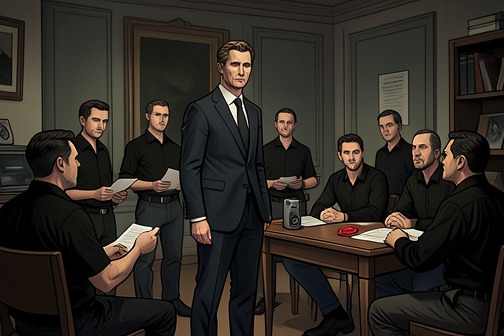
The [Fall of the Bonomi Government](entity:event-recall-event-9c0982d7f768) was a turning point in the prolonged collapse of [Italy](entity:location-recall-location-italy-85c2492cd54b)’s liberal parliamentary order. In February 1922, economic scandal, party fragmentation, and disputes over public order combined to bring down [Ivanoe Bonomi](entity:character-recall-character-87432be97504)’s government. The crisis did not produce an effective anti-Fascist alternative: [Benito Mussolini](entity:character-recall-character-benito-mussolini-0330d40d2c3f) used the divisions around him to avoid isolation, while the king and [Luigi Sturzo](entity:character-recall-character-luigi-sturzo-0a091db6f2c0) helped block [Giovanni Giolitti](entity:character-recall-character-giovanni-giolitti-24b78735ff0a)’s return and Facta became prime minister.
## Causes and mounting paralysis
The government fell after months in which its central promise of pacification had lost force. In letters to Velia, [Giacomo Matteotti](entity:character-recall-character-giacomo-matteotti-b1b8c0b072bc) described the pact intended to soothe the civil conflict as already exhausted. Attempts to disarm the Fascists had failed, and he believed Mussolini had kept Bonomi’s government alive until February for his own convenience. The crisis could no longer be treated as a narrow problem of policing: many now argued that the Fascists had to be brought into government.
Public order measures had meanwhile revealed how limited the government’s authority was. On December 15, Bonomi issued a circular equating truncheons with weapons requiring a license and classifying Fascist paramilitary formations as illegal. [Michele Bianchi](entity:character-recall-character-michele-bianchi-6ec6b0301223), the newly elected secretary general of the [National Fascist Party](entity:organization-recall-organization-national-fascist-c9d1f7e3cfc5), answered by declaring that party sections and combat squads were inseparable; the directive appeared in [Il Popolo d’Italia](entity:object-recall-object-il-popolo-d-italia-b2b48dcea0f3). Rather than arrest the leaders of an armed organization represented in parliament, the government issued another circular on December 21, complaining that its public-order instructions were not being obeyed. The contrast between formal orders and their weak enforcement made the state’s impotence visible well before the cabinet fell.
The immediate February crisis grew out of both financial scandal and political self-sabotage. The bankruptcy of Banca di Sconto, whose owners had used depositors’ money to finance their businesses, ruined thousands of small account holders and became the last straw. In parliament, Liberal [Democracy](entity:concept-recall-concept-democracy-5578a15716f4) and Social Democracy merged into a new Democratic Group in order to overthrow Bonomi. The maneuver deepened the instability it was meant to resolve: the factions that had supported his liberal majority helped dismantle it.
## The socialist dilemma and Mussolini’s maneuver
The Socialist Party faced its own division. Unwilling to enter a governing coalition with capitalist parties, the socialists chose again to denounce the state’s failure to act against Fascist violence rather than strengthen it through political compromise. Their refusal weakened the prospect of an anti-Fascist majority even as Fascist power made the existing state’s weakness more urgent. Matteotti’s account also situates the fall amid a split between reformists and maximalists, another fracture in an already divided political movement.
The decisive parliamentary turn came through the reformist deputy Celli, whose motion called for stronger public order. Although the motion was directed against the Fascists, Mussolini supported it. That tactical support helped him avoid isolation and frustrate the formation of an anti-Fascist government. The episode captures the crisis’s central reversal: a motion intended to strengthen public authority became an instrument in Mussolini’s political maneuvering, while the parties opposing him could not agree on how to defend that authority.
The breakdown had been preceded by a broader shift in political respectability. In April 1921, [Luigi Albertini](entity:character-recall-character-luigi-albertini-a87aea485d6b) urged readers to accept the alliance between liberals and Fascists despite its moral cost. Mussolini read this as evidence that [Fascism](entity:concept-recall-concept-fascism-37baf0d2849a) had moved from the trenches into parliament. The Bonomi crisis unfolded in a political landscape where cooperation with Fascists had already become thinkable to some liberal leaders, even as the violence that made such cooperation dangerous continued.
## The succession and the consequences
The king took nearly a month to find someone willing to assume the government. Giovanni Giolitti, described as the one statesman capable of controlling Fascism, was prevented from returning: [Vittorio Emanuele III](entity:character-recall-character-vittorio-emanuele-i-45cfd86fd0a5) and Luigi Sturzo, both personally opposed to him, helped block his path. [Luigi Facta](entity:character-recall-character-luigi-facta-76e3fd731ea0), an unassuming provincial lawyer and Giolitti’s political shadow, was appointed instead. The succession resolved the immediate vacancy without resolving the crisis that had produced it.
The fall also exposed how personal rivalries and factional vetoes could outweigh efforts to build a stable parliamentary majority. At the same time, Mussolini could present himself as a participant in parliamentary politics while exploiting the failures of the liberal state. The government’s downfall was therefore not simply a change of ministers. It marked the failure of a political strategy that sought to manage Fascist violence through weak restrictions and shifting alliances, and it left the institutions meant to contain that violence less capable of acting together.
## A crisis that outlasted the cabinet
Bonomi’s fall did not end the struggle over public order. In October 1922, as the Fascist advance on [Rome](entity:location-recall-location-f3877a21016f) reached its decisive moment, Facta’s government prepared a state of siege. Orders for Rome’s defense were sent to General [Emanuele Pugliese](entity:character-recall-character-emanuele-pugliese-29fa1d25664a) shortly after six in the morning; arrest orders for those responsible for the sedition followed, and the proclamation was posted in the streets at 8:30. The sequence showed that the state could still draft and transmit extraordinary measures, but it also placed the unresolved question of political authority at the center of the confrontation.
By November, the [Chamber of Deputies](entity:organization-recall-organization-20acc842a4eb) could still convene in full ceremonial form, with crowds filling its galleries and corridors, and Benito Mussolini entering as prime minister to a public ovation. That spectacle of parliamentary continuity stood beside the violence and upheaval of the preceding weeks. The earlier fall of Bonomi belongs to this longer unraveling: the institutions remained visible, but repeated crises had steadily diminished their capacity to check Fascist power.
Event 53
1922 Occupation of Ferrara
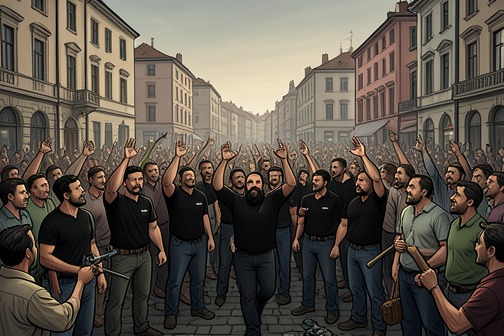
The [1922 Occupation of Ferrara](entity:event-recall-event-1922-dd48665809c1) was a carefully organized show of force that turned rural unemployment into a political weapon. Led by [Italo Balbo](entity:character-recall-character-2e79cde02db9), tens of thousands of farm laborers entered and paralyzed the city, surrounding its institutions until the government agreed to provide public works. The episode displayed the Fascists’ capacity to mobilize a mass constituency and challenge the state, while exposing how rapidly political allegiance could shift when work and food were at stake.
## Background: Rural control and unemployment
The occupation drew on a countryside already transformed by conflict between landowners and organized farm laborers. In [Ferrara](entity:location-recall-location-970ebca292e4), socialist leagues had imposed collective rules governing hiring and working conditions. Their reach extended beyond the workplace: they controlled labor placement and influenced threshing, seed supplies, and crop planting. Because farmhands could find work for an average of only 120 days a year, access to employment during the idle months was a matter of survival. The leagues’ system could enforce its rules through fines and social pressure against those who undercut agreed wages.
By 1922, political control of this rural population had begun to change hands. In Ferrara, large numbers of workers had moved from the red leagues into Fascist unions. Yet the new allegiance did not remove the underlying scarcity of work. The accord that required landowners to hire six farmhands for every thirty hectares provided employment through the winter; between April and May, laborers again faced idleness. Balbo saw that gap as an opportunity to demonstrate that Fascist organization could deliver material relief where the government had not.
## Balbo’s plan
On April 25, Balbo presented his proposal to [Benito Mussolini](entity:character-recall-character-benito-mussolini-0330d40d2c3f) in [Milan](entity:location-recall-location-617379caf4c2). A mass occupation, he argued, could compel [Rome](entity:location-recall-location-f3877a21016f) to fund public works for unemployed farm laborers. The design also protected the interests of the agrarians who financed the local Fascist organizations: employment would be secured at state expense rather than by imposing new costs on landowners. The action was thus framed both as relief for the workers and as a test of Fascist power against the government.
Mussolini approved the plan but left responsibility for failure with Balbo. Preparations began immediately. Balbo sent a secret memorandum to provincial leaders demanding a disciplined mobilization. Beatings, alcohol, and visits to brothels were prohibited. These instructions sought to make the demonstration a controlled operation rather than an uncontrolled outburst, even as its purpose was to exert coercive pressure on the authorities.
## The countryside enters Ferrara
At midnight on May 11, groups of laborers set out from isolated farmhouses across the Ferrarese countryside. They travelled on foot, by bicycle and wagon, and aboard barges pulled along the canals by horses or by people on the banks. By the following morning, about 50,000 farm laborers had entered Ferrara. Many arrived with blankets over their shoulders and only polenta and cheese in their provisions; fascist detachments organized the columns as they proceeded along Corso della Giovecca.
The mobilization overwhelmed the city’s ordinary routines. Balbo ordered telephone lines cut and shops and businesses closed, while school buildings were requisitioned as quarters. The crowd camped in the streets, and the castle was surrounded. The prefect, alarmed by the scale of the occupation, requested a meeting with the commander. When Balbo appeared at the drawbridge, the assembled laborers made the force behind his demands unmistakable.
## Negotiation and outcome
Balbo presented the prefect with an ultimatum: the police were to return to their barracks, the Fascists would maintain public order, and the peasants would remain mobilized until the government guaranteed public works. For the next forty-eight hours, negotiations, meetings, and encampments continued. Meanwhile, the municipal kiln produced 45,000 pounds of bread for the city.
At dawn on May 14, word arrived that the minister had accepted the demands. The state had conceded, and Balbo ordered the laborers to demobilize. The immediate outcome was a government commitment to public works; the political outcome was a demonstration that a Fascist-led rural mobilization could force the state to bargain. From Milan, Mussolini celebrated the success but also registered an unease: many of the workers had been socialists only the day before. Their rapid change of allegiance raised a question the occupation could not settle—whether the shift represented durable political commitment or a temporary response to need.
Event 54
1922 Occupation of Bologna
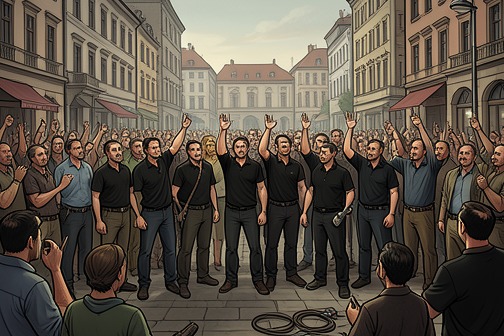
The [1922 Occupation of Bologna](entity:event-recall-event-1922-3e87e8940137) was a five-day Fascist show of force that converted a dispute over policing into a public test of whether the Italian state could still impose its authority. Organized around [Italo Balbo](entity:character-recall-character-2e79cde02db9)’s mass mobilization and [Leandro Arpinati](entity:character-recall-character-leandro-arpinati-504d6ebd7829)’s local network, the occupation ended with the government yielding on the transfer of [Cesare Mori](entity:character-recall-character-366445fac855). Its example pointed beyond [Bologna](entity:location-recall-location-bologna-e9b2b10db055): Mussolini presented the operation as a precedent for demonstrations with broader aims, while Balbo later described it in his diary as a rehearsal for revolution.
## Background and Political Stakes
The occupation took shape amid a struggle over who controlled work and public order. In [Emilia](entity:location-recall-location-emilia-b49a9aa2ef04), socialist organizations and peasant leagues had built influence through unions, cooperatives, and labor placement offices. In the countryside, those leagues shaped hiring, work schedules, and other parts of agricultural life; in [Ferrara](entity:location-recall-location-970ebca292e4) Province, the leagues’ membership had grown to 81,000 by mid-May [1920](entity:time-recall-time-1920-510f1fd63aa4). In Bologna itself, competing labor organizations and increasingly radical political appeals deepened conflict, while employers and the middle classes faced mounting pressure.
The state’s attempts to restrain Fascist violence were also proving ineffective. In December, [Ivanoe Bonomi](entity:character-recall-character-87432be97504) had issued orders against the squads, and [Michele Bianchi](entity:character-recall-character-michele-bianchi-6ec6b0301223), the [National Fascist Party](entity:organization-recall-organization-national-fascist-c9d1f7e3cfc5)’s secretary general, answered by declaring the party sections and combat squads inseparable. The government’s inability to enforce its own restrictions formed the larger context for the Bologna confrontation. By spring 1921, Cesare Mori had been given regional responsibility for coordinating public order. He curbed squad raids by limiting vans on weekends, brought rural employment under government offices, and sought to prevent the use of seasonal replacement labor. Fascists treated these measures as an attack on their organization and influence.
## Mobilization and Occupation
Balbo’s occupation of Ferrara in May supplied the immediate model. There, thousands of impoverished farmworkers had marched into the city, and Balbo’s forces had paralyzed civic life through measures including cutting telephone lines and closing businesses. In Bologna, Arpinati turned to Balbo as the party prepared a larger mobilization. After Bianchi ordered the city’s squads to assemble on May 28, Balbo readied Fascists from Ferrara and the surrounding area. From May 29, thousands arrived from places including Codigoro, Portuense, and Copparo. They were assigned shifts lasting thirty hours, and residents watched as the newcomers spent four nights beneath the arcades on strawboard pallets.
The march was not simply a display of numbers. [Fascist squads](entity:organization-recall-organization-fascist-squads-02305958dd0b) systematically devastated Socialist and Communist headquarters, along with labor and agricultural cooperative offices. They beat socialist deputies and police commissioners, extending their attacks beyond the movement’s usual targets. Around [Palazzo d’Accursio](entity:location-recall-location-palazzo-d-accursio-7ffb825d39f4), government forces placed cordons of [Carabinieri](entity:organization-recall-organization-carabinieri-28c84a9cf0f4), royal guards, and plainclothes agents. The Fascists first feigned an assault on the main entrance, then broke through from the opposite side. Elsewhere, they used white handkerchiefs and firecrackers to unsettle mounted forces; when the horses shied, the riders were thrown from formation. Arpinati also led an assault on the prison of San Giovanni in Monte, freeing sixty detained Fascists.
## The State Gives Way
Bologna’s institutions came under pressure from both the occupied streets and political allies of the Fascists. On May 29, a citizens’ committee representing the city’s bourgeoisie sent a telegram to the Ministry of the Interior asking that Mori be removed. The following day, Giacomo Vigliani, the director of public security, arrived from [Rome](entity:location-recall-location-f3877a21016f) to investigate. He accused Mori of excessive zeal, while much of the national press supported the Fascist uprising against him. Cavalry officers called away to other duties made no secret of their sympathy for the insurgents.
For three days, the mayor remained besieged in the prefecture and repeatedly telegraphed Rome for instructions, receiving answers described as vague and evasive. The rallies and encampments added a threat of further escalation. Yet no order to open fire came; the confrontation instead ended through political retreat. After five days of occupation and assurances that Mori would be transferred, Mussolini issued the demobilization order on June 2. The government had not defeated the mobilization or restored its authority on the terms Mori had been trying to enforce. The transfer of the official who embodied that effort was the practical concession that brought the occupation to a close.
## Consequences and Significance
Mussolini’s demobilization order presented the demonstration as a precedent and pledged that, if it had to be repeated, he would lead it himself, with wider reach and more far-reaching objectives. The episode thus made the march a political instrument: it could assemble forces across provincial networks, occupy civic space, attack opponents’ institutions, and pressure the state without waiting for the government’s authorization. Its success in Bologna helped shift Fascist action from attempts to impose demands on officials toward openly confronting the state.
The outcome also advanced Arpinati’s political career. When the withdrawal of Fascist candidates who failed to meet the minimum age requirement opened a parliamentary seat, he learned that he would enter parliament. He packed his bags, kissed Rina, and left for Rome. Balbo’s diary entry on June 5 gave the occupation its most consequential retrospective meaning: a local operation had served as a dress rehearsal for a revolution. The episode’s significance lies in the contrast between that expanding ambition and the state’s retreat: after the occupation, Rome was no longer merely the distant center to which Fascists made demands, but the next target they began to contemplate.
Event 55
1922 Cremona Siege and Fascist Assaults
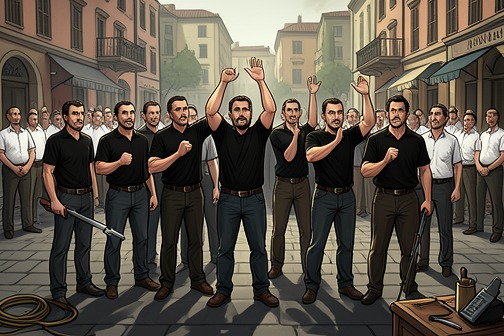
The 1922 [Cremona](entity:location-recall-location-cremona-68fc915f0d92) siege and Fascist assaults marked the escalation of local squad violence into an open challenge to civic and state authority. Under [Roberto Farinacci](entity:character-recall-character-roberto-farinacci-2da81f7e737e), [Fascist squads](entity:organization-recall-organization-fascist-squads-02305958dd0b) attacked peasant organizations and town councils, occupied the prefecture, and ultimately besieged Cremona. [Benito Mussolini](entity:character-recall-character-benito-mussolini-0330d40d2c3f) privately ordered the assault demobilized, but the confrontation ended with the city devastated, its administration powerless, and the government falling soon afterward.
## Background and Targets
The campaign began with the arrival of fine weather and extended across the province of Cremona. Farinacci’s squadristi targeted peasant leagues and municipal councils associated with both the socialist “red” and Catholic “white” movements. The attacks were not confined to one political faction: they struck at the local organizations and administrations that represented competing forms of rural political power.
The pressure had immediate institutional consequences. Within two months, thirty-five municipal administrations resigned, saying they could not withstand the situation. This wave of resignations registered more than a series of isolated assaults: local government itself was being driven out of operation under the threat of Fascist violence.
## Occupation and Siege
On June 16, the blackshirts occupied the prefecture and set fire to the home of Deputy Miglioli, a Catholic politician associated with the “white” peasant leagues. On July 5, Farinacci entered Cremona’s town hall alone while its custodian slept in the entrance hall. From the mayor’s private office, he used paper bearing the municipal seal to notify the prefect that he had appointed himself mayor. The act turned the authority of the town hall into an instrument of its own usurpation.
Ten days later, Farinacci returned with thousands of squadristi to besiege the city. For three days and three nights, Cremona endured destruction and killings while its administration proved unable to act. The siege did not merely intimidate the city; it demonstrated that a local Fascist leader could mobilize a mass force, take possession of civic institutions, and render ordinary government ineffective.
## Mussolini and the Government Crisis
Behind the public violence, Mussolini tried to contain Farinacci’s operation. He ordered him to demobilize from Cremona. Farinacci initially refused, and Mussolini ultimately had to threaten him physically to secure compliance. On July 18, Mussolini also used the prefect of [Milan](entity:location-recall-location-617379caf4c2) to reassure the state that he intended to restrain the squadristi and enter government through legal channels. Since June, he had sought to end [Fascism](entity:concept-recall-concept-fascism-37baf0d2849a)’s political isolation by approaching the king, former liberals associated with [Francesco Saverio Nitti](entity:character-recall-character-francesco-saverio-n-f3bc92931cc1), [Don Luigi Sturzo](entity:character-recall-character-61787ee0bdb4), and socialist reformists; those efforts had failed.
The narrative presents Farinacci’s actions as the force that brought down the Facta government. Two days after the siege’s three-night assault, the government fell. Mussolini’s public effort to distinguish legal political participation from uncontrolled squad violence therefore coexisted with his dependence on a movement whose local commanders could defy his orders. The episode makes that tension concrete: the leader’s attempt to claim political control could not erase the violence through which Fascist power was being established.
## Significance
The Cremona episode joined the coercion of rural organizations to the seizure of urban institutions. Resigning councils, the occupation of the prefecture, Farinacci’s self-appointment as mayor, and the siege formed a progression in which violence displaced public authority rather than simply pressuring it. The brief interval between the siege and the government’s fall further linked local Fascist action to the crisis of national rule.
Mussolini’s intervention revealed the limits as well as the uses of his authority within the movement. He attempted to restrain Farinacci because uncontrolled violence obstructed his bid for legal entry into government, yet the need for a physical threat to enforce demobilization showed that a provincial leader possessed substantial independent power. Cremona thus stands as a point where the Fascist movement’s local capacity to overpower institutions and its national leader’s political calculations collided.
Event 56
Fall of the Facta Government in 1922
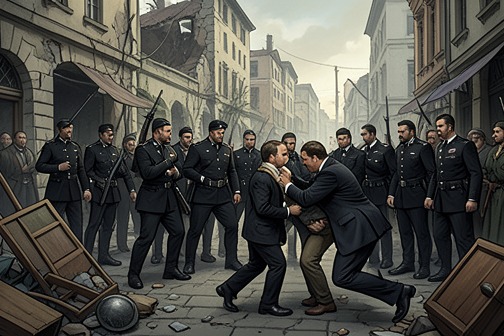
The [Fall of the Facta Government in 1922](entity:event-recall-event-1922-e1ca239905cc) unfolded amid a spreading campaign of Fascist violence and a mounting crisis of state authority. It was not simply a change of ministry: attacks on local institutions exposed the weakness of the liberal state, while [Benito Mussolini](entity:character-recall-character-benito-mussolini-0330d40d2c3f) maneuvered between the armed movement and the prospect of entering government through legal channels.
## Background: Organized Conflict and Political Opportunity
The crisis developed against a landscape of intense social conflict. In [Emilia](entity:location-recall-location-emilia-b49a9aa2ef04), socialist organizations held 223 of 280 municipalities, while peasant leagues had gained substantial influence over hiring, work schedules, threshing, seed supplies, and planting. Farmhands averaged only 120 days of work a year, making control of labor and wages a matter of survival for workers and a direct challenge to landowners. These organized rural movements formed part of the political terrain on which [Fascist squads](entity:organization-recall-organization-fascist-squads-02305958dd0b) operated.
[Fascism](entity:concept-recall-concept-fascism-37baf0d2849a) had also moved from street mobilization toward parliamentary participation. In 1921, Benito Mussolini accepted a place for Fascists within the national blocs, an alliance of traditional anti-Bolshevik parties. That parliamentary opening did not displace squad violence. Instead, legal participation and coercion developed side by side, leaving the government to confront a movement that claimed a place in parliament while maintaining armed formations beyond its control.
## The [Cremona](entity:location-recall-location-cremona-68fc915f0d92) Campaign and the Government’s Fall
With the arrival of fine weather, [Roberto Farinacci](entity:character-recall-character-roberto-farinacci-2da81f7e737e)’s squadristi launched a province-wide campaign against peasant leagues and municipal administrations, both socialist and Catholic. Within two months, thirty-five municipal administrations resigned, citing their inability to withstand the situation. The campaign showed how violence could empty local offices of authority without replacing them through ordinary political competition.
On June 16, blackshirts occupied the prefecture and set fire to the home of Deputy Miglioli, a Catholic representative who had led the white peasant leagues. On July 5, Roberto Farinacci entered Cremona’s town hall alone while its custodian slept in the entrance hall. From the mayor’s office, using paper bearing the municipality’s seal, he informed the prefect that he had appointed himself mayor. Ten days later, he returned with thousands of squadristi to besiege the city. Three days and nights of destruction, killings, and administrative paralysis followed; two days later, the government fell.
The episode made the contest over authority concrete. A Fascist leader could claim the mayoralty by using the town hall’s own official stationery, then return with a mass force to impose pressure on the city. The resignation of administrations, the occupation of the prefecture, and the siege of Cremona together showed how local government could be disabled while the institutions of the state remained nominally in place.
## Mussolini’s Contradictory Maneuver
Publicly, Benito Mussolini defended the campaign. In [Il Popolo d’Italia](entity:object-recall-object-il-popolo-d-italia-b2b48dcea0f3), he answered condemnations of Fascist violence with a promise to defeat opponents politically and through their unions. Behind the propaganda, however, he ordered Roberto Farinacci to demobilize from Cremona. Farinacci initially refused; Benito Mussolini ultimately had to threaten him in person. The contrast revealed a difference in the uses of violence: for the leader, it was a political instrument to be applied and restrained as circumstances required, while local squad leaders could treat it as an end in itself.
Since June, Benito Mussolini had been trying to end Fascism’s isolation. He approached the king, [Francesco Saverio Nitti](entity:character-recall-character-francesco-saverio-n-f3bc92931cc1)’s old liberals, [Don Luigi Sturzo](entity:character-recall-character-61787ee0bdb4), and socialist reformists, but these efforts failed. On July 18, through the prefect of [Milan](entity:location-recall-location-617379caf4c2), he reassured the state that he intended to contain the squadristi and enter government by legal means. His promise of restraint came alongside public support for conquest and a movement whose armed actions were undermining the government he hoped to join.
In parliament on July 19, Benito Mussolini renewed his threats and described a choice between a party of government and a party of insurrection. He then voted against [Luigi Facta](entity:character-recall-character-luigi-facta-76e3fd731ea0) alongside Catholics and socialists who had lost faith in the government’s ability to protect them from squad attacks. The vote was a maneuver, not a break with Fascist violence: it positioned Benito Mussolini against a ministry already damaged by the movement’s actions and by its own failure to stop them.
## Aftermath and Significance
The parliamentary debate drew unusually broad criticism of Fascist coercion. [Claudio Treves](entity:character-recall-character-claudio-treves-0854cd58f6fd) attacked the ministers, and [Filippo Turati](entity:character-recall-character-filippo-turati-ab4f1019d6ae) warned that civilization was nearing collapse. Liberal newspapers also condemned the violence: the [Corriere della Sera, the government-critical daily](entity:organization-recall-organization-e675c78d20b2), deplored Fascist blackmail, while [La Stampa, the anti-fascist daily](entity:organization-recall-organization-545c66cbe3b8), held right-wing ministers responsible for enabling inaction. Their criticism underscored that the crisis was no longer confined to socialist opponents or local officials; it had become a test of whether the state would defend its own authority.
The pattern recurred in the later October crisis. Facta’s government prepared a state of siege, sent defense orders to General [Emanuele Pugliese](entity:character-recall-character-emanuele-pugliese-29fa1d25664a), and dispatched arrest orders to prefects; a proclamation was posted in [Rome](entity:location-recall-location-f3877a21016f). Those preparations belong to a distinct confrontation, but they echo the earlier collapse: formal state powers could still be drafted and announced, while their effectiveness depended on decisions at the highest level. By November, the [Chamber of Deputies](entity:organization-recall-organization-20acc842a4eb) was packed for Benito Mussolini’s appearance, and the [March on Rome](entity:event-recall-event-f817683ad1d8) was being publicly described as bloodless despite nineteen dead and twenty seriously injured in Rome during the preceding fifteen days. The fall of Facta’s government thus marks a stage in the erosion of liberal authority, as parliamentary procedure continued while political violence increasingly set its terms.
Event 57
1922 Fascist Punitive Expedition in Ravenna
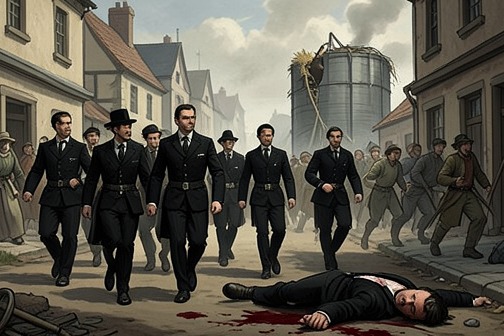
The [1922 Fascist Punitive Expedition in Ravenna](entity:event-recall-event-1922-2d7a1a749f05) was a twenty-four-hour campaign of organized Fascist violence across the provinces of [Ravenna](entity:location-recall-location-b931f601f413) and Forlì. Set in motion after a union conflict over the transport of threshed wheat, it began as a response to a local killing and widened into an attack on socialist and communist organizations. Its course exposed a central tension in the movement: while [Benito Mussolini](entity:character-recall-character-benito-mussolini-0330d40d2c3f) and party representatives pursued entry into government, [Italo Balbo](entity:character-recall-character-2e79cde02db9) used regional squads to impose power through coercion, even when their actions undermined those negotiations.
## Causes and Political Setting
The immediate crisis reached Balbo in [Ferrara](entity:location-recall-location-970ebca292e4) in a letter from Ravenna reporting that Balestrazzi had been beaten to death, that shooting had broken out, and that seven people were dead. The account locates the killing in a dispute between Fascist and socialist unions over the transport of threshed wheat: a Fascist carter was killed during the conflict. Balbo ordered the Romagna squads to march on Ravenna and set out himself. The violence thus began in a specific labor dispute, but the response treated it as a wider contest for control of the city and countryside.
That contest had deep roots in the region’s polarized labor politics. Earlier accounts describe socialist organizations exercising influence over urban and rural life, while peasant leagues controlled hiring, work arrangements, threshing, and seed distribution in parts of [Emilia](entity:location-recall-location-emilia-b49a9aa2ef04). In Ferrara, the leagues’ power rested on a large membership and coordinated control of agricultural labor; landowners and workers were already locked in struggles over wages, employment, and authority. The Ravenna expedition did not arise from that background alone, but it took place in a region where organizing and counter-organizing had become contests over who could set the terms of work and public life.
Balbo’s decision also coincided with a national political maneuver. In [Rome](entity:location-recall-location-f3877a21016f), Mussolini was speaking with political figures in an effort to bring the Fascists into government or prevent the formation of an anti-Fascist government. The campaign in Ravenna therefore unfolded beyond the parliamentary arena, as a demonstration of the movement’s capacity to mobilize and act locally while national negotiations remained unresolved.
## Mobilization and Escalation
The initial clashes spread beyond the city. In Cesenatico, [Leandro Arpinati](entity:character-recall-character-leandro-arpinati-504d6ebd7829) survived an assassination attempt while travelling toward Ravenna, but his companion Clearco Montanari, a founder of the Bolognese Fascio, was killed. That night, Fascists attacked the Provincial Confederation of Socialist Cooperatives in retaliation. The building, described as a stronghold of the red leagues, was destroyed by fire. [Nullo Baldini](entity:character-recall-character-be2e38d274a8), a moderate socialist deputy who had founded the cooperative and devoted his life to the farmworkers of Romagna, arrived as it burned. The account emphasizes the contrast between his lifelong work and the destruction of the institution he had built; no one physically attacked him.
The party leadership in Rome attempted to halt the escalation. [Michele Bianchi](entity:character-recall-character-michele-bianchi-6ec6b0301223) telegraphed Balbo, on behalf of the party, ordering an end to the violence because it was obstructing Mussolini’s negotiations. Balbo ignored the reprimand. He went to the police commissioner and threatened to burn the homes of Ravenna’s socialists unless trucks with fuel were provided within half an hour. The police chief supplied them, and Balbo joined the column as it departed. The episode shows the expedition’s dependence on transport and its capacity to compel state officials to assist it, even as party leaders sought to restrain its actions.
## The Twenty-Four-Hour Campaign
The expedition began at eleven in the morning on July 29, at the same time that [Filippo Turati](entity:character-recall-character-filippo-turati-ab4f1019d6ae) was meeting the king at the [Quirinal Palace](entity:location-recall-location-quirinal-palace-23b46ee6a65f) for the first time in the history of the Socialist Party. The timing placed the armed campaign alongside a major political attempt to resolve the crisis through negotiation. The Fascist column remained in motion through the night and into the following morning; the account describes twenty-four hours without rest or food.
Its route ran through Rimini, Santarcangelo, Savignano, Cesena, and Bertinoro, and across the countryside of the provinces of Forlì and Ravenna. In his diary, Balbo recorded that the squads destroyed and burned the headquarters of socialist and communist organizations and other buildings identified as red houses. The account describes fires marking their passage across the plain. The violence was not confined to one confrontation in Ravenna: the march carried the campaign through multiple towns and rural districts, turning a local retaliation into a province-wide punitive expedition.
At this stage, the narrative reports nine dead in the outskirts and rural areas. It does not provide a final total for the expedition. Its emphasis instead falls on the breadth of the operation, the destruction of organized opponents’ premises, and the fear experienced across the countryside. The march’s scale depended on coordinated squads and transport, while the rapid movement itself became part of its political force.
## Consequences and Significance
The squads returned to Ravenna at dawn on July 30. News of the campaign reached Rome, and negotiations for a government arrangement ceased. Turati’s effort had failed, and the socialists again proclaimed a general strike. The expedition therefore had consequences beyond the destruction it caused locally: it helped close off the political negotiations taking place during the march and contributed directly to a new confrontation between the labor movement and the Fascists.
The episode also makes visible the gap between the party’s national strategy and the conduct of its local commanders. Michele Bianchi’s order to stop violence reflected the immediate political cost of the attacks; Balbo’s refusal, followed by his threat to the police commissioner, showed that the campaign proceeded according to the logic of coercion rather than party restraint. The movement’s capacity to act outside parliament could strengthen its leverage, but in Ravenna that same action ended negotiations and renewed the strike.
The narrative places this campaign within a larger postwar struggle over who would shape [Italy](entity:location-recall-location-italy-85c2492cd54b)’s political future. It recalls the return of millions of veterans into a country where conflict and mass mobilization remained central, and it contrasts promises of national renewal with the practical use of organized force against political opponents. In Ravenna, the promise of order did not arrive through an agreed settlement: it was asserted by a moving column whose passage destroyed institutions, spread fear, and altered the national political situation.
Event 58
1922 Legalitarian General Strike and Fascist Suppression
The [1922 Legalitarian General Strike and Fascist Suppression](entity:event-recall-event-1922-1750359043ad) was a turning point in the struggle between organized labor, the Fascist movement, and the Italian state. The strike sought to defend political and union liberties; its defeat gave the Fascists an opening to present their violence as a substitute for state authority. Although labor called off the action, the reprisals continued, and the destruction of socialist organizations made the strike’s end a broader political collapse.
## Background and stakes
The confrontation followed a prolonged contest over control of work and local institutions. In [Emilia](entity:location-recall-location-emilia-b49a9aa2ef04), socialist organizations held 223 of 280 municipalities, while peasant leagues had gained control over hiring, work schedules, threshing, seed supplies, and planting. Their rules aimed to protect farmhands who could find work for an average of only 120 days a year, but the system also imposed penalties and boycotts on those who accepted lower wages or otherwise broke its collective terms. To landowners and many middle-class observers, this organization could look like an alternative authority governing rural life.
[Ferrara](entity:location-recall-location-970ebca292e4) made the material stakes especially visible. Seasonal farmworkers faced idle months and hunger, while landowners financed the local Fascist organizations. On April 25, 1922, [Italo Balbo](entity:character-recall-character-2e79cde02db9) proposed occupying Ferrara through a mass mobilization, using pressure on the government to secure work for farmworkers without burdening the agrarians who supported the Fascists. [Benito Mussolini](entity:character-recall-character-benito-mussolini-0330d40d2c3f) authorized the plan, and on the night of May 11 thousands marched into the city. The next morning, some fifty thousand impoverished farmworkers filled Ferrara; Balbo had cut telephone lines, requisitioned school buildings, and closed businesses. The operation demonstrated how a mass demonstration could be organized as both a political spectacle and a show of power.
The immediate trigger for the August confrontation was the Labor Alliance’s decision to call a general strike. Its leaders framed the action as a final collective defense of political freedom and trade-union rights, bringing workers’ and peasants’ organizations together. The announcement was disclosed prematurely by a newspaper employee in Genoa, disrupting the organizers’ plans. At the same time, [Vittorio Emanuele III](entity:character-recall-character-vittorio-emanuele-i-45cfd86fd0a5) summoned [Luigi Facta](entity:character-recall-character-luigi-facta-76e3fd731ea0) and pressed him to form a government without the socialists. Facta’s new ministry was effectively identical to the previous one, leaving the confrontation unresolved.
## The ultimatum and the opening of the assault
On August 1, [Michele Bianchi](entity:character-recall-character-michele-bianchi-6ec6b0301223) issued an ultimatum giving the state forty-eight hours to establish its authority over its employees and those said to threaten the nation. Once the deadline passed, he declared, [Fascism](entity:concept-recall-concept-fascism-37baf0d2849a) would claim freedom of action and replace a state that had again demonstrated its impotence. Benito Mussolini, writing in his newspaper, welcomed the prospect of victory. The ultimatum transformed the strike into a direct test of whether the government could restrain armed Fascist action.
In [Milan](entity:location-recall-location-617379caf4c2), the attack took the form of a coordinated occupation. Outside La Scala, a truck marked with the word Terror drove into the crowd. [Cesare Forni](entity:character-recall-character-cesare-forni-f7d2d174b95a) stood on its platform as it advanced toward [Palazzo Marino](entity:location-recall-location-c8d83f7646da), where the municipal council met. Fascists arrived in cars and in columns from Via Verdi, Via Manzoni, and Via Santa Margherita; they overwhelmed the military presence and entered the building. [Cesare Rossi](entity:character-recall-character-cesare-rossi-92b80e4f71a4), who had been waiting for the strike to provide a pretext for action, directed arriving squads with [Amerigo Dumini](entity:character-recall-character-amerigo-dumini-c67af1da031c) close beside him as his bodyguard.
The scene was not directed from a single, clearly present national command. Benito Mussolini was away from Milan, and those around Rossi could not locate him; his brother Arnaldo repeatedly called hotels in the Castelli area. Meanwhile, rumors circulated among the Fascists that [Gabriele D’Annunzio](entity:character-recall-character-gabriele-d-annunzio-6e66d28027db) might appear. He was staying nearby, but his visit to Milan had no connection to the strike, and he refused to let his name be drawn into an act of violence he opposed. His distance from the operation contrasted with the effort by Fascist organizers to invoke his presence as a source of authority.
## Suppression across [Italy](entity:location-recall-location-italy-85c2492cd54b)
When the ultimatum expired, armed Fascist action spread through Italy, backed, the narrative observes, by bourgeois and liberal fears. In Milan, [Aldo Finzi](entity:character-recall-character-aldo-finzi-616b59a6f498) began the operation by driving a tram out of its depot on Via Leoncavallo, with armed squad members at its windows. The attack on Palazzo Marino formed part of a wider counteroffensive rather than an isolated street clash.
The day also exposed the gap between appeals for restraint and events on the ground. In Milan, Gabriele D’Annunzio called for compassion and brotherhood among workers. At the same time, a few streets away on [Via San Damiano](entity:location-recall-location-1b391e490dc0), squads associated with Forni and [Roberto Farinacci](entity:character-recall-character-roberto-farinacci-2da81f7e737e) prepared to burn the premises of [Avanti!](entity:object-recall-object-avanti-1bed44223b67) for the third time. The newspaper offices were destroyed, and the assault became part of a wider retaliation. The contrast did not merely juxtapose two speeches or two locations: it showed how, amid the strike’s defeat, conciliatory words had little power to interrupt organized action.
The strike was called off on August 4, but the reprisals did not stop. Hundreds of cooperatives, associations, and chambers of labor were destroyed throughout the country, and socialist administrations resigned. On August 12, as Benito Mussolini flew over Italy in a [Macchi M.18](entity:object-recall-object-macchi-m-18-ca8584297d88) seaplane, smoke from fires remained visible in [Tuscany](entity:location-recall-location-5aab1681c149), Emilia, and the lower [Po Valley](entity:location-recall-location-po-valley-77b96c5b60d4). The aerial view made the scale and persistence of the destruction legible: the defeat had continued beyond the formal end of the strike.
## Consequences and significance
[Filippo Turati](entity:character-recall-character-filippo-turati-ab4f1019d6ae) described the strike in La Giustizia as the socialists’ [Caporetto](entity:location-recall-location-6efe2fb82db4), conceding that they had played their last card and been soundly defeated. His report acknowledged that Fascists had become masters of the field in the major centers and could, if they chose, continue delivering blows. The strike’s failure was therefore not simply a lost work stoppage. It revealed how vulnerable organized labor had become when political liberties depended on a state unable or unwilling to protect its institutions from armed groups.
For Benito Mussolini, the socialist defeat changed the immediate calculation. He judged that there was no longer a need to keep striking the socialists and that the next decisive conflict would be between the Fascists and the liberal state. That assessment gives the event its larger significance: the suppression weakened the movement that had organized the strike while leaving the state as the next object of Fascist pressure. The action presented as a defense of order had helped demonstrate that armed squads could determine events even when the government remained formally in place.
Event 59
1922 Italian General Strike
The [1922 Italian General Strike](entity:event-recall-event-1922-0ccf692dce6e) was the Labor Alliance’s last attempt to unite [Italy](entity:location-recall-location-italy-85c2492cd54b)’s workers and peasants against Fascist attacks and defend political and union liberties. Proclaimed for midnight on July 31 as a legalitarian strike, it was undermined by factional division and a premature leak. Its defeat exposed the weakness of organized resistance and dealt what the narrative calls the coup de grâce to the remnants of the socialist movement.
## A movement divided before the strike
The strike came after months of weakening socialist organization. On June 1, at the request of the labor confederation, the socialist parliamentary group had voted for the Zirardini agenda, which committed deputies to seek an agreement with the government to restore public liberties and the rule of law. The party’s maximalist leaders rejected the initiative, accusing the reformists of collusion with the bourgeoisie. Meanwhile, between late July and early August, 221 left-wing administrations fell in the province of Novara alone. The proletariat, the account observes, was left without help or protection as its leaders argued over strategy.
The divisions were visible in the days immediately before the strike. On July 29, [Filippo Turati](entity:character-recall-character-filippo-turati-ab4f1019d6ae) went to meet [Vittorio Emanuele III](entity:character-recall-character-vittorio-emanuele-i-45cfd86fd0a5); radical socialists condemned the visit as a betrayal, while communists mocked Turati. The strike was thus called not by a unified movement but by organizations already mistrustful of one another. The Labor Alliance’s appeal insisted that the body uniting the proletariat had to survive and strengthen the workers’ defense movement, framing collective action as necessary precisely because Fascist pressure was intensifying.
## The call and the government’s response
The immediate trigger was the news of [Italo Balbo](entity:character-recall-character-2e79cde02db9)’s column of fire. The Labor Alliance made a final attempt at resistance by proclaiming a general strike to begin at midnight on July 31. It presented the action as a united defense of political freedoms and trade-union rights, and as a decisive gamble: the movement was staking everything on a final effort to resist.
The announcement was mistakenly disclosed in advance by a newspaper employee in Genoa, throwing the preparations into disarray. At the same time, Vittorio Emanuele III was still negotiating for socialist support for a government of the left. He summoned [Luigi Facta](entity:character-recall-character-luigi-facta-76e3fd731ea0) and, in an emotional appeal, urged him to form a new cabinet without the socialists. By five o’clock that afternoon, Facta had formed a ministry identical to the previous one. The strike’s call therefore coincided with a government change that did not bring the socialists into power or resolve the crisis the action was meant to confront.
On August 1, as unrest began, Fascist secretary [Michele Bianchi](entity:character-recall-character-michele-bianchi-6ec6b0301223) issued an ultimatum giving the state forty-eight hours to establish its authority over its employees and those said to threaten the nation. After that deadline, he declared, [Fascism](entity:concept-recall-concept-fascism-37baf0d2849a) would claim full freedom of action and replace the state if it again proved impotent. [Benito Mussolini](entity:character-recall-character-benito-mussolini-0330d40d2c3f) likewise used his newspaper to express confidence in Fascist victory. The ultimatum turned the confrontation into a direct contest over who could claim to exercise authority: the government, or the movement threatening to act in its place.
## Defeat and its human cost
The strike failed to halt the Fascist offensive. Workers who had responded to the call despite having struck repeatedly before were seized at home under armed threat and forced back to work; their houses were burned. [Giacomo Matteotti](entity:character-recall-character-giacomo-matteotti-b1b8c0b072bc) saw their return to action as an admirable act of faith, but one without a future. The defeat was not simply a lost labor dispute: it showed how little protection workers could expect from a movement whose organizations were divided and from a state unable to secure their freedom to act.
The narrative describes the strike as the coup de grâce to what remained of the socialist movement. Benito Mussolini later argued that antifascist passivity had helped the Fascists and conceded that even a limited general strike might have obstructed their advance. That retrospective remark underscores the strike’s significance: its defeat strengthened the impression that Fascist power faced no effective collective resistance, while the call for unity made plain how far the socialist movement had fallen short of the solidarity it needed.
Event 60
1922 Split in the Italian Socialist Party
The [1922 Split in the Italian Socialist Party](entity:event-recall-event-1922-1f5c3f4b079a) was a decisive rupture in an already embattled movement: at its October congress in [Rome](entity:location-recall-location-f3877a21016f), reformists were expelled, and those ousted formed a separate party under [Giacomo Matteotti](entity:character-recall-character-giacomo-matteotti-b1b8c0b072bc). The division did not simply settle an argument about revolutionary strategy. It left the reformists responsible for a new organization at a moment when socialist influence and collective resistance were under mounting pressure.
## A movement under pressure
The split came after years in which socialist organizations had become powerful in local political and working life. In [Bologna](entity:location-recall-location-bologna-e9b2b10db055), competing labor organizations pressed demands in an atmosphere of escalating class conflict; even the socialist mayor struggled to keep pace with calls to occupy elegant homes. Union membership could determine access to bread, while employers, caught between pressure and uncertainty, sometimes preferred to sell their businesses. In the countryside, leagues, cooperatives, and popular institutions gave socialism a broad organizational presence.
In [Emilia](entity:location-recall-location-emilia-b49a9aa2ef04), socialists controlled 223 of 280 municipalities. The peasant leagues also shaped hiring, work schedules, threshing, seed supplies, and planting. Farmhands averaged only 120 working days a year, making wages and access to seasonal employment immediate questions of survival. This influence depended on organization and enforcement: labor hiring went through league placement offices, and those who accepted lower wages or broke agreed rules could face social exclusion or be forced to leave. Such strength made the socialist movement a major force, but it also placed its internal disputes amid intense conflict over who would control work and political life.
That conflict had increasingly included organized fascist action. In January 1921, a [Ferrara](entity:location-recall-location-970ebca292e4) expedition was planned as a coordinated attack on peasant leagues in six rural communities, using armed groups, surprise, and trucks supplied by the Agrarian Association. In May 1922, thousands of impoverished rural people marched toward Ferrara under the organization of local fascist leaders. By the summer, the Labor Alliance’s call for a legalitarian general strike sought to unite workers’ and peasants’ organizations in defense of political and union liberties. Its announcement was disclosed early, and the effort became a final, high-stakes attempt at resistance. These pressures formed the political setting for the later rupture, though the congress’s immediate dispute was the direction of the socialist party itself.
## The Rome congress and the break
The decisive confrontation took place on October 3, 1922, during the nineteenth congress of the Italian Socialist Party. The delegates faced a strategic dilemma: another division might further weaken the movement, yet the opposing positions had become difficult to reconcile. The question of expelling the reformists came to a vote. [Giacinto Menotti Serrati](entity:character-recall-character-giacinto-menotti-se-21bcf4177c8d)’s proposal carried by only a handful of votes, and [Filippo Turati](entity:character-recall-character-filippo-turati-ab4f1019d6ae) and Matteotti were expelled from the party to which they had devoted their political lives.
The congress did not end with expulsion alone. It resolved that the party should join the [Communist International](entity:organization-recall-organization-communist-intern-ce17a5248ccd) and send a new delegation to [Moscow](entity:location-recall-location-19aceb5ce281). Discussion then turned to who should make up that delegation. The sequence exposed how the congress joined two consequential decisions: it removed the reformist wing while committing the remaining party to a closer international communist alignment. The vote settled the immediate question by splitting the organization, not by reconciling its competing strategies.
## The [Unitary Socialist Party](entity:organization-recall-organization-bed6c5ce7f9c)
Turati, Matteotti, [Claudio Treves](entity:character-recall-character-claudio-treves-0854cd58f6fd), Giuseppe Saragat, and Sandro Pertini established a third party of the Italian left, the Unitary Socialist Party. Matteotti was elected secretary. The founders were now outside the party’s maximalist revolutionary politics, but this new independence offered no clear program for what to do next. The account presents their freedom as both a release from a politics of repeatedly announced but unrealized revolution and a fresh uncertainty.
Matteotti’s appointment made that uncertainty personal. On October 10, he wrote to [Velia Titta Matteotti](entity:character-recall-character-velia-titta-matteot-07f1af338e3a) that he wanted to protect her, their children, and himself, and that extreme sacrifices seemed pointless. Yet he had accepted the party secretaryship, adding that he hoped not to hold it for long. His reluctance did not keep him from taking responsibility for the organization created by the split; instead, the new party’s leadership began with the uneasy coexistence of political duty and a desire to withdraw from danger.
## Consequences and significance
The division followed a broader weakening of socialist resistance. After the summer strike, workers who had repeatedly answered strike calls were forced back to work under threat, while some saw their homes burned. The narrative presents their persistence as an act of faith even as the movement’s ability to act collectively diminished. Against that backdrop, the October rupture further divided an already pressured political force.
The episode also contrasts two kinds of political cohesion. The socialist congress produced a narrow vote, expulsion, and unresolved questions about both strategy and leadership; outside it, political movements were organizing supporters through disciplined mobilization and increasingly forceful action. The split did not by itself explain the decline of Italian socialism, but it marked a moment when a major internal disagreement became an institutional break. The new party gave the expelled reformists a distinct home, while the congress’s decision to join the Communist International set a different course for those who remained.
Event 61
March on Rome
The [March on Rome](entity:event-recall-event-f817683ad1d8) was the [National Fascist Party](entity:organization-recall-organization-national-fascist-c9d1f7e3cfc5)’s planned seizure of power in October 1922, combining a threatened armed uprising with political maneuvering against a faltering government. The columns that gathered near the capital were badly outmatched by the forces defending it, and the insurrection had already failed in the Lazio countryside when [Benito Mussolini](entity:character-recall-character-benito-mussolini-0330d40d2c3f) was appointed prime minister. Its decisive result was therefore not a military conquest of [Rome](entity:location-recall-location-f3877a21016f), but a transfer of government under pressure from a movement whose armed threat the liberal state could not—or would not—suppress.
## Background and Decision
The plan emerged amid a wider struggle over who could command the streets and the countryside. In [Emilia](entity:location-recall-location-emilia-b49a9aa2ef04), socialist leagues and labor organizations had built formidable local networks; in [Ferrara](entity:location-recall-location-970ebca292e4), the leagues regulated hiring and other parts of rural economic life. Against this background, Fascist organizers developed methods for mobilizing people and resources beyond the city. An early example came in January 1921, when a Ferrara punitive expedition used trucks supplied by the Agrarian Association and organized armed men to strike several rural centers simultaneously. The later march drew on this growing capacity for coordinated action, though it operated on a national scale and pursued a different immediate objective: control of the government.
The political crisis sharpened in the summer of 1922. After the Labor Alliance called a general strike to defend political and union liberties, [Michele Bianchi](entity:character-recall-character-michele-bianchi-6ec6b0301223) issued an ultimatum claiming that [Fascism](entity:concept-recall-concept-fascism-37baf0d2849a) would act in place of a state unable to defend its authority. [Luigi Facta](entity:character-recall-character-luigi-facta-76e3fd731ea0) formed a new cabinet, but the confrontation reinforced the Fascists’ claim that the government was impotent. Meanwhile, attempts by the state to restrain the squads had faltered. On December 15, 1921, Prime Minister Bonomi had issued a circular treating truncheons as weapons requiring a license and classifying Fascist paramilitary groups as illegal formations. Within forty-eight hours, Bianchi countered that party sections and combat squads were inseparable, and the directive appeared in [Il Popolo d’Italia](entity:object-recall-object-il-popolo-d-italia-b2b48dcea0f3). The episode exposed the widening distance between the state’s formal orders and its capacity to enforce them.
In the planning discussions, Mussolini argued that an immediate march was necessary before Facta could strengthen his position through a reconciliation with [Giovanni Giolitti](entity:character-recall-character-giovanni-giolitti-24b78735ff0a) and [Gabriele D’Annunzio](entity:character-recall-character-gabriele-d-annunzio-6e66d28027db). He said he had reached an understanding with D’Annunzio, but feared that a public gesture joining Giolitti and the poet on November 4, [Italy](entity:location-recall-location-italy-85c2492cd54b)’s victory anniversary, would give Giolitti renewed authority. The decision was for violent action; the precise day was left open until after a major Fascist conference in [Naples](entity:location-recall-location-naples-13ce8e2c4961). The plan assigned full military powers to a four-man command: Bianchi, [Italo Balbo](entity:character-recall-character-2e79cde02db9), [Emilio De Bono](entity:character-recall-character-emilio-de-bono-c12a4110f12e), and [Cesare Maria De Vecchi](entity:character-recall-character-cesare-maria-de-vec-8f7ef66572f9). [Perugia](entity:location-recall-location-perugia-1cc190912c09) was to serve as headquarters, Foligno as the reserve base, and forces were to gather at designated points near Rome.
## Mobilization and Command
At a later confidential meeting, Mussolini set out a more detailed operational plan. Party hierarchies would transfer authority to the quadrumvirate at midnight between October 26 and 27, after which even Mussolini was expected to obey its orders. Italy was divided into twelve zones, each assigned an inspector general; the strategically important zone of Piedmont, Liguria, and Lombardy went to [Cesare Forni](entity:character-recall-character-cesare-forni-f7d2d174b95a). On the appointed day, inspectors were to mobilize local forces and occupy key provincial positions. Columns would assemble at [Santa Marinella](entity:location-recall-location-santa-marinella-4cd56252021e), Mentana, and [Tivoli](entity:location-recall-location-tivoli-3d8f79483f9d), with the objective of compelling the formation of a government that included at least six Fascists in important ministries. Mussolini also read aloud a proclamation he had kept ready for the insurrection.
The command arrangements proved weaker than the plan suggested. In Perugia, the quadrumvirs found themselves cut off from reliable communication with the rest of the country. The city had few, circuitous regional rail connections, and its telephone and telegraph links were nearly nonexistent. Unable to reach Mussolini in [Milan](entity:location-recall-location-617379caf4c2) for permission, the commanders could not move their headquarters to [Orte](entity:location-recall-location-orte-c8e973c174b3), a better-connected railway hub near the troop concentration areas. The local command included the squads Satana, Toti, [Fiume](entity:location-recall-location-fiume-c271af61753f), Grifo, and Disperatissima, a name meaning Extremely Desperate that suited the strained circumstances. The details of mobilization could be precise; the means of coordinating it were not.
## The Failed Insurrection and Appointment
At 8:30 a.m. on October 28, as the proclamation of a state of siege was being posted in Rome, the uprising had already failed in the Lazio countryside. General [Emanuele Pugliese](entity:character-recall-character-emanuele-pugliese-29fa1d25664a) commanded 28,000 defenders, including soldiers, [Carabinieri](entity:organization-recall-organization-carabinieri-28c84a9cf0f4), finance guards, and royal guards. They had 60 machine guns, 26 cannons, and 15 armored cars. The three Fascist columns at the concentration areas numbered perhaps 10,000. Many marchers were hungry, rain-soaked, and inadequately armed; some carried pistols, daggers, clubs, or farm tools, while others had no weapons. Even among those with military rifles, ammunition was scarce, and the few rifles were assigned to experienced veterans positioned at the fronts and sides of the columns.
The disparity makes the outcome’s political character especially clear. The marchers did not overcome Rome’s defenders in a decisive battle. Rather, the prospect of an armed assault operated alongside negotiations and the government’s crisis. On October 30, at 11:05 a.m., Victor Emmanuel III received Mussolini at the Quirinal and charged him with governing Italy. At thirty-nine, Mussolini became the country’s youngest prime minister and the youngest ruler in the world at the time. He had entered the [Chamber of Deputies](entity:organization-recall-organization-20acc842a4eb) only sixteen months earlier and had no experience in government or public administration. He arrived in a black shirt, the uniform of an armed party, as the head of a government whose formation followed the insurrection’s threat rather than its military success.
The appointment did not immediately turn the marchers’ presence into a completed spectacle. Mussolini had travelled from Milan by train, delayed when Blackshirts blocked the tracks at several points, including [Sarzana](entity:location-recall-location-4920330c3a3d) and [Civitavecchia](entity:location-recall-location-civitavecchia-62608a89bf89), to greet him. On October 31, after the Fascist government had been formed, the squads were allowed to enter Rome. Mussolini had resisted sending them home without the satisfaction of a march, warning that he could not answer for their reaction. The capital thus saw a public procession by men who had spent three days and nights outside in the rain, even though the decisive transfer of office had already taken place.
## Aftermath and Political Meaning
The armed movement continued to exact a price beyond the capital. In [Bologna](entity:location-recall-location-bologna-e9b2b10db055), [Leandro Arpinati](entity:character-recall-character-leandro-arpinati-504d6ebd7829) led an attack on barracks and ammunition depots after freeing Fascist comrades held in San Giovanni in Monte. Eight young Blackshirts were killed in the action, which took place after Mussolini had already received the king’s telegram and was preparing to leave Milan. Their deaths show how the march’s momentum could outlast the strategic moment it was meant to serve: local squads continued to act even when the national transfer of power had been secured.
A year later, the anniversary was staged as proof of transformation. On October 28, 1923, an assembly in Milan began at eight in the morning with army battalions, militia centuriae, and civic and patriotic associations. Mussolini reviewed the assembled forces on horseback in the uniform of an honorary militia corporal. The scale of the gathering—thousands where an earlier rally had drawn only a few hundred—gave public form to the claim that a small movement had become a mass national force. The march was remembered not simply as an attempted military operation, but as the founding scene of a new political order.
That founding claim sat beside the continuing operation of institutions the Fascists had not abolished. In January 1924 the Chamber was dissolved and elections were called for April 6; the coming vote was presented as a plebiscite for or against Mussolini. At the same time, Mussolini’s agreement with [Yugoslavia](entity:location-recall-location-yugoslavia-34570170fc0c) granting Fiume to Italy offered a diplomatic achievement that contrasted with Gabriele D’Annunzio’s earlier poetic enterprise. Together, these developments show how the consequences of the march extended beyond the streets: the threat of armed mobilization had helped bring Mussolini into office, while elections, diplomacy, and public ceremony became means of consolidating the authority that followed.
Event 62
Mussolini's Bivouac Speech
Mussolini’s Bivouac Speech, delivered by [Benito Mussolini](entity:character-recall-character-benito-mussolini-0330d40d2c3f) to the [Chamber of Deputies](entity:organization-recall-organization-20acc842a4eb) on November 16, 1922, made the threat behind his government’s arrival impossible to ignore. He described the blackshirt revolution as legitimate and told the assembled deputies that armed supporters could have turned their chamber into a bivouac. Parliament remained in session, but the speech presented its authority as conditional on Mussolini’s restraint.
## The Chamber and Its Welcome
At three in the afternoon, the chamber was packed: galleries and corridors overflowed with spectators, and the public mood was festive. Benito Mussolini entered with his ministers, preceded by Chamber president Enrico De Nicola and followed by General [Armando Diaz](entity:character-recall-character-armando-diaz-85fb43befc5b). Deputies rose to applaud, except for representatives of the left; the galleries joined the ovation. The scene suggested broad anticipation that the new government might restore order, even among people who had suffered under Fascist violence.
Mussolini began by calling his appearance an act of formal deference to the deputies, adding that he asked no explicit recognition. The courteous formula was also an insult: he presented his address as a concession to parliamentary form, not an acknowledgment that the chamber was entitled to his government’s obedience.
## A Revolution Claimed as Mandate
He then appealed beyond the deputies to the Italian people, asserting that they had passed over a ministry and given themselves a government outside, above, and contrary to parliamentary appointment. He called the revolution fully legitimate and said he was there to defend and empower the blackshirt revolution. The claim shifted the source of authority from parliamentary procedure to a popular mandate defined by the Fascist movement itself.
The galleries filled with [Squadristi](entity:character-recall-character-squadristi-eced99702e80) answered the invocation of revolution with thunderous applause. In that response, the street action that had brought Mussolini to power seemed to enter the chamber with him. His words did not merely recall the march on [Rome](entity:location-recall-location-f3877a21016f); they refused to let parliament treat it as an episode that could be set aside now that a government had been appointed.
## The Bivouac Threat
After indicating that he did not intend to be intemperate, Mussolini abruptly turned to the force he said he could command. He spoke of 300,000 armed young men, determined and ready for his order, and said he could have punished those who had maligned him and turned the chamber into a bivouac for companies of Squadristi. The threat was framed as a possibility he had chosen not to enact, but its restraint was itself the point: the deputies were being told that their safety depended on his decision.
The chamber’s relief at his assurance that he would not act intemperately gave way to the force of the threat. Most non-Fascist deputies sat in painful silence. [Francesco Saverio Nitti](entity:character-recall-character-francesco-saverio-n-f3bc92931cc1) left the hall; [Giacomo Matteotti](entity:character-recall-character-giacomo-matteotti-b1b8c0b072bc) and Modigliani rose from the Socialist benches. Their dissent stood out against the broader failure to answer Mussolini’s humiliation of parliament, while the Squadristi in the galleries cheered.
## Meaning and Political Context
The speech joined two claims that would recur in Mussolini’s public politics: that a new national order would replace a discredited old one, and that mass enthusiasm could be made to signify both popular consent and disciplined power. At the founding of the [National Fascist Party](entity:organization-recall-organization-national-fascist-c9d1f7e3cfc5), he had described [Fascism](entity:concept-recall-concept-fascism-37baf0d2849a) as a force that would absorb prior methods through violence and remake Italians into a unified nation. Later, addressing a vast Fascist gathering, he presented the movement’s growth from small groups into legions as a religious revival and the transformation of a people into a state. The Bivouac Speech gave that language of national rebirth an immediate parliamentary edge.
Its title captures the speech’s central reversal. A bivouac belongs to an army in the field; Mussolini used it to imagine the elected chamber as a space that armed followers might occupy. The institution was not formally dissolved in the speech, but its vulnerability was made part of the address. Parliamentary procedure continued, while the leader openly asserted that force—not the chamber’s independent authority—set the limits of political life.
Event 63
Italian Chamber of Deputies Confidence Vote on the Mussolini Government
The [Italian Chamber of Deputies Confidence Vote on the Mussolini Government](entity:event-recall-event-92b1dee731ce) turned a parliamentary session into a demonstration of the new government’s authority. Although the [National Fascist Party](entity:organization-recall-organization-national-fascist-c9d1f7e3cfc5) held only 35 seats, the chamber voted 306 to 116, with 7 abstentions, to support [Benito Mussolini](entity:character-recall-character-benito-mussolini-0330d40d2c3f)’s government and grant it full powers. The result preserved the appearance of parliamentary procedure while revealing how little room remained for effective resistance.
## A Chamber Under Pressure
On November 16, 1922, the chamber was packed with deputies and spectators. Senators, diplomats, former deputies, and elegantly dressed visitors filled the galleries; the public gallery and side corridors were crowded with people who had come to see the new government. The atmosphere was festive, and most deputies rose to applaud when Mussolini entered, accompanied by his ministers and General [Armando Diaz](entity:character-recall-character-armando-diaz-85fb43befc5b). Representatives of the left remained seated.
The session took place only fifteen days after the [March on Rome](entity:event-recall-event-f817683ad1d8). The press had variously described that seizure of power as a bloodless revolution, a dawn of a new era, or a farce. Yet, in [Rome](entity:location-recall-location-f3877a21016f) alone, the preceding fifteen days had left 19 dead and 20 seriously injured. The crowded chamber and its applause gave the new government a spectacle of public welcome even as the violence surrounding its arrival risked being forgotten.
## The Ultimatum and the Vote
Mussolini told the deputies that he did not wish to govern against the chamber while that remained possible, but warned that it could be dissolved in two days or two years. The threat made the chamber’s continued existence seem conditional: the deputies were being asked to approve a government that had already made clear it could dispense with them.
He then requested full powers. No deputy openly rebelled. During the recess, parliamentarians urged [Giovanni Giolitti](entity:character-recall-character-giovanni-giolitti-24b78735ff0a) to protest in defense of the chamber’s dignity; he declined, saying that the chamber had the government it deserved. His response captured the session’s prevailing resignation, but the recorded vote made that capitulation institutional: 306 deputies voted in favor, 116 against, and 7 abstained. Even outspoken critics, including Deputy Gasparotto and Senator [Luigi Albertini](entity:character-recall-character-luigi-albertini-a87aea485d6b), voted for the government. The chamber also granted the requested powers.
## Parliamentary Form and Political Reality
The vote’s scale was striking beside the Fascist Party’s limited representation: its 35 deputies could not account for the 306 votes of confidence. The government’s authority therefore rested not simply on its own parliamentary strength, but on the wider chamber’s decision to endorse it. Formal approval did not neutralize the ultimatum that preceded it; instead, it gave the concentration of power a parliamentary form.
The episode also followed a longer weakening of the liberal state’s ability to restrain Fascist organization. When Prime Minister [Ivanoe Bonomi](entity:character-recall-character-87432be97504) tried to classify party sections and combat squads as illegal formations, [Michele Bianchi](entity:character-recall-character-michele-bianchi-6ec6b0301223) declared them an inseparable unit and published the directive in [Il Popolo d’Italia](entity:object-recall-object-il-popolo-d-italia-b2b48dcea0f3). The government’s rules were not effectively enforced. Against that background, the chamber’s grant of full powers marked more than a vote of confidence: it showed elected representatives authorizing an executive whose armed movement had already tested the limits of state control.
## Consequences and Significance
Giolitti’s refusal to defend the chamber and the overwhelming vote together made the session a turning point in the practical standing of parliament. The legislature was not immediately dissolved, but Mussolini’s warning cast its survival as a matter of his choice. The vote thus confirmed the government while diminishing the institution that confirmed it.
The session’s contrast was stark: a packed, applauding chamber on the surface, and a decisive transfer of authority beneath it. The deputies’ approval gave the new government a legal and parliamentary endorsement, but the terms of the encounter showed how approval under threat could help hollow out the restraints it seemed to uphold.
Event 64
Turin Massacre of 1922
The [Turin Massacre of 1922](entity:event-recall-event-1922-61e5964f1fac) was a two-day wave of Fascist squad violence in [Turin](entity:location-recall-location-turin-7d5a70373e49), beginning after two Fascists were killed in a street clash. [Piero Brandimarte](entity:character-recall-character-piero-brandimarte-b057f8a73b48) assembled thousands of Blackshirts for retaliation; the raids spread beyond those responsible for the initial deaths, bringing killings, destruction, and innocent victims. [Benito Mussolini](entity:character-recall-character-benito-mussolini-0330d40d2c3f) publicly condemned the massacre, but his subsequent amnesty and creation of a state militia turned the episode into a stark example of how Fascist violence could be denounced and then absorbed into the state.
## Background and Trigger
Barely a month after the vote of confidence in Benito Mussolini’s government, a communist tram driver killed two Fascists during a street clash near the Barriera di Nizza tram station. The account suggests the dispute may have been personal and connected to a woman, rather than a planned political attack; the circumstances are presented with uncertainty. That distinction did not restrain the response. Piero Brandimarte, leader of Turin’s [Fascist squads](entity:organization-recall-organization-fascist-squads-02305958dd0b), gathered 3,000 Blackshirts from across the region, invoking revenge for the dead as the justification for a much wider operation.
## The Raids and Their Victims
From the afternoon of December 18 until the afternoon of December 20, Brandimarte’s squads carried out raids, seizures, arson, and killings. Their actions included mistaken identifications and the deaths of innocent people. The violence reached homes and workplaces: people were attacked in family settings, young workers were dragged into the streets, and bodies were later found beyond the city center. The campaign also included another fire at the Chamber of Labor, described as the third in a series. The squads celebrated beside the burning building, making the destruction both an assault on organized labor and a public display of their power.
The episode’s reach and duration made it more than a reprisal against the individuals involved in the initial clash. For two days and nights, Turin was subjected to unrestrained violence, while raids, fires, and killings accumulated across the city. The account emphasizes the scale of the suffering but gives no total death toll; it records instead the variety of victims and the role of mistaken identity in extending the attack beyond its stated target.
## Government Response and Aftermath
Benito Mussolini immediately repudiated the squads’ conduct and called the massacre a discredit to humanity, threatening punishment. Three days after the violence ended, on December 23, he proclaimed a general amnesty for politically motivated blood crimes committed in the name of national aims. On December 28, he issued the first decree to the [Italian Council of Ministers](entity:organization-recall-organization-fd77d697b055) for the creation of the [Voluntary Militia for National Security](entity:organization-recall-organization-5ad84aae927b).
The sequence exposed a central contradiction in the government’s response. Mussolini presented the squads’ actions as intolerable, yet the amnesty shielded politically motivated violence, and the new militia offered a way to place former squad members within a national institution. The attempt to contain further abuses thus also advanced the incorporation of Fascist armed force into the state.
## Significance
The massacre shows how a local clash could become the pretext for organized collective punishment, with retaliation reaching people beyond those responsible for the original deaths. Its aftermath joined condemnation to accommodation: the violence was publicly repudiated, politically motivated crimes were amnestied, and a state militia was established. In that progression, the episode marks not simply a breakdown of public order but a consequential shift in the relationship between Fascist squads and government power.
Event 65
Creation of the Voluntary Militia for National Security
The [Creation of the Voluntary Militia for National Security](entity:event-recall-event-4fa3d4b1741f) was the proposed institutional transformation of Fascist squad violence into a force directed by [Benito Mussolini](entity:character-recall-character-benito-mussolini-0330d40d2c3f). Presented as a means to defend the [Fascist revolution](entity:concept-recall-concept-fascist-revolution-4d42fe69bd6c) and maintain public order, the militia was also designed to disarm local squad leaders of independent authority while keeping organized coercion at the government’s disposal. Its creation exposed the tension between imposing order and preserving the threat of violence that had helped bring Mussolini to power.
## Causes and Political Context
The plan followed the [Turin](entity:location-recall-location-turin-7d5a70373e49) massacres of December 1922. After two Fascists were killed in a street clash, [Piero Brandimarte](entity:character-recall-character-piero-brandimarte-b057f8a73b48) assembled 3,000 blackshirts, and his squads carried out raids and other acts of violence across the city. Mussolini publicly repudiated the killings and threatened punishment. Three days after the violence ended, however, he proclaimed a general amnesty for politically motivated blood crimes committed for national purposes. On December 28, he sent the first decree for creating the militia to the Council of Ministers. The sequence made the government’s dilemma plain: it condemned uncontrolled squad violence while protecting its perpetrators from full accountability and preparing to incorporate them into a new institution.
The political context extended beyond Turin. The narrative presents the postwar period as a struggle between returning veterans, revolutionary mass movements, and established liberal institutions. In July [1919](entity:time-recall-time-1919-329d1bdc3600), the government had already urged Fascist cooperation in repressing revolutionary attempts, provided the Fascists accepted official command. In [Ferrara](entity:location-recall-location-970ebca292e4), meanwhile, new Fascist sections had grown rapidly after violence at the [Castello Estense](entity:location-recall-location-766b45cb2f0f); agrarian interests supplied material support, and 20,000 lire had entered local Fascist coffers by December 20. These earlier arrangements show how Fascist organization drew on both state accommodation and local resources, even as Mussolini sought to make the movement answer to him.
## Announcement and Organization
The proposal was announced to Fascist leaders in mid-December and approved by the Council of Ministers on December 28. At the first meeting of the [Grand Council of Fascism](entity:organization-recall-organization-2db651c9f0fe), [Emilio De Bono](entity:character-recall-character-emilio-de-bono-c12a4110f12e) presented its organizational plan. Its stated purposes were to defend the Fascist revolution and maintain public order. That duty would be removed from the army, while the [Royal Guard of Italy](entity:organization-recall-organization-royal-guard-of-i-389ef0fa706b), which had performed it in recent years, would be disbanded.
Recruitment was described as voluntary but limited to members of Fascist military formations. The existing squads were to be dissolved; Fascists who wished to remain in the movement would have to join the militia. Senior officers would come from the army, alongside some Fascist consuls promoted to colonel. Members would swear allegiance to [Italy](entity:location-recall-location-italy-85c2492cd54b) and, above all, to Mussolini as prime minister, with obedience defined as absolute. The structure thus joined military personnel and Fascist organizers under a command relationship centered on the head of government.
The announcement unsettled leaders who had expected to enjoy the results of their victory rather than continue a struggle framed as potentially lasting a generation. Mussolini also directed a pointed warning at [Roberto Farinacci](entity:character-recall-character-roberto-farinacci-2da81f7e737e), a prominent opponent of normalization who sat in the back row. The plan was not simply a response to public disorder: it was a bid to limit the provincial leaders’ independent control of armed squads.
## Centralization and Its Contradictions
Mussolini’s design sought to legalize Fascist violence while regulating it. By transferring squad members into a state-linked militia, he could present their force as an instrument of public order and draw them away from local commanders. At the same time, the militia would remain bound personally to the prime minister. The project therefore centralized armed power without separating it from Fascist party loyalty.
The arrangement was deliberately double-edged. Mussolini needed to restrain squads that refused to disarm after returning to their home towns, lest provincial leaders use them against him. Yet he also depended on the squads as a continuing threat against Parliament and the monarchy. The narrative stresses that the prospect of civil conflict remained a guarantee of his power. The militia was intended to make violence governable, not to remove it from politics.
## Decree and Aftermath
The militia’s formation was not yet complete when the plan reached the Grand Council. Three weeks after the Council of Ministers approved the decree, it was still on the king’s desk awaiting signature. The proposed institution therefore stood between political announcement and formal authorization: its organization had been laid out, but the decree had not yet cleared the royal stage described in the account.
The measure answered the immediate aftermath of the Turin killings by recasting the squads as a prospective national force. The combination of repudiation, amnesty, and institutional incorporation made the government’s response especially consequential: it promised to end uncontrolled violence by assigning armed Fascists a sanctioned role in public order. The plan’s significance lies in this conversion of movement violence into an instrument of state power, under a command structure intended to secure Mussolini’s control.
Event 66
1923 Turin Congress of the Italian People’s Party
The [1923 Turin Congress of the Italian People’s Party](entity:event-recall-event-1923-420dc9aa0269) turned an internal dispute over cooperation with [Benito Mussolini](entity:character-recall-character-benito-mussolini-0330d40d2c3f)’s government into a direct contest over the rules of parliamentary power. Its April 15 platform, carried by a majority, made collaboration conditional on party autonomy, constitutional freedoms, parliamentary integrity, and proportional representation, challenging Mussolini’s effort to secure a dependable majority through electoral reform.
## A Party Divided
The [Italian Popular Party](entity:organization-recall-organization-italian-popular-1ca12ab11e06) entered the congress divided over how to deal with Mussolini. Its right wing, close to the Vatican hierarchy, supported full cooperation and held ministerial and undersecretarial posts in his government. The left, associated with the white peasant leagues repeatedly targeted by [Fascist squads](entity:organization-recall-organization-fascist-squads-02305958dd0b), opposed cooperation outright. Between them, the center led by [Luigi Sturzo](entity:character-recall-character-luigi-sturzo-0a091db6f2c0) and his young secretary [Alcide De Gasperi](entity:character-recall-character-alcide-de-gasperi-3768bea85342) was willing to collaborate only if the party retained its independence and its moral principles were respected.
That division gave the congress stakes beyond the composition of the party leadership. The Popular Party had 110 deputies, and its support could determine whether a government coalition could be formed. The congress would therefore decide not only the terms on which Catholics might remain in Mussolini’s government, but also whether their parliamentary representation would continue to act independently.
## The Electoral Stakes
The immediate dispute concerned electoral reform. Mussolini had only 36 Fascist deputies in the legislature and wanted new elections under rules that could turn a minority of votes into a secure parliamentary majority. The [Grand Council of Fascism](entity:organization-recall-organization-2db651c9f0fe) had assigned an internal commission to examine proposals. Some southern liberals and provincial Fascist leaders favored single-member constituencies; [Roberto Farinacci](entity:character-recall-character-roberto-farinacci-2da81f7e737e) openly supported that arrangement. Mussolini instead favored a national-list system with a majority premium.
[Giacomo Acerbo](entity:character-recall-character-giacomo-acerbo-4672b8c7e6d0), undersecretary to the prime minister, was studying a proposal that would award two-thirds of parliamentary seats to a party receiving more than 25 percent of the affirmative vote. Such a rule, the account explains, would likely benefit the Fascist Party and allow Mussolini to determine the candidates placed on its lists. It threatened to weaken opposition and limit the autonomy of coalition partners as well as dissenting Fascists. The Popular Party’s insistence on proportional representation thus challenged a proposed change with consequences for the balance of power across parliament.
## The [Turin](entity:location-recall-location-turin-7d5a70373e49) Decision
The decisive assembly opened in Turin on April 12. Luigi Sturzo prevailed without openly presenting himself as the central figure in the contest. On April 15, the congress adopted its platform by majority vote: Popular Party participation in Mussolini’s government would be conditional on respect for its autonomy, the integrity of parliament, constitutional freedoms, and the preservation of proportional representation.
The decision made the electoral system the test of whether cooperation could continue on terms the Popular Party considered acceptable. Its 110 deputies gave that position substantial parliamentary force. The congress did not merely register a difference of opinion within the party; it established a collective condition that Mussolini’s government could not easily ignore while pursuing reform.
## Immediate Political Consequences
Two days after the congress ended, Mussolini summoned Stefano Cavazzoni, the Popular Party’s remaining minister following Tangorra’s death, together with Catholic undersecretaries. They belonged to the party’s right wing, which had lost at Turin. Mussolini thanked them for their collaboration and told them they were free to act and move as they wished—a formula that, in practice, dismissed them from the government. Cavazzoni made the portfolios available and signed a resignation letter on behalf of the Popular Party’s leaders.
The sequence gave the congress an immediate consequence: the party’s defeat of unconditional cooperation was followed by the removal of its remaining government representatives. Its demand to preserve proportional representation also placed a clear obstacle before Mussolini’s plans for an electoral law that would magnify Fascist parliamentary strength. The gathering made the Popular Party’s internal divisions visible, but its majority decision asserted a distinct parliamentary boundary against the government’s effort to consolidate power.
Event 67
阿尔弗雷多·米苏里遇袭事件
The assault on [Alfredo Misuri](entity:character-recall-character-alfredo-misuri-4c2cbbf02662) was a politically directed attack on a Fascist dissident after he challenged [Benito Mussolini](entity:character-recall-character-benito-mussolini-0330d40d2c3f)’s government in Parliament. Its significance lies in the sequence: Misuri invoked constitutional liberties and proposed restoring institutional limits; Mussolini demanded that he be punished; and squadristi attacked him that night. The next day, deputies confirmed confidence in the government, showing how parliamentary procedure could continue alongside intimidation of its critics.
## Background and party conflict
Misuri’s position inside [Fascism](entity:concept-recall-concept-fascism-37baf0d2849a) had become precarious through a series of local and organizational shifts. After leading squads in Umbria and founding the [Perugia](entity:location-recall-location-perugia-1cc190912c09) [Fasci di Combattimento](entity:organization-recall-organization-fasci-di-combatt-e2d38bb2a0ac) in January 1921, he moved to the nationalists amid a rivalry with Bastianini, another leader of the Perugia squads. When the nationalists merged with the [National Fascist Party](entity:organization-recall-organization-national-fascist-c9d1f7e3cfc5), Misuri found himself inside the party again, but its executive council expelled him four days after the merger for his earlier dissidence.
He remained personally devoted to Mussolini, yet announced in advance that he intended to speak in Parliament in opposition to Fascism. Mussolini warned him against doing so and threatened arrest. Misuri answered by appealing to the constitutional statute as a protection between a deputy and the prime minister. The dispute thus concerned not only Misuri’s standing in the party, but whether parliamentary representation and constitutional rights could impose any limit on Fascist authority.
The immediate atmosphere was sharpened by a call for renewed violence. On the morning of May 29, the chamber was crowded with deputies and members of the public awaiting Misuri’s speech. Circulating among them was an issue of [Cremona](entity:location-recall-location-cremona-68fc915f0d92) Nuova in which [Roberto Farinacci](entity:character-recall-character-roberto-farinacci-2da81f7e737e) urged another campaign of squadrist violence to complete the revolution and crush dissent. Its article was titled [Second Wave](entity:expression-recall-expression-second-wave-8fadf1316309). Misuri’s speech would become a direct test of whether such a threat could be answered from within the party’s own institutions.
## Misuri’s speech and Mussolini’s response
In the silent chamber, Misuri argued that Fascism was degenerating. He warned that the party’s growth to half a million members had overwhelmed its original core and allowed corrupt newcomers to contaminate public administration. His proposed remedies were institutional: separate the state from the party, incorporate the militia into the army, restore Parliament’s democratic function, and broaden the government’s base to include other national parties.
The speech made a strong impression. Deputies hurried to congratulate Misuri, and several Fascists joined them, including the undersecretary of agriculture, Corgini. Their gestures of support took place in Mussolini’s presence, lending the episode the character of an open challenge rather than a private dispute. [Cesare Rossi](entity:character-recall-character-cesare-rossi-92b80e4f71a4), leaving the press box, threatened Misuri with consequences that evening.
Mussolini was furious. In the corridors of [Montecitorio](entity:location-recall-location-montecitorio-884403622079), surrounded by his inner circle, he called the speech intolerable and insisted that the party punish Misuri immediately and mercilessly. [Italo Balbo](entity:character-recall-character-2e79cde02db9) offered to handle the matter and said that [Arconovaldo Bonaccorsi](entity:character-recall-character-arconovaldo-bonacco-49bcc8f56cb9) was in [Rome](entity:location-recall-location-f3877a21016f). The transition from parliamentary dissent to a proposed punitive response was swift: the account links the leader’s demand to the squadristi who waited for Misuri after the sitting.
## The attack in Rome
That evening, [Amerigo Dumini](entity:character-recall-character-amerigo-dumini-c67af1da031c) sat in a Lancia K with two of Bonaccorsi’s Bolognese squadristi. The car had been found in a courtyard of the Palazzo del [Viminale](entity:location-recall-location-viminale-99ab43625934), then under construction. They followed Misuri through the streets around Montecitorio and stopped on Via Due Macelli, where they waited for him to emerge from a public urinal on Vicolo dello Sdrucciolo.
When Misuri came out, Bonaccorsi approached and struck him with a club. The other squadristi joined the attack, beating and kicking him. Dumini drew a knife and waved it as a patrol of carabinieri arrived; Bonaccorsi asserted his authority as a senior militia officer rather than submit to arrest. Misuri was left on the ground. The attackers’ actions, their prior pursuit, and the sequence following Mussolini’s demand present the assault as organized political intimidation, not an incidental street altercation.
## Parliamentary aftermath and significance
On May 30, the Chamber voted on the provisional budget and confirmed confidence in the government by 238 votes to 83. The vote followed immediately after the assault, yet the account records no parliamentary reversal or suspension of that confidence. The contrast is central to the episode: Misuri had called for the state to stand apart from the party and for the militia to be brought under the army, but the attack demonstrated the force available to punish such proposals outside the chamber.
The assault also belongs to a wider setting in which the liberal state had already sought Fascist assistance against revolutionary movements. A confidential government circular had urged Fascist collaboration in maintaining public order, including violent repression, if Fascists accepted official command. In the countryside, meanwhile, newly formed Fascist sections could be organized chiefly to oppose socialists and supported by agrarian interests. These circumstances help explain how a movement could present itself as a force for order while relying on extra-parliamentary violence and local networks of support.
Misuri’s challenge briefly made the possibility of internal opposition visible: fellow deputies, including Fascists, congratulated him, and his proposals named clear boundaries between party, state, militia, and Parliament. The assault answered that challenge through force; the confidence vote then registered the government’s continued parliamentary support. The episode therefore exposes the tension between constitutional language and the coercive practices used to discipline dissent within Fascism.
Event 68
Passage of the Acerbo Law
The [Passage of the Acerbo Law](entity:event-recall-event-d8f52241b1fe) marked a decisive effort to turn [Benito Mussolini](entity:character-recall-character-benito-mussolini-0330d40d2c3f)’s fragile parliamentary position into durable control of the legislature. The measure promised two-thirds of the seats to the list winning a relative majority, provided it received more than 25 percent of the vote. Its advance depended not only on the rule itself but on pressure outside the chamber and a fracture among the allies whose votes could still obstruct it.
## The electoral stakes
By the spring, the law had become the central issue in Mussolini’s effort to secure his government. He had only 36 Fascist deputies; threats of violence and dissolution could keep Parliament under pressure, but neither by itself could provide a stable majority or guarantee control over allies and dissenters. New elections under a favorable electoral system offered a route from precarious power to a commanding parliamentary bloc.
The [Grand Council of Fascism](entity:organization-recall-organization-2db651c9f0fe) examined competing proposals. Provincial Fascist leaders and notable southern liberals favored single-member constituencies, which could reward locally powerful candidates; [Roberto Farinacci](entity:character-recall-character-roberto-farinacci-2da81f7e737e) openly supported that approach. Mussolini instead wanted a national-list system that awarded a premium to the party with a relative majority. [Giacomo Acerbo](entity:character-recall-character-giacomo-acerbo-4672b8c7e6d0), then undersecretary to the prime minister, developed the proposal that gave two-thirds of Parliament’s seats to a list receiving more than 25 percent of the approving votes. The result would give the winning party’s leader extensive influence over Parliament and the country, while leaving opponents and demands for autonomy with little room to affect the outcome.
The law’s consequences were especially threatening to smaller allies. Candidates seeking a return to Parliament would have to accept places on national lists, and Mussolini could determine their ranking. The proposed arrangement therefore promised not simply a larger Fascist presence but a means of disciplining coalition partners and internal dissent through control of electoral access. In the narrative, the law’s institutional form does not soften its political purpose: it makes the distribution of seats itself an instrument of command.
## The Catholic obstacle
The Popular Party was the main obstacle because its 110 deputies could prevent the measure from advancing. Its internal divisions reflected competing views of cooperation with the Fascist government. The party’s right wing favored close collaboration; its left represented Catholic peasant leagues exposed to Fascist attacks; and its center, led by [Luigi Sturzo](entity:character-recall-character-luigi-sturzo-0a091db6f2c0) and his secretary [Alcide De Gasperi](entity:character-recall-character-alcide-de-gasperi-3768bea85342), made cooperation conditional on Catholic autonomy, parliamentary integrity, and constitutional freedoms. Sturzo’s position also meant defending proportional representation rather than accepting a system designed to manufacture a large majority.
At the party’s [Turin](entity:location-recall-location-turin-7d5a70373e49) assembly, which opened on April 12, 1923, Sturzo prevailed despite avoiding an open personal confrontation. The platform adopted on April 15 made cooperation conditional on preserving autonomy, constitutional liberties, Parliament’s integrity, and proportional representation. That decision set the stakes for the subsequent confrontation: without Catholic votes, the opposition had little chance of blocking electoral reform; with them, a united Popular Party might still form a barrier.
But Sturzo’s leadership was removed before the decisive parliamentary test. On July 10 he was forced to resign after Mussolini demanded the end of his political career and the Vatican, facing threats against Catholic institutions and associations, accepted his departure. The party’s deputies were left to decide whether to maintain the resistance without its founder. The resulting split would prove consequential: some Catholics chose accommodation even as others opposed the bill.
## The parliamentary vote
As the electoral proposal came before the chamber, its committee had unexpectedly approved Acerbo’s plan. Outside, Fascist leaders had threatened a second wave of violence should the measure be defeated. Inside, black-shirted squadristi watched from the galleries, where they handled daggers beside the spectators. The prospect of renewed coercion shadowed a debate presented in parliamentary form: deputies were being asked to decide a rule whose defeat might provoke an extra-parliamentary assault, while its approval could make future elections far less competitive.
When the session resumed at 8:10 p.m., the chamber was full. The government demanded a vote on its agenda: deputies could affirm confidence in the government and proceed to discuss the individual articles of electoral reform, or face a ministerial crisis. Alcide De Gasperi proposed dividing the vote, so deputies could support confidence in the government without thereby endorsing the law’s principles. The distinction gave the Popular Party a chance to resist the electoral measure while avoiding an immediate declaration against the government itself. The Fascist benches responded with shouting; De Gasperi’s proposal had made clear that the Catholics were prepared to contest the bill and seek changes, including raising the threshold for a majority to 40 percent.
The party’s unity then broke. Some Catholic deputies supported moving forward with the bill’s articles despite the opposition from their colleagues. The government received 307 votes of confidence, against 140 opposed and seven abstentions. The separate motion to proceed to discussion of the [Acerbo Law](entity:rule-recall-rule-acerbo-law-d2ea08cfd3a1)’s articles passed by 235 votes to 139, with 77 abstentions. The second vote was the decisive procedural advance: it opened the way to the law’s approval, but it was not itself the final enactment of the measure. The support of the secessionist Catholics supplied the margin that the opposition could not overcome.
## From parliamentary advance to state power
The vote exposed how formal procedure and political intimidation operated together. The chamber remained the arena in which confidence and legislative business were counted, but the debate unfolded beneath an explicit threat of renewed violence and amid the visible presence of armed Fascist supporters. The result did not abolish parliamentary forms; instead, it used them to advance a rule capable of weakening future competition and reducing the independence of allies and dissident deputies.
The episode belonged to a broader consolidation of the party and its armed organizations. Earlier, [Michele Bianchi](entity:character-recall-character-michele-bianchi-6ec6b0301223) had declared the party sections and combat squads inseparable, frustrating Prime Minister [Ivanoe Bonomi](entity:character-recall-character-87432be97504)’s attempt to treat the squads as illegal paramilitary formations. By the first anniversary of Fascist rule, the Acerbo reform was described as about to become state law within days. Its passage thus connected the immediate parliamentary victory to a wider transformation: electoral machinery, party discipline, and coercive pressure increasingly reinforced one another. The law’s significance lay in that conversion of an advantage won under threat into a prospective majority built into the rules of representation.
Event 69
Assault on Matteotti at the Siena Palio
The [Assault on Matteotti at the Siena Palio](entity:event-recall-event-5a7221b627c8) took place on July 2, 1923, when [Giacomo Matteotti](entity:character-recall-character-giacomo-matteotti-b1b8c0b072bc) and his wife, [Velia Titta Matteotti](entity:character-recall-character-velia-titta-matteot-07f1af338e3a), were attacked during [Siena](entity:location-recall-location-siena-0176483022e8)’s horse race and escorted out of the city. The episode began as a rare shared outing amid the political struggle surrounding Matteotti; it ended with the couple excluded from a public celebration and the local Fascist press treating that exclusion as a step in a larger campaign against its opponents.
## The Palio and its public
The race is presented not as a spectacle detached from ordinary life but as an event belonging to Siena’s people. Its three laps around [Piazza del Campo](entity:location-recall-location-piazza-del-campo-a7ca1695514d) take barely three minutes, yet the city’s seventeen contrade have gathered around it across generations. The race’s compact duration and intense popular following make the square a place where everyday distinctions in status are temporarily brought into close proximity, even though social rank remains visible in who watches from above and who stands in the crowded center.
That contrast matters to the episode. The account sets elite spectators in protected stands and balconies against the people packed into the piazza, who experience the race from within the press of the crowd. It describes the Palio as an expression of popular life, while also emphasizing that those who dominate political and economic affairs can shape, and even end, the lives of the people below. The event thus provides more than a colorful setting: it establishes the crowd as both a source of collective belonging and a space in which an individual can be recognized, surrounded, and exposed.
## Matteotti and Velia at the race
Some socialists had criticized the Palio as a brutal spectacle, including a party member who objected to the danger the race posed to the horses. Matteotti nevertheless brought Velia to watch it during what the narrative identifies as a rare moment of diversion. She wore an elegant dress that she seldom had occasion to wear beside her husband. Under the arches of the Loggia della Mercanzia, the couple stood arm in arm among the spectators and watched the procession of the seventeen contrade.
Their position in the crowd is central to the scene. Matteotti, an opposition politician increasingly isolated by the political climate, is described as finding protection and concealment among ordinary people. The authorities’ attention is directed elsewhere: [Giovanni Gentile](entity:character-recall-character-giovanni-gentile-15812dad2c84), the minister of public education, is the honored guest on an official visit, and Fascist leaders focus on him. The contrast gives Matteotti and Velia a brief interval outside the formal political spotlight. It also makes the interruption abrupt: the couple have joined the festive crowd, not a political meeting, when Matteotti is identified.
## The assault and removal from Siena
As the procession gives way to preparations for the race, someone calls out Matteotti’s name in a manner that marks him as an enemy. The men who recognize him are not dressed in black shirts; they wear the bright colors associated with their contrade. That detail places the confrontation inside the festival’s customary identities and rivalries rather than presenting it as a formally uniformed action. But the account makes clear that the attackers’ clothing does not lessen the political character of what follows.
Velia holds on to her husband’s arm, and Matteotti shields her with his body. The surrounding spectators do not immediately treat the disturbance as exceptional, since clashes between supporters of different contrade are familiar during the Palio. The presence of a woman in the confrontation makes some onlookers stop, however, and the incident is recognized as a breach even within the ordinary belligerence of the festivities. A police car then makes its way through the crowd. The police remove the couple from the immediate danger and escort them to the station; Matteotti and Velia are expelled from the city as the race is about to begin.
The account sets their departure against the continuing roar of the Palio. The festive city does not pause for them: the crowd’s attention returns to the race, while the couple are carried away from the celebration and Siena. This separation gives the episode its decisive reversal. A public gathering that had briefly seemed to shelter Matteotti becomes the setting in which he is identified and forced out.
## Matteotti’s record and the Fascist response
That evening, Matteotti returned to his book and noted the incident under the date July 2. His brief entry records that he had appeared with his family, had been attacked by Fascists, and had been forced to leave Siena; it also says that the police looked on helplessly. The compressed record stands apart from the narrative’s account of the police car escorting the couple to the station. Together, the two accounts convey both the practical fact of their removal and Matteotti’s judgment that the authorities had failed to prevent the attack.
The next day, the Siena Fascist Federation’s newspaper, La scure, published an article about Matteotti’s expulsion from the Palio. Rather than treating his removal as a reason for restraint, the article described political opponents as temporarily tolerated and foretold that Fascist action would eventually deprive them of political life and then physical existence. The episode therefore has a documentary aftermath as well as an immediate one: Matteotti’s terse entry preserves his account, while the local Fascist publication makes the threat against opponents explicit.
## Political significance
The assault shows how political intimidation could operate in the middle of an ordinary civic gathering without requiring the attackers to appear as a formal squad. Contrada colors and the familiar prospect of crowd scuffles initially blurred the difference between festival disorder and the targeting of a national opposition figure. Matteotti’s name, once called out, transformed the meaning of the encounter; the crowd that had concealed him could no longer keep him safe.
The episode also brings competing claims about the people into direct tension. In the Palio’s crowded center, the people are represented as the life of the city and as Matteotti’s element. Yet collective presence does not guarantee protection: the couple must leave while the spectacle carries on around them. Against later Fascist imagery of national rebirth, unity, and a people becoming a state, the expulsion presents a concrete limit to that promise. Political belonging is not shared on equal terms when an opponent can be singled out, removed from a public celebration, and followed by a press warning of harsher consequences.
Event 70
Resignation of Luigi Sturzo
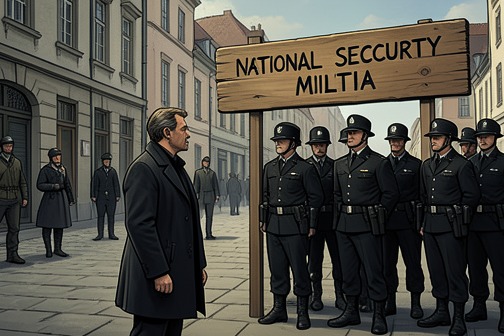
[Luigi Sturzo](entity:character-recall-character-luigi-sturzo-0a091db6f2c0)’s resignation on July 10, 1924, was a turning point in the contest over the [Acerbo Law](entity:rule-recall-rule-acerbo-law-d2ea08cfd3a1): after Mussolini and the [Holy See](entity:organization-recall-organization-665bca047a84) helped force the [Italian Popular Party](entity:organization-recall-organization-italian-popular-1ca12ab11e06)’s founder from political life, the fate of opposition to the electoral reform rested on the party’s deputies. His departure weakened the party’s independence at the moment when its votes could determine whether the government’s proposal advanced.
## Pressure on Sturzo
The account places the resignation within a campaign to remove Sturzo from public life. Mussolini had demanded the end of his political career, while Catholic institutions and associations faced continuing threats of reprisals, including threats directed at churches. Monsignor Pucci, speaking for the Holy See, publicly urged Sturzo not to create problems. The Holy See then granted Mussolini’s demand, and Sturzo was forced to resign.
The episode connected political pressure on a party leader to the vulnerability of the institutions around his party. Sturzo was not simply leaving an office: his removal came amid threats against the Catholic organizations that gave the Italian Popular Party its broader political setting. The account presents the Holy See’s intervention as part of the pressure that made his departure possible.
## The parliamentary consequence
With its founder gone, the party’s survival and parliamentary role passed to its deputies. The immediate test was the Acerbo Law, which would award two-thirds of the seats to the list receiving a relative majority. Giolitti’s liberal followers had already decided to accept the proposal, hoping that electoral accommodation might tame fascism; some socialist reformists, too, were prepared to cooperate, invoking the protection of workers.
The Popular Party deputies therefore faced a sharply narrowed choice. Without their votes, the opposition could not mount an effective barrier to the bill. The account describes voting against it as the remaining available battle, with each vote potentially determining whether the reform passed. Sturzo’s resignation thus had an immediate institutional consequence: the decision over resistance fell to a parliamentary group deprived of its founder and exposed to pressure from both the government and the Church authorities.
## De Gasperi and the divided vote
After Sturzo’s resignation, [Alcide De Gasperi](entity:character-recall-character-alcide-de-gasperi-3768bea85342) served as secretary of the Italian Popular Party. When the Chamber reopened its debate, he proposed dividing the government’s motion into two separate votes: one on confidence in the government and another on the principles of electoral reform. This distinction allowed the Catholic deputies to affirm confidence in Mussolini while refusing to endorse his electoral law.
The party was not presenting a simple choice between supporting and opposing the government. Its deputies sought to preserve room to contest the reform, including by raising the threshold for a list to be declared the majority to 40 percent. Their position showed how Sturzo’s removal changed the form of the conflict: the founder’s exclusion did not end the parliamentary struggle, but left his successors to conduct it through a carefully divided vote.
## Significance
The resignation joined coercive political pressure to a decisive parliamentary calculation. Mussolini’s demand, the threats facing Catholic institutions, and the Holy See’s yielding of Sturzo’s political position narrowed the space for independent party leadership. The ensuing debate made the consequences visible: the Popular Party’s deputies had to decide whether to preserve their opposition to the Acerbo Law even while separating that opposition from a vote of confidence in Mussolini’s government.
Event 71
Assassination of Don Giovanni Minzoni
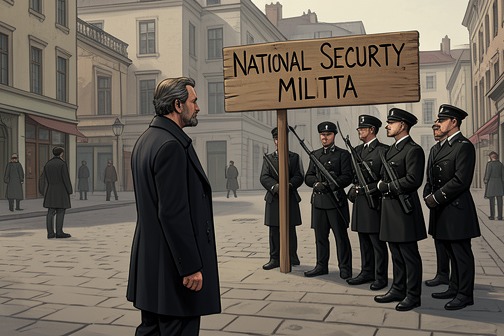
The assassination of [Don Giovanni Minzoni](entity:character-recall-character-don-giovanni-minzon-a76b965039de) exposed the distance between Fascist claims to restore order and the violence used to secure local power. Minzoni, the archpriest of [Argenta](entity:location-recall-location-argenta-b68072f9fbaf), opposed [Fascism](entity:concept-recall-concept-fascism-37baf0d2849a) and organized young Catholics and workers outside Fascist structures. After his killing, [Tommaso Beltrami](entity:character-recall-character-tommaso-beltrami-3430e281c22b), secretary of the [Ferrara](entity:location-recall-location-970ebca292e4) Fascist Federation, implicated local Fascists and acknowledged that he had helped the two men escape. [Italo Balbo](entity:character-recall-character-2e79cde02db9) responded by preparing a public disavowal and deciding to suppress the affair rather than expose its connections.
## Minzoni and the conflict in Argenta
Born in [Ravenna](entity:location-recall-location-b931f601f413), Minzoni served as a military chaplain during the war after volunteering for the front, and received a silver medal. On returning to his community, he opposed Fascism from its beginnings. His opposition took an organized form: he sought to educate young Catholics beyond Fascist ideology and to arrange for workers to organize outside Fascist unions. Socialist peasants followed him as well, making his parish a point of contact among people who did not accept the local movement’s claim to represent the community.
The political ground around him was changing. After populists left [Benito Mussolini](entity:character-recall-character-benito-mussolini-0330d40d2c3f)’s government, Catholic bankers and agrarians in the Ferrara region began moving into the Fascist Party. In Ferrara, all the leaders of the Popular Party had abandoned their party cards. Minzoni remained a conspicuous exception in the southern part of the province, persisting in his work even as it antagonized both ecclesiastical hierarchies and red unionists. In July, a youth gathering he organized at the parish church brought him close to a confrontation with Ladislao Rocca, leader of the local Fascist organization. The killing followed this increasingly contested struggle over who could organize young people and workers in Argenta.
## The attack and Minzoni’s death
On Thursday, August 23, Minzoni was walking back to the rectory with one of his pupils. They passed the Recreational Center along a narrow, dark street; a film was being shown inside. Two men came out from around a corner, and one struck Minzoni with a club. He fell, managed to move a short distance toward his residence, and collapsed again. He was carried home and placed in his small room. A doctor could do nothing, and a [Carabinieri](entity:organization-recall-organization-carabinieri-28c84a9cf0f4) lieutenant was unable to question him. Two Sisters of Charity stayed beside him, praying and weeping. Minzoni died shortly after midnight.
The account keeps the attack tightly bound to its immediate setting: the walk from the church, the nearby film, the short distance to the rectory, and the people who gathered around the dying priest. The violence was not presented as an impersonal clash between rival crowds. It struck a particular organizer returning home with a pupil, and ended his work in a community where competing political and religious authorities were already in conflict.
## Beltrami’s disclosure and Balbo’s response
Tommaso Beltrami reported the killing to Italo Balbo, who had hurried to Argenta from [Rome](entity:location-recall-location-f3877a21016f). Balbo had appointed Beltrami secretary of the Ferrara Fascist Federation. He dictated a press statement condemning the killers as men who had no genuine connection with the movement, though they had operated within its ranks. The statement offered a public boundary between the Fascist organization and the perpetrators before their responsibility had been clarified in public.
Beltrami then disclosed more. He named Raoul Forti, a militia consul and Balbo’s personal friend, as the person who had conceived the idea; he said Augusto Maran, secretary of Argenta’s Fascist organization, was also involved. Beltrami admitted that he himself had helped the two men escape from the house where one had hidden them. These admissions establish distinct roles: Forti was identified as the originator, Maran as involved, and Beltrami as having assisted the escape. The account does not identify the two attackers by name, so the reported connections should not be confused with a definitive identification of who delivered the blow.
Balbo’s answer was to hush the affair up. That decision followed the public statement of condemnation and stood in direct tension with it. Rather than pursue the connections Beltrami had disclosed, Balbo chose concealment. The episode thus presents both a violent act and the effort, immediately afterward, to control what could be said about responsibility for it.
## Local power and the politics of order
Balbo’s concern was not detached from the political structure he had built in Ferrara. The account describes his efforts to reaffirm control: he had strengthened the alliance with agrarians through municipal tax changes favorable to them, and placed allies, relatives, and even dissidents in important administrative and party roles. The Fascists had also triumphed across the province in the previous December’s administrative elections, where the socialists did not run. Minzoni’s murder therefore threatened a local system Balbo considered carefully arranged, even as the evidence reported to him implicated people within that system.
The episode belongs to a wider setting in which the boundary between state authority and Fascist coercion had already weakened. In [1919](entity:time-recall-time-1919-329d1bdc3600), the government had urged Fascist cooperation in suppressing revolutionary attempts, including through violence, provided Fascists accepted official command. In [Bologna](entity:location-recall-location-bologna-e9b2b10db055), a massacre had been followed by a general strike and the creation of a bourgeois self-defense association, with its supporters accusing the state of abandoning its responsibilities. These earlier episodes do not establish a direct chain leading to Minzoni’s death; they show, instead, a political environment in which rival groups increasingly claimed the right to enforce order themselves.
Minzoni’s work represented an alternative to that coercive claim: Catholic youth education and worker organization outside Fascist control, supported by some socialist peasants as well as young Catholics. His assassination, and Balbo’s choice to conceal the reported links, reveal how local authority could be defended not only through violence but through the management of its aftermath. The public rejection of the killers did not lead, in the account, to an open reckoning with the people Beltrami had named.
Event 72
Corfu Incident (1923)
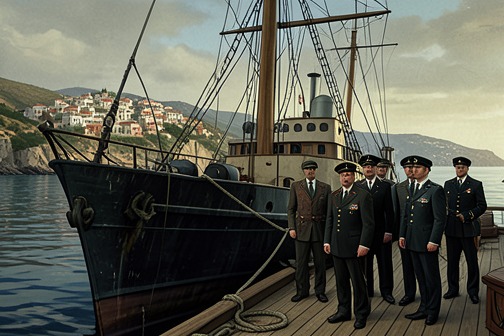
The [Corfu Incident (1923)](entity:event-recall-event-1923-1f412479ce45) began when [Benito Mussolini](entity:character-recall-character-benito-mussolini-0330d40d2c3f) turned the killing of an Italian officers’ delegation into a confrontation with [Greece](entity:location-recall-location-greece-6f5775f30806). He demanded extensive reparations, sent a naval squadron to occupy [Corfu](entity:location-recall-location-corfu-947439dbef20), and threatened further military action when Greece rejected his terms. In the book’s account, the episode exposed the collision between the [League of Nations](entity:organization-recall-organization-8477634b7fbf)’ rules and Mussolini’s nationalist politics, while giving his embattled movement a renewed appearance of authority.
## Causes and Political Opportunity
On August 28, Mussolini had just returned to [Rome](entity:location-recall-location-f3877a21016f) when news arrived that Italian officers serving on a mission for the Allied powers had been killed in a remote town near the Greek-Albanian border. The perpetrators were described as Balkan brigands, and their motive was unknown. The Greek government said that it had no involvement. The account does not resolve who ordered the killings or establish a Greek responsibility; instead, it emphasizes how swiftly Mussolini made the incident an opportunity for action.
The timing favored escalation. Salvatore Contarini, the foreign secretary and an experienced diplomat who supported cooperation with Great Britain and the other major powers, was still on vacation. Before Contarini could return with advice for caution, Mussolini sent a telegram to Athens. The narrative presents this as a chance to mobilize Italian nationalism and loosen what Mussolini regarded as subjection to English influence. Thus a still-unexplained killing became the occasion for a deliberate choice of policy, rather than a settled finding of Greek culpability.
That choice belonged to a larger political language of national renewal. Earlier, the postwar return of millions of soldiers had been framed as the arrival of a new mass that would overrun the old political order. Mussolini’s later vision of fascism likewise joined national unity within [Italy](entity:location-recall-location-italy-85c2492cd54b) to imperial ambition beyond its borders. Against this background, the Corfu crisis offered a concrete international stage on which strength and expansion could be presented as answers to national decline.
## Ultimatum and Occupation
Mussolini’s demands went far beyond a limited inquiry or compensation. He required the most extensive apologies, a solemn funeral ceremony, honors for the Italian flag, an investigation conducted by Italian inspectors, capital punishment for those responsible, and 50 million lire in compensation. The Greek government, denying involvement, could not accept the demands and appealed to the League of Nations, relying on Great Britain’s protection.
Mussolini answered by dispatching a naval squadron to occupy Corfu. He set August 29 as the deadline for satisfaction and threatened that, if Greece did not comply, Italian forces would land after bombing the Old Venetian Fortress. The episode therefore advanced through a sequence of increasing pressure: expansive demands, an appeal by Greece to international protection, a naval occupation, and the stated prospect of bombardment and landing. The account distinguishes the threatened assault from the action already taken; it does not say that the threatened bombing occurred.
The move was presented as an unprecedented breach of the League of Nations’ statute by one of its member states, and as the first such violation since the end of the [Great War](entity:time-recall-time-great-war-bb7a98afe36b). The scale of the military preparation made the threat more than rhetorical. Forty Italian ships and seven thousand armed troops, with ammunition and equipment, were assembled off the coast of Epirus. Mussolini stayed awake during the night, waiting for naval telegrams as reports arrived hour by hour. His attention to those messages placed him at the center of the unfolding confrontation, while the fleet and troops gave the ultimatum material force.
## Nationalist Spectacle and Political Effect
The crisis revived enthusiasm for fascism. In the narrative, Mussolini’s audacity briefly freed him from the reputation of a leader burdened by his own followers’ rivalries and ambitions. The foreign confrontation redirected attention toward a larger promise: Italy moving outward toward the [Balkans](entity:location-recall-location-balkans-92c685d5a2c4), the Middle East, and Africa. During the vigil, the country is portrayed as breathing together again. That unity is a political effect of the episode as the book tells it, not evidence that all Italians supported the occupation.
This response resonates with the movement’s broader imagery. Fascist rhetoric had promised to make Italians into a unified nation and to connect national rebirth with imperial purpose. Mussolini was also being fashioned as a decisive new man who could impose order on chaos. The Corfu episode translated that self-presentation into foreign policy: military pressure could be made to look like national action, and an international crisis could restore a sense of momentum to a party whose standing had weakened. The narrative’s emphasis is not simply on force, but on the way force became a public performance of resolve.
## Resolution and Significance
The confrontation was settled at the end of September. According to the account, Italy’s prestige was restored and it received 50 million lire in compensation for damages. The settlement thus echoed one of Mussolini’s central demands, although the available evidence does not specify how each other demand was resolved or provide the terms of the final agreement. The initial cause remained described as a killing by unknown perpetrators; the outcome, by contrast, was presented as a political gain for Italy.
In its later review of Mussolini’s first year in power, the book places the Corfu controversy among the successes he could claim: it had been risky, but was said to have ended with Italy’s prestige restored and compensation secured. That retrospective framing shows how the incident served both as an international dispute and as material for domestic political legitimation. Its significance lies in the conjunction of unresolved responsibility, disproportionate demands, threatened force, and a settlement narrated as victory. The crisis dramatized the gap between the League’s collective rules and Mussolini’s willingness to press national power, while temporarily renewing the image of a leader able to make Italy act with a single purpose.
Event 73
Nicola Bombacci’s Parliamentary Speech and the Bombacci Affair
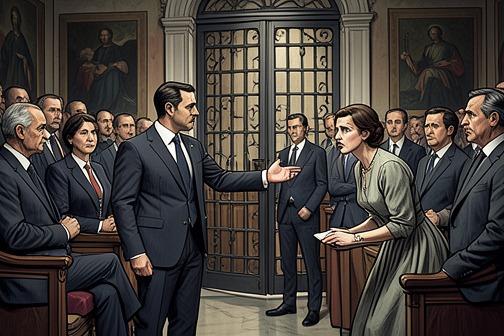
[Nicola Bombacci’s Parliamentary Speech and the Bombacci Affair](entity:event-recall-event-58255a0384c2) began as a debate over trade with Soviet [Russia](entity:location-recall-location-e36341713c23) and became a public rupture between personal friendship and ideological discipline. Bombacci asked [Benito Mussolini](entity:character-recall-character-benito-mussolini-0330d40d2c3f)’s government to pursue negotiations with Russia and suggested that the two revolutions might find common ground. The proposal exposed the limits of his position: he could address Mussolini as an old friend, but his own party and the wider socialist movement treated such cordiality as an intolerable breach.
## Parliamentary Setting
The debate took place in a crowded [Italian Parliament](entity:organization-recall-organization-italian-parliame-ae2e1a53a21b), where 250 deputies were present for a vote on converting into law a 1921 decree between the Kingdom of [Italy](entity:location-recall-location-italy-85c2492cd54b) and the Russian Soviet Federative Socialist Republic. The measure concerned the development of trade agreements between Fascist Italy and Soviet Russia. It placed representatives of sharply opposed political camps in a shared discussion of practical relations between the two states.
The opening exchanges followed familiar party lines. A Popular Party deputy supported ratification, while socialist maximalists and [Francesco Giunta](entity:character-recall-character-francesco-giunta-6162c18e8383), the Fascist Party secretary, clashed over communism and capitalism. Giunta was known for bringing the style of squadristi politics into parliamentary debate. Against this setting, the issue was not simply whether trade would be useful: the possibility of dealing with Soviet Russia carried political meaning for both sides.
Bombacci’s intervention had a personal as well as diplomatic history. Known as [Moscow](entity:location-recall-location-19aceb5ce281)’s favored Italian intermediary, he had spent years working toward trade agreements that could lead to Italian recognition of the Soviet state. He was also a longtime friend of Mussolini. The two had been young schoolteachers in remote villages of Romagna, where they shared both intellectual work and poverty. The account reports a spiteful rumor that Bombacci had been spared in a recent wave of arrests of communist leaders on Mussolini’s orders; it presents this as hearsay, not an established explanation for his survival or his conduct.
## The Appeal and the Exchange
Bombacci framed his speech as an economic argument rather than a defense of either country’s political system. He said he would not discuss the politics of the two nations and concentrated on the practical interests that might bring them together. His opening criticism of earlier governments drew an immediate interruption from Mussolini: “Good thing you recognize it!” Bombacci replied, “It’s the truth.” The exchange briefly made their old familiarity audible within a debate otherwise organized around opposing political identities.
Bombacci then urged negotiations with Russia in a cordial atmosphere and addressed Mussolini personally. He reminded the prime minister of his stated intention to rebuild not only Italy but Europe, and argued that political prejudice should not block a useful agreement. When the discussion turned to American efforts to secure an oil monopoly, he called for Italy to protest and again pressed for a treaty that would permit Italian industrialists to do business in Russia. Francesco Giunta interjected that a party card was ready for him. Bombacci rejected the suggestion that political membership was required to serve the country, insisting that an Italian citizen needed no card to do his duty.
The speech reached beyond commerce when Bombacci proposed that the Fascist and Russian revolutions might yet conclude in an alliance between their peoples. At this point, the account pauses over his silence: he faltered, looked up at the hall’s glass-and-iron canopy, and then continued. He argued that Russia stood on a revolutionary plane and that, if [Fascism](entity:concept-recall-concept-fascism-37baf0d2849a) also claimed a revolutionary mentality, there should be no obstacle to a definitive alliance. The right and center responded with laughter, while the left clamored. The appeal had made the underlying contradiction explicit: Bombacci was asking a Fascist government to recognize a political kinship that its opponents regarded as a false analogy.
## The Affair and Its Consequences
The controversy acquired the name of the Bombacci affair the following day. [Avanti!](entity:object-recall-object-avanti-1bed44223b67) denounced the speech, rejecting any comparison between the [Russian Revolution](entity:event-recall-event-russian-revolution-6444f80ee8e1) and what it called the parody of revolution represented by Fascism. For the socialist newspaper, contempt for Fascism was a matter of political dignity and unity, and Bombacci’s overture crossed that boundary. [Antonio Gramsci](entity:character-recall-character-antonio-gramsci-8b56f896360d) also criticized his cordiality toward Mussolini, arguing that it amounted to flattering the [Fascist revolution](entity:concept-recall-concept-fascist-revolution-4d42fe69bd6c) and Mussolini’s grand claims.
On December 5, the Communist Party of Italy’s executive committee called on Bombacci to resign his parliamentary seat. The demand was not uncontested. Some members of the parliamentary group saw no grounds to accuse him of unworthiness, while working-class supporters who had revered him for years struggled to understand why an appeal made in the name of Russia and [Vladimir Lenin](entity:character-recall-character-vladimir-lenin-34f94d23ace7) should lead to his expulsion from public office. The disagreement revealed the distance between Bombacci’s stated economic and diplomatic purpose and the party’s insistence that no accommodation with Fascism could be treated as politically neutral.
Bombacci did not resign voluntarily. The account presents his resistance as an act of good faith, but one that could not alter the party’s decision: the Communist Party of Italy ordered him to relinquish his seat. The episode thus ended not in an Italian-Soviet alliance, but in Bombacci’s political isolation from the organization whose cause he had sought to represent. Its timing sharpened the contrast. As the party pressed its demand, news arrived from Moscow that Vladimir Lenin, incapacitated after another stroke and confined to a wheelchair, had ceased communicating with the outside world; his death was now being anticipated.
## Political Meaning
The speech joined two kinds of connection that the surrounding politics could not sustain: the remembered companionship of Mussolini and Bombacci’s youth, and Bombacci’s effort to bring revolutionary states into practical relations. In Parliament, their exchange allowed an old friendship to surface briefly, but it did not soften their political antagonism. Mussolini answered Bombacci’s appeal with a narrower declaration of satisfaction with Italy and a reminder that he had already signed many commercial treaties; neither answer endorsed Bombacci’s proposed alliance between revolutions.
The affair’s significance lies in the way a proposal presented as economic cooperation was judged as a test of political allegiance. Bombacci’s attempt to distinguish trade from ideology failed because his language itself crossed that divide: cordial negotiation became, to his critics, an endorsement of Fascism’s revolutionary claims. The episode therefore records both the persistence of personal ties across political enmity and the force of a movement’s demand for ideological separation. Men might speak to one another; their political doctrines, as the narrative observes, did not.
Event 74
Treaty of Rome (1924)
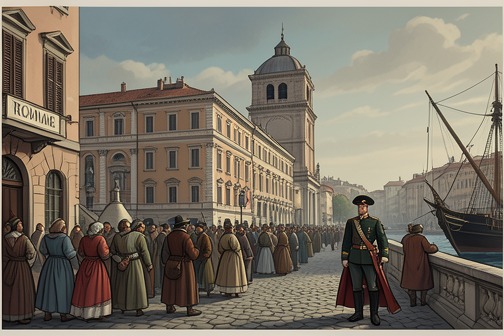
The [Treaty of Rome (1924)](entity:event-recall-event-1924-9085fef11d37) settled the dispute over [Fiume](entity:location-recall-location-fiume-c271af61753f) by granting the city to [Italy](entity:location-recall-location-italy-85c2492cd54b). Signed by [Benito Mussolini](entity:character-recall-character-benito-mussolini-0330d40d2c3f) in January 1924, the agreement resolved a question that had kept the unresolved wounds of the [Great War](entity:time-recall-time-great-war-bb7a98afe36b) open since [1919](entity:time-recall-time-1919-329d1bdc3600). In the book’s account, its importance lies not only in the territorial outcome but also in the contrast between Mussolini’s diplomatic achievement and [Gabriele D’Annunzio](entity:character-recall-character-gabriele-d-annunzio-6e66d28027db)’s unfinished dream of Fiume.
## Background: Fiume and the Postwar Dispute
Fiume had become a defining symbol of the unsettled postwar order. In January [1920](entity:time-recall-time-1920-510f1fd63aa4), Gabriele D’Annunzio described 1919 as the year of Fiume rather than the year of the Versailles negotiations. He set the city’s promise of youth, life, faith, and a future against what he portrayed as a fearful and exhausted Europe. Yet the book also notes that Italians had not followed him in the way he hoped, and that his standing was already waning.
The treaty belongs to a wider period in which political authority was being remade through both institutions and force. By 1921, Benito Mussolini could read the liberals’ acceptance of an alliance with the fascists as evidence that the movement had entered parliamentary politics. At the same time, the government’s attempts to constrain armed fascist groups were frustrated by the party leadership’s insistence that its sections and combat squads formed an inseparable unit. Against this unsettled political background, an agreement on Fiume offered a conspicuous diplomatic resolution to a dispute that had resisted settlement since 1919.
## The Agreement and Its Immediate Reception
On January 27, 1924, Benito Mussolini signed an accord with [Yugoslavia](entity:location-recall-location-yugoslavia-34570170fc0c) granting Fiume to Italy. The next evening, at a meeting of fascist leaders in [Palazzo Venezia](entity:location-recall-location-palazzo-venezia-afb9c3a11489), the agreement was presented as a diplomatic achievement: the dispute was mended by negotiation rather than by the kind of spectacular exploit associated with a poetic nationalist dream. The book identifies this distinction as central to Mussolini’s success. The territorial outcome mattered, but so did the demonstration that he could turn a long-running national claim into an agreement between states.
The accord received public praise from King Alexander of Yugoslavia, who credited Benito Mussolini’s brilliance and strength with making a difficult undertaking possible. That acclaim gave the settlement an international dimension within the narrative: Mussolini was not merely claiming to embody national renewal at home, but was being recognized abroad as the statesman who had resolved a persistent dispute.
## Mussolini, D’Annunzio, and Rival Claims to Fiume
The book places the treaty in deliberate contrast with Gabriele D’Annunzio’s continuing attachment to Fiume. Where D’Annunzio had made the city the setting for a passionate vision of national and generational rebirth, Benito Mussolini secured its transfer through diplomacy. The contrast is sharpened by the image of D’Annunzio, still living on the shores of [Lake Garda](entity:location-recall-location-cfb600a9a06f), building what the narrative calls a monumental tomb. The settlement thus becomes a political answer to a rival’s poetic project, and a way of claiming practical command over an issue that had helped define the postwar nationalist imagination.
This contrast also carries an irony. D’Annunzio’s account had placed Fiume among the signs of a new age, but the city’s fate was ultimately settled not by his continued presence there but by an agreement negotiated by Benito Mussolini. The treaty did not erase the symbolic force Fiume had acquired; instead, it shifted who could claim to have brought the dispute to an end.
## Political Significance
The treaty was signed as Mussolini’s domestic position was being measured against the coming election. Parliament had been dissolved on January 25, and the April 6 vote was expected to become a plebiscite for or against him. The book emphasizes the contrast that fascism had weakened while Benito Mussolini himself had grown stronger. The agreement with Yugoslavia provided a concrete diplomatic success at this moment, reinforcing the picture of a leader whose authority was increasingly associated with personal achievement.
The Treaty of [Rome](entity:location-recall-location-f3877a21016f) therefore joins territorial settlement to political image-making without reducing one to the other. It resolved the Fiume dispute in Italy’s favor and, in the narrative, demonstrated a method sharply different from D’Annunzio’s theatrical nationalist enterprise. Its significance rests on that double result: Fiume was granted to Italy, and Mussolini could present the settlement as proof that he—not the poet who had once made the city his cause—could close the postwar wound through state diplomacy.
Event 75
Formation of the Fascist Cheka
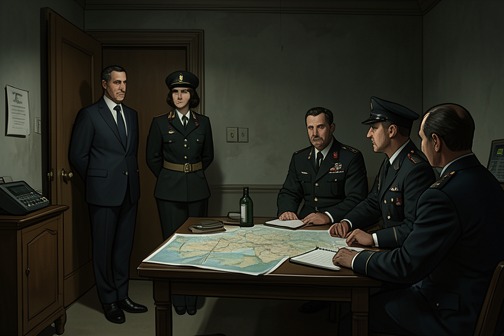
The [Formation of the Fascist Cheka](entity:event-recall-event-ee8a476b7371) was the creation of a secret unit directly supervised by [Benito Mussolini](entity:character-recall-character-benito-mussolini-0330d40d2c3f) and intended to strike at fascism’s enemies. At a moment when Mussolini publicly invoked legal order and the fascist movement was also cooperating with state authorities against revolutionary activity, the new group was conceived as a means of acting outside laws that still bore the imprint of liberal government.
## From public order to clandestine action
Earlier in the postwar crisis, the liberal state had opened a public channel for fascist involvement in repression. A confidential government circular urged fascist groups to assist in suppressing revolutionary attempts, including by violent means, provided they accepted the authorities’ command. Mussolini had already instructed [Michele Bianchi](entity:character-recall-character-michele-bianchi-6ec6b0301223) to make the [Milan](entity:location-recall-location-617379caf4c2) fasci available to the prefect for maintaining public order. That arrangement placed fascist force, at least formally, at the service of state authority.
The secret unit represented a different relationship to legality. On January 10, [Cesare Rossi](entity:character-recall-character-cesare-rossi-92b80e4f71a4), [Francesco Giunta](entity:character-recall-character-francesco-giunta-6162c18e8383), [Giovanni Marinelli](entity:character-recall-character-giovanni-marinelli-0ce42cb5408c), [Emilio De Bono](entity:character-recall-character-emilio-de-bono-c12a4110f12e), and Mussolini met at Mussolini’s residence, a house run by Cesira Carocci on [Via Rasella](entity:location-recall-location-via-rasella-0f38245ba231). Despite public proclamations about the legal path, they decided to establish an organization under their direct supervision to strike at fascism’s enemies. The stated rationale was that, during the transition, laws still retained traces of liberalism and the task could not be carried out through legal means. The clandestine organization was designed to bridge that gap.
## A model and a name
At the meeting, Mussolini praised the ruthless energy with which [Vladimir Lenin](entity:character-recall-character-vladimir-lenin-34f94d23ace7) had authorized the [Cheka](entity:organization-recall-organization-2cf4d8362484), the Russian secret police, to use terror during the early phase of the communist state. His advisers promptly proposed naming their own clandestine organization the [Fascist Cheka](entity:organization-recall-organization-44800c6cf58d). The choice made the group’s intended character legible: this was not simply another public fascist association or a militia operating openly, but a secret instrument modeled on political policing and terror.
The book places this decision against a wider pattern in which political violence was already being organized and enabled through overlapping networks. The state’s invitation to fascists to help repress revolutionary activity supplied a public justification for their force, while the new unit’s founders treated the remaining legal restraints as an obstacle. The distinction is central: official cooperation with authorities and a secret body directed by Mussolini could coexist, but they did not operate on the same terms.
## Leadership and operational support
The name of [Amerigo Dumini](entity:character-recall-character-amerigo-dumini-c67af1da031c) was proposed to lead the unit, and Mussolini accepted him. Dumini was a Florentine squadrist who had recently undertaken several secret missions in France to eliminate antifascists in exile. His selection tied the new organization to a man already trusted with covert assignments beyond [Italy](entity:location-recall-location-italy-85c2492cd54b), rather than to a purely administrative role within the party.
The group’s practical operations also depended on political patronage. After Vladimir Lenin died on January 21, Rossi wrote to the president requesting a permanent railway pass for Dumini from February 1. He explained that Dumini often had to travel by train to carry out assignments from him, from [Aldo Finzi](entity:character-recall-character-aldo-finzi-616b59a6f498), or from others, and that this need would grow during the approaching election period. The request translated secret authority into ordinary logistical support: a state-connected travel document could facilitate missions whose purposes were not publicly acknowledged.
## Later role and political significance
Giovanni Marinelli, the party treasurer, later jealously guarded his position as head of the Cheka, a role assigned by Mussolini and shared with Rossi. The organization was thus not simply a loose label for squad violence; it had an acknowledged leadership structure among Mussolini’s close associates, even as its work was clandestine. Its existence connected party authority, personal command, and the activity of men selected for covert action.
The Cheka returned to the foreground after [Giacomo Matteotti](entity:character-recall-character-giacomo-matteotti-b1b8c0b072bc)’s parliamentary challenge. The book records Mussolini’s anger over the fact that Matteotti remained at liberty after his speech and notes that Mussolini summoned Marinelli for private meetings on June 1 and June 2, 1924. These later details do not by themselves establish the unit’s responsibility for a particular act, but they show that its leadership was drawn into the political response to Matteotti. The January decision therefore foreshadows a central contradiction of the fascist rise: a movement that spoke in the language of legality also built a secret apparatus because it considered legal limits insufficient.
Event 76
Assault on Cesare Forni at Milan Central Station
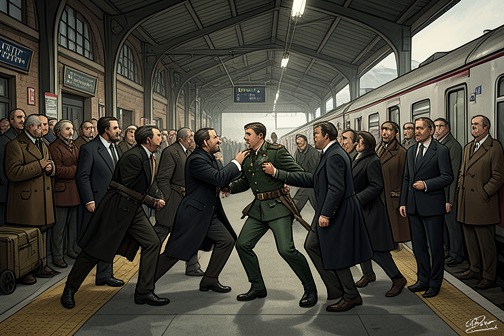
The assault on [Cesare Forni](entity:character-recall-character-cesare-forni-f7d2d174b95a) at [Milan Central Station](entity:location-recall-location-milan-central-statio-e9ac248aae99) on March 12, 1924, was a planned attack on a former Fascist leader who had refused to submit to [Benito Mussolini](entity:character-recall-character-benito-mussolini-0330d40d2c3f)’s authority. Its significance lay not only in the violence at the station but in the political conflict that brought Forni there: he had stood as a dissident, accused senior Fascists of enriching themselves, and resisted efforts to bring his organization back under party control. The episode showed violence operating within the movement as well as against its political opponents, while Mussolini’s subsequent defense of punishment for traitors made that coercion part of a public political argument.
## A dissident inside the movement
Forni’s break with the [National Fascist Party](entity:organization-recall-organization-national-fascist-c9d1f7e3cfc5) had become unmistakable at the elections, when he presented his own dissident list, the national fasci. Mussolini tried several means to make him yield. He offered Forni a command in Africa, threatened him, directed prefects to seize his newspapers and arrest his friends, and ordered party sections in Forni’s territories disbanded. Forni did not bend. The dispute was therefore about more than an electoral challenge: it tested whether a local organization could remain independent of the national leadership and whether a prominent Fascist could openly criticize those at the top.
At a meeting in Biella, before thousands of people, Forni accused party figures of having been so poor in [1920](entity:time-recall-time-1920-510f1fd63aa4) and 1921 that they had asked him for money to eat, but of now living in elegant [Rome](entity:location-recall-location-f3877a21016f) apartments paid for by the Italian people. The accusation drew applause from the Fascists present. Even Vittorio Sella, the founder of the local fascio, praised Forni after taking the floor to answer him. The public response made Forni’s challenge harder to dismiss as a private quarrel: he was speaking before an audience that could hear an indictment of the party leadership and applaud it.
## Planning the operation
The account places the attack within a chain of coordination. [Cesare Rossi](entity:character-recall-character-cesare-rossi-92b80e4f71a4) tracked Forni down in [Perugia](entity:location-recall-location-perugia-1cc190912c09), where Forni had taken refuge with a woman, and ordered him to hurry to [Milan](entity:location-recall-location-617379caf4c2) to coordinate the operation. Rossi then contacted Pirro Nenciolini in [Florence](entity:location-recall-location-706cb92b9779), a former comrade from punitive raids, and assembled a small group of trusted associates. In Milan, Asvero Gravelli, who reported directly to [Francesco Giunta](entity:character-recall-character-francesco-giunta-6162c18e8383), the party secretary, gave Nenciolini 5,000 liras. The payment appeared in Rossi’s payroll ledger under the description special political assignment.
The organizers also mobilized [Albino Volpi](entity:character-recall-character-albino-volpi-fcc25af3d38e)’s Milanese [Arditi](entity:organization-recall-organization-ce1ea9816d56) from Via Cerva, known as the raw meat squad. The plan combined these men with the Florentine squadristi. Rossi feared that the younger men from the Lombard fasci, acting alone, might not be capable of carrying out the assignment. The mixed force was intended to make the operation more certain. In this preparation, political direction, money, local connections, and the choice of personnel converge; the assault was not presented as an unplanned confrontation that merely erupted among station passengers.
## The attack at the station
At Milan Central Station, travelers crowded the exit and the staircase was congested. Three trains were due to arrive at nearly the same time. More than twenty men waited near the foot of the stairs and in front of the turnstiles, where passengers emerged beneath the station canopy. Some carried clubs and iron rods. Forni was recognizable among the crowd, and the attackers waited for him to appear.
They struck him from behind. The passengers around him scattered, leaving him surrounded by the assailants. Forni, unarmed, fought back; another man joined him, and the attackers briefly drew away. Some bystanders, seeing this opening, came closer. The assault resumed and the attackers closed in again. Even after Forni collapsed, they continued striking him. People in the crowd shouted for them to stop. When the attackers finally left, Forni remained alone in the vast railway atrium. The scene turned the station, a place of movement and passage, into the setting for a public demonstration of force against a political dissident.
## Public justification and political meaning
On March 15, Mussolini published an article originally entitled “He Who Betrays, Perishes,” asserting [Fascism](entity:concept-recall-concept-fascism-37baf0d2849a)’s right to punish its traitors. He argued that Fascist violence was insignificant beside the violence with which [Bolsheviks](entity:organization-recall-organization-5133e982d5e0) eliminated dissidents, and added that Forni was not dead. The argument answered the attack by shifting attention from the operation against Forni to the alleged offenses of the person attacked and to violence attributed to Fascism’s political enemies. The qualification about Forni’s survival also made the assault easier to minimize without denying that it had occurred.
That defense followed a longer political development in which party organization and armed squads had been publicly treated as inseparable. In December 1921, [Michele Bianchi](entity:character-recall-character-michele-bianchi-6ec6b0301223), newly elected secretary general of the National Fascist Party, declared that party sections and combat squads formed a single unit, after a government attempt to restrict the squads had been frustrated. The assault on Forni gave this relationship an internal target: a dissident could be treated as a traitor to be punished even though he was himself a former Fascist and electoral rival.
The attack’s aftermath also sharpened the contrast between official standing and actual impunity. The following week, [Vittorio Emanuele III](entity:character-recall-character-vittorio-emanuele-i-45cfd86fd0a5) awarded Mussolini the collar of the Supreme Order of the Most Holy Annunciation, the highest honor of the House of Savoy, in connection with the treaty granting [Fiume](entity:location-recall-location-fiume-c271af61753f) to [Italy](entity:location-recall-location-italy-85c2492cd54b). A message denouncing the attempted assassination and asking the king to ensure that its identifiable organizers were brought to justice invoked the good name of Fascism and Italy. The episode thus ended not with a recorded resolution of the assault but with competing claims: a demand for justice on one side, and a public defense of political punishment on the other. Forni’s case made visible the movement’s capacity to direct organized violence at a dissenter and then contest what that violence meant.
Event 77
1924 Italian General Election
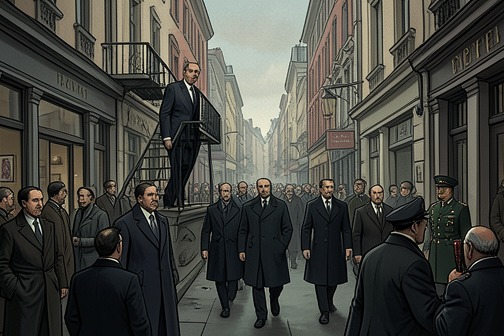
The [1924 Italian General Election](entity:event-recall-event-1924-d8c35dd2209c) transformed [Benito Mussolini](entity:character-recall-character-benito-mussolini-0330d40d2c3f)’s political position into an overwhelming parliamentary majority, but it did not settle the conflict over how that authority had been won. The campaign and its aftermath expose a central contradiction: Fascist leaders sought popular approval through an election while local intimidation narrowed the opposition’s ability to compete, and the final national tally obscured deep regional resistance.
## Background and the opposition’s dilemma
The campaign opened in January against a political landscape already shaped by violence and weakened state authority. In December 1922, Prime Minister [Ivanoe Bonomi](entity:character-recall-character-87432be97504) had tried to regulate the use of truncheons and classify Fascist paramilitary groups as illegal formations. [Michele Bianchi](entity:character-recall-character-michele-bianchi-6ec6b0301223), newly elected secretary general of the [National Fascist Party](entity:organization-recall-organization-national-fascist-c9d1f7e3cfc5), answered by declaring party sections and combat squads inseparable; the directive was published openly in [Il Popolo d’Italia](entity:object-recall-object-il-popolo-d-italia-b2b48dcea0f3). The government did not arrest the party leadership, and Bonomi’s further circular complained that earlier public-order instructions had gone unheeded. This recent history formed the setting for an election in which formal political competition continued while the state struggled to enforce its own limits on organized force.
The opposition faced a separate strategic choice: abstain in protest or enter a contest expected to be dominated by violence. [Giacomo Matteotti](entity:character-recall-character-giacomo-matteotti-b1b8c0b072bc) initially favored mass abstention. To him, refusing to participate could deny legitimacy to a rigged contest and preserve the opposition for a future struggle. In February, an agreement with the democrats led by [Giovanni Amendola](entity:character-recall-character-giovanni-amendola-92d9a53f94b5) seemed possible, as did a broader left-wing front around the communist proposal for a united proletarian front. Both prospects collapsed. Matteotti then rejected abstention as an evasion and decided that the struggle had to continue in the electoral arena as well as elsewhere. He urged [Filippo Turati](entity:character-recall-character-filippo-turati-ab4f1019d6ae) to help establish a more resolute position between the government and its opponents, and between socialists unwilling to collaborate and those prepared to do so.
## Campaign and coercion
Benito Mussolini’s own anxiety centered not on an opposition resurgence but on the possibility that voters would stay away. He feared empty polling stations and a mass refusal to take part. During the week before the April 6 vote, he stayed in [Milan](entity:location-recall-location-617379caf4c2), arriving in a sports car he drove himself, and awaited reports from the provinces. News of violations and violence prompted outbursts and fresh orders to prefects for severe repression. Yet the instructions did not become a consistent curb on local Fascist power. At the urging of Mussolini, [Emilio De Bono](entity:character-recall-character-emilio-de-bono-c12a4110f12e) telegraphed Milan’s police chief and ordered the arrest of [Albino Volpi](entity:character-recall-character-albino-volpi-fcc25af3d38e) if he continued to disrupt the pre-election period; Mussolini did not find the resolve to ensure that the order was carried out.
The reported abuses were most pronounced in smaller towns rather than provincial capitals, where the contest was comparatively orderly. Newspapers were seized, opposition candidates were repeatedly attacked, and even priests were assaulted in several localities. In parts of the South and the [Po Valley](entity:location-recall-location-po-valley-77b96c5b60d4), provincial Fascist leaders openly refused to permit lists other than the Fascist one. Socialist leaders were barred from some towns, and in some places voters were instructed to deliver their ballots to the local fascio office. These practices made the campaign more than a contest of national platforms: they affected whether opponents could organize and whether voters could exercise a free choice locally.
## Results and regional divisions
The April 6 result gave the Fascist national list 4.65 million votes, described in the narrative as roughly two Italians in three. Under the [Acerbo Law](entity:rule-recall-rule-acerbo-law-d2ea08cfd3a1), a list winning more than 25 percent of the vote received a large majority bonus. The Fascist list won 64.9 percent of the yes votes, so the bonus was not needed to establish its lead. All 356 of its candidates were elected, as were 19 representatives from a second national list, giving Mussolini’s government a parliamentary total of 374. Turnout also increased. By the aggregate figures, the victory was decisive.
The distribution of votes complicates that picture. Opposition parties lost many seats: the Socialists fell from 123 deputies to 46, the Populists from 108 to 39, and the Democrats from 124 to 30. The Communists rose from 15 seats to 19. [Antonio Gramsci](entity:character-recall-character-antonio-gramsci-8b56f896360d) entered the chamber in place of [Nicola Bombacci](entity:character-recall-character-nicola-bombacci-5ddc3dca87f9), who had been excluded from the lists. Yet figures from the [Italian Ministry of the Interior](entity:organization-recall-organization-31703f4ed008) showed that the Fascist long list remained a minority in the major industrial regions of the North and in their capitals, including Milan. Workers in northern factories voted against [Fascism](entity:concept-recall-concept-fascism-37baf0d2849a). The national triumph depended instead on Central [Italy](entity:location-recall-location-italy-85c2492cd54b) and, above all, the South, where Fascism had been practically absent before the [March on Rome](entity:event-recall-event-f817683ad1d8). The contrast between the national majority and the industrial North’s opposition makes the result less a portrait of uniform consent than of sharply uneven political support.
## Parliament and the unsettled outcome
The newly elected Parliament opened on May 24, the ninth anniversary of Italy’s entry into the [Great War](entity:time-recall-time-great-war-bb7a98afe36b), a date chosen to mark the beginning of a Fascist era. The Socialists left the chamber in protest against electoral irregularities. Their empty benches interrupted the triumphal presentation of the new legislature, while insults and threats came from the benches occupied by Mussolini’s supporters. [Vittorio Emanuele III](entity:character-recall-character-vittorio-emanuele-i-45cfd86fd0a5) nevertheless inaugurated the chamber and greeted the elected representatives as the generation of victory; Mussolini watched from the government bench with his arms folded. The scene showed the new majority installed through parliamentary procedure, but also an opposition rejecting the conditions under which it had been assembled.
The election’s legitimacy remained contested beyond the opening session. A further point of pressure was the oil concession signed on April 29, granting Sinclair Oil exploitation rights beneath Italian soil. After criticism of the concession, Mussolini issued a public assurance denying the American company’s involvement in the foreign-trade monopoly over Italian oil. It was rumored that Giacomo Matteotti had obtained evidence of corruption during a recent trip to England; the account presents this as a suspicion circulating at the time, not as a finding established by the election itself. On May 30, Matteotti was given the floor in the [Chamber of Deputies](entity:organization-recall-organization-20acc842a4eb). His challenge to the new political order carried the dispute over electoral conduct into Parliament and showed that the vote’s overwhelming arithmetic had not silenced questions about its fairness.
## Significance
The election’s result joined institutional continuity to deteriorating conditions for political competition. Voting took place, parliamentary seats were allocated, and the new chamber convened; at the same time, local intimidation, seizures of newspapers, attacks on candidates, and uneven enforcement of official orders constrained the opposition. The law’s majority mechanism magnified the consequences of the vote, though the Fascist list exceeded its threshold by a wide margin. The resulting majority was therefore both an electoral achievement and a concentration of power secured in a contest whose conditions were disputed.
The narrative’s emphasis on empty polling stations, local coercion, and the geographical pattern of the vote resists treating the national total as a simple measure of unanimous support. Mussolini wanted consent and feared its absence, while the campaign revealed how difficult it was to separate consent from pressure. The election installed a powerful government, but its opening parliamentary scene and the challenges that followed left the central question unresolved: whether the new majority represented freely expressed agreement or a political landscape already narrowed by force.
Event 78
Giacomo Matteotti’s Parliamentary Speech of 30 May 1924
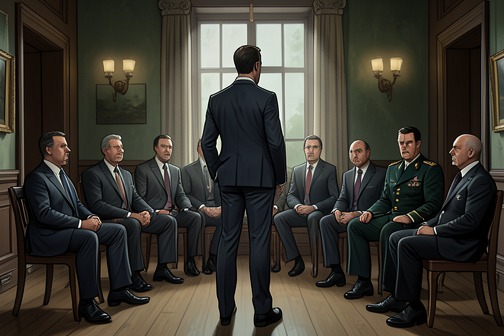
On 30 May 1924, [Giacomo Matteotti](entity:character-recall-character-giacomo-matteotti-b1b8c0b072bc) used the floor of the [Italian Chamber of Deputies](entity:organization-recall-organization-eb950b89e958) to contest the legitimacy of the governing majority’s election victory. He argued that voters had not been free to choose, pointing to an armed Fascist militia and enumerating violations of electoral procedure. The speech’s significance lies both in its detailed public challenge to the result and in the scene it creates: a solitary opposition deputy persists as the chamber answers him with interruption, abuse, and threats, while [Benito Mussolini](entity:character-recall-character-benito-mussolini-0330d40d2c3f) sits in apparent indifference and leaves visibly enraged.
## Setting and Political Stakes
The address took place at [Montecitorio](entity:location-recall-location-montecitorio-884403622079) after the electoral council had proposed confirming the governing list. Matteotti, secretary of the [Unitary Socialist Party](entity:organization-recall-organization-bed6c5ce7f9c), rose from the left benches at the invitation of the chamber’s new president, jurist [Alfredo Rocco](entity:character-recall-character-alfredo-rocco-6de76b9f46d0). The narrative presents him as an isolated figure in a hostile assembly. In four years as a deputy, he had delivered 106 long, painstaking speeches, often on finance and budgets; to many colleagues, including members of his own party, his persistence had made him seem tiresome and obsessive. This time, however, the subject was the basis on which the governing majority claimed power.
The political contradiction behind the speech was already visible in the state’s inability to separate the [National Fascist Party](entity:organization-recall-organization-national-fascist-c9d1f7e3cfc5) from its armed formations. In December 1921, after Prime Minister [Ivanoe Bonomi](entity:character-recall-character-87432be97504) attempted to restrict the squads through a prefectural circular, party secretary [Michele Bianchi](entity:character-recall-character-michele-bianchi-6ec6b0301223) declared that party sections and combat squads were inseparable. The directive was published openly, while the government failed to enforce its public-order orders. That earlier episode forms a relevant backdrop to Matteotti’s central charge: the militia was not merely a presence outside electoral politics but, he said, a force capable of shaping what voters could do.
## The Challenge to the Election
Matteotti began by objecting to confirmation of the governing majority’s list, which claimed more than four million votes. He asserted that those votes had not been freely obtained and that, in his view, the result was invalid because Italian voters had not been able to decide according to their own will. Right-wing interruptions began almost immediately. One deputy countered that eight million Italians had voted; [Francesco Giunta](entity:character-recall-character-francesco-giunta-6162c18e8383) told Matteotti he was not Italian and should go to [Russia](entity:location-recall-location-e36341713c23). The personal attacks displaced the substance of the argument, but Matteotti returned to it: the government had possessed an armed militia to coerce voters.
The phrase and point recurred amid protests and prolonged clamor. Matteotti described the force as a militia made up of citizens belonging to one party, a party that should have abstained but had instead been present in strength. The accusation made the election’s numerical outcome secondary to the conditions under which it had been produced. A large majority of Fascist deputies filled the chamber, and the narrative describes the room as charged by the conflict between the speaker’s claim and the majority’s refusal to hear it.
He then moved from the general charge to specific procedural violations. He cited missing signatures on candidate lists, formal certifications prevented by violence, opposition rallies denied, and seats dominated by representatives of the Fascist list. Among the examples he began to give was the case of a man named Corsi in Iglesias, whose home was surrounded while he was collecting signatures. The account emphasizes Matteotti’s method: he insisted on presenting particulars rather than retreating into general denunciation. Each attempted example met fresh shouting, interruptions, and insults.
## Resistance and the Chamber’s Response
The exchange escalated as [Roberto Farinacci](entity:character-recall-character-roberto-farinacci-2da81f7e737e) and other Fascist deputies joined the attacks. Farinacci threatened that they might end by doing what they had not yet done; Matteotti answered that they would be doing what they usually did. The threats did not stop him. He resumed his list of abuses, maintaining that he was setting out facts that could be tested as true or false, not offering a provocation.
The confrontation continued for an uncertain length of time. Estimates in the account range from an hour and a half to two or even three hours. Rocco rang the bell in an effort to control the proceedings and urged Matteotti to speak prudently. Deputies on both sides pressed him to finish, but he continued until he had made his argument. The speech thus unfolds not as a calm parliamentary presentation but as an endurance contest: the formal right to speak remained in place, while the conditions for exercising it were repeatedly disrupted by the chamber’s dominant faction.
At the close, Matteotti argued that those holding power should observe the law more carefully than others. He defended the capacity of the Italian people to correct its own errors when granted liberty, and rejected the claim—implicit in government by force—that the people could not govern themselves. He also warned that foreign domination had already done harm and that the population was beginning to recover and educate itself, only to be pushed backward again. His conclusion widened the dispute beyond the validity of one election: it set political liberty and popular self-government against rule sustained by force.
## Immediate Aftermath and Significance
After sitting down, Matteotti turned to his desk mate and said that he had spoken and that his funeral oration should now be prepared. The account leaves the meaning of his smile uncertain, but the remark gives the speech its most chilling personal consequence: he understood the danger of the confrontation he had just made public. It does not establish that the threats in the chamber were themselves a plan for his death; it does make the risks of speaking in that setting unmistakable.
Mussolini had remained at the presidency desk, appearing absorbed in newspapers and notes and tapping his pencil on the wood. Reporters said that when he finally left the chamber his face was tight and livid. He then angrily asked what [Amerigo Dumini](entity:character-recall-character-amerigo-dumini-c67af1da031c) and the [Fascist Cheka](entity:organization-recall-organization-44800c6cf58d) were doing, and his outburst spread panic among his entourage. The contrast between his display of indifference during the speech and his reported reaction afterward complicates the appearance of detachment: Matteotti’s challenge had plainly reached the center of power.
The episode exposes the gap between parliamentary form and political reality. The chamber could grant an opposition deputy the floor, yet the governing majority’s interruptions and threats constricted his ability to speak; election procedures existed, yet Matteotti described them as compromised by violence. His address does not resolve the dispute by force of parliamentary procedure. Instead, it records the challenge in public, names the mechanisms he believed had corrupted the vote, and leaves the assembly—and the reader—with the question of whether a state that permits such conditions can still claim to represent free political choice.
Event 79
Abduction and Killing of Giacomo Matteotti
The [Abduction and Killing of Giacomo Matteotti](entity:event-recall-event-1f72abb8fc24) began as a planned seizure of a socialist deputy and became a political crisis when evidence of the operation reached [Benito Mussolini](entity:character-recall-character-benito-mussolini-0330d40d2c3f). On [June 10, 1924](entity:time-recall-time-june-10-1924-9ad5528ecd4d), five men intercepted Matteotti in [Rome](entity:location-recall-location-f3877a21016f), intending to take the white envelope he carried; he resisted, and he was killed before the car reached the countryside. In the days that followed, the effort to conceal the crime drew senior Fascist figures into a chain of knowledge, denial, and attempted damage control, even as the investigation began to uncover a vehicle and its occupants.
## Political Setting
The operation took place in a political climate shaped by the growing overlap between Fascist violence and state authority. In [1919](entity:time-recall-time-1919-329d1bdc3600), a confidential government circular had urged Fascist cooperation in repressing revolutionary attempts, including by violent means, provided Fascists accepted the authorities’ command. In [Milan](entity:location-recall-location-617379caf4c2), Benito Mussolini had arranged for the local Fascists to assist the prefect in maintaining public order. The arrangement gave the movement a place within the state’s response to social unrest even as it developed its own capacity for coercion.
By October [1920](entity:time-recall-time-1920-510f1fd63aa4), Mussolini was assuring the prefect of Milan that the Fascists would oppose [Italy](entity:location-recall-location-italy-85c2492cd54b)’s ruin by whatever means necessary. In the same period, violence across the country brought deaths, injuries, arson, and arrests, while Fascists increasingly presented themselves as defenders of the liberal state against their socialist and anarchist opponents. That history does not by itself explain the specific decision to abduct Matteotti, but it establishes the setting in which organized political violence could be treated as a usable instrument rather than as an attack on public order.
The weakness of the state’s political response had become especially visible in October 1922. After the telegram reporting [Gabriele D’Annunzio](entity:character-recall-character-gabriele-d-annunzio-6e66d28027db)’s abdication was intercepted, officials understood that a Fascist assault was being prepared. The government drafted orders for a state of siege and for the arrest of the leaders of the sedition; the king then refused to sign the decree, and the state of siege was revoked. The later murder of an opposition deputy occurred within this history of institutional confrontation and accommodation. It exposed, in a new form, the danger created when political violence and official power could no longer be kept clearly apart.
## Planning and Surveillance
The five participants were [Amerigo Dumini](entity:character-recall-character-amerigo-dumini-c67af1da031c), [Giuseppe Viola](entity:character-recall-character-giuseppe-viola-1fd37cbfdbd4), [Albino Volpi](entity:character-recall-character-albino-volpi-fcc25af3d38e), [Augusto Malacria](entity:character-recall-character-augusto-malacria-093e1f337db9), and [Amleto Poveromo](entity:character-recall-character-amleto-poveromo-066c0d41344e). All were former [Arditi](entity:organization-recall-organization-ce1ea9816d56) and had previous convictions for nonpolitical offenses; all had also experienced both the trenches and imprisonment. Their backgrounds joined the habits of wartime service to a criminal operation organized around waiting, surveillance, and coordinated action.
The group had gathered at the Hotel Dragoni on May 22, registering under false names. For a period, Giuseppe Marinelli, the party treasurer, financed their meals and leisure. Their assignment began in early June, when Marinelli summoned Dumini and instructed the group to act. By then, the men had been watching Matteotti for days and had learned his movements. They knew that, while Parliament was not in session, he generally left home after lunch at about 4:30 p.m. and went to the library of the budget committee by tram. They expected him to carry a white envelope marked [Chamber of Deputies](entity:organization-recall-organization-20acc842a4eb), which was the object they had been told to take.
The surveillance had left a trace before the abduction. On the evening of June 9, custodians in a building beside Matteotti’s home became suspicious of a [Lancia Lambda](entity:object-recall-object-lancia-lambda-0266a765f749) repeatedly moving through the neighborhood. They recorded its license plate, fearing it might be connected to burglaries. The observation would later become a concrete lead for the police, linking the car to the preparations around Matteotti’s disappearance.
## The Abduction and Killing
On the afternoon of June 10, the men waited in the Lancia Lambda near Matteotti’s home. Their plan met unexpected circumstances when Matteotti came out without a hat and, instead of following the route they anticipated, walked beside the river. People were nearby, including a police officer, swimmers, a street sweeper, and two children. Dumini ordered Viola to drive. The car passed Matteotti, stopped, and the men got out to seize him.
Matteotti fought back. Malacria first tried to grab him, and Volpi joined the struggle. Poveromo then struck him, and the men carried him to the car. Even after they had forced him inside, Matteotti continued resisting. As the Lancia crossed [Ponte Milvio](entity:location-recall-location-ponte-milvio-45942b6b0f9d) and sped toward the countryside, his resistance was audible outside the vehicle; the driver sounded the horn to cover his cries. In the car, Matteotti broke the glass divider between the passenger compartment and the driver’s seat, further disrupting the kidnappers’ plan. Volpi ultimately stabbed him, and the struggle stopped.
The sequence was witnessed in part by ten-year-old Renato Barzotti, who was playing nearby. He later described seeing the men approach Matteotti, knock him down, carry him into the car, and drive away while he was still struggling. His account supplies an immediate view of the seizure from outside the conspirators’ enclosed vehicle and confirms that the abduction took place in public, close to ordinary street life.
## Concealment and Public Denial
The first efforts to suppress knowledge of the crime began before any public explanation. On the morning of June 11, Benito Mussolini’s private secretary, [Arturo Benedetto Fasciolo](entity:character-recall-character-arturo-benedetto-fa-f090470ccb28), brought him a wallet stained with blood. Volpi had given it to Fasciolo the previous evening at a bar in the Galleria Colonna and told him what had happened. Mussolini took the wallet and placed it in a desk drawer. Fasciolo was instructed to keep quiet, but he then told [Cesare Rossi](entity:character-recall-character-cesare-rossi-92b80e4f71a4), who confronted Marinelli. Marinelli defended the operation and urged that Mussolini not be alarmed.
The group also moved to dispose of evidence and get the participants out of Rome. At a meeting at the Hotel Dragoni around lunchtime, Marinelli gave the men 20,000 lire for their escape and directed them to clean the car before leaving the city. [Filippo Filippelli](entity:character-recall-character-filippo-filippelli-d604cb899aa5) had arranged for the Lancia Lambda to be hidden in a garage. The effort to erase traces of the abduction thus involved party officials, a newspaper editor, and the men who had carried it out, not only the five members of the car crew.
Meanwhile, [Velia Matteotti](entity:character-recall-character-velia-matteotti-4a0895f22e1c) had spent the night waiting for her husband and notified his political comrades that he was missing. [Filippo Turati](entity:character-recall-character-filippo-turati-ab4f1019d6ae) told [Anna Kuliscioff](entity:character-recall-character-anna-kuliscioff-5f01434ff70f) that he felt grief at Matteotti’s fate but could not yet believe that a crime had been planned by the government. His hesitation reflected how difficult the implication was to accept before the evidence had emerged publicly.
That evening, Mussolini addressed Parliament. He acknowledged that the abduction suggested a crime and declared that the police were pursuing suspicious persons and would bring the perpetrators to justice. He also expressed the hope that Matteotti would soon return to Parliament. At that moment, however, he knew where the grave was and how it was covered. The public promise of an investigation therefore stood in direct conflict with his private knowledge. When a Republican deputy demanded further explanation, the accusation that Mussolini was complicit was spoken aloud in the chamber, prompting a scuffle.
## Arrest and Political Consequences
A few hours later, Dumini was arrested at Termini railway station while trying to leave for the north. [Emilio De Bono](entity:character-recall-character-emilio-de-bono-c12a4110f12e), the chief of police, took him to a private meeting at the commissioner’s office and obtained the suitcase containing Matteotti’s bloodied clothes. Dumini was told to deny everything in the name of saving [Fascism](entity:concept-recall-concept-fascism-37baf0d2849a). He became prisoner 780/GSI at [Regina Coeli Prison](entity:location-recall-location-regina-coeli-prison-66a4bd807dd3), held under high surveillance and isolation. For the time being, he was the only participant in custody, and he was promised an early release; the other members of the group remained at large.
On June 12, the investigation acquired a new lead when the district police commissioner learned that the custodians had recorded the Lancia Lambda’s license plate before the abduction. The information passed through the police hierarchy to Mussolini. His response focused on the fact that the men had rented a car from a public garage, an oversight that had made identification possible. The discovery showed how the group’s attempts at secrecy had been undermined by an ordinary act of observation and record-keeping.
The killing transformed a hidden operation into a test of the government’s credibility. Its immediate aftermath joined several strands: the physical evidence gathered from the car and suitcase, the knowledge carried by Fascist officials, the arrest of Dumini, and Mussolini’s public denial of what he privately knew. The initial promise that the arrested man would be released, while the rest of the group remained free, made the investigation itself part of the political struggle. Matteotti’s abduction and killing therefore marked not only the destruction of an opposition deputy but also the exposure of a system in which party violence, official protection, and public authority had become dangerously entangled.
Event 80
Matteotti crisis
The [Matteotti crisis](entity:event-recall-event-matteotti-crisis-b7594083c424) was the political emergency that followed the abduction and murder of socialist deputy [Giacomo Matteotti](entity:character-recall-character-giacomo-matteotti-b1b8c0b072bc) in 1924. What began as an act of violence against a parliamentarian in broad daylight in the city center became a national reckoning over whether [Italy](entity:location-recall-location-italy-85c2492cd54b)’s institutions could restrain fascist power. The crisis brought mass protest, an opposition boycott of parliament, wavering support for [Benito Mussolini](entity:character-recall-character-benito-mussolini-0330d40d2c3f), and finally his dramatic declaration of responsibility—without a corresponding loss of office.
## Conditions Before the Crisis
The violence surrounding the crisis emerged from a political landscape in which institutions continued to function formally while their authority was being eroded. In the countryside, socialist leagues exercised extensive control over hiring, wages, and agricultural work. In [Emilia](entity:location-recall-location-emilia-b49a9aa2ef04), socialists controlled 223 of 280 municipalities, while the leagues’ power over labor placement, threshing, seed supplies, and crop planting made compliance with their rules a condition of economic survival. In this atmosphere of organized mass politics and coercion, fascist squads also developed systematic methods of attack: a January 1921 expedition from [Ferrara](entity:location-recall-location-970ebca292e4), for instance, assembled armed groups, trucks supplied by the Agrarian Association, and plans to strike several rural leagues simultaneously.
The pressure on parliamentary politics was visible well before Matteotti’s disappearance. In April 1921, the phrase “The party ticket is not open to discussion. We vote” marked the passage of fascists into an electoral alliance with established political forces. Later, when Prime Minister [Ivanoe Bonomi](entity:character-recall-character-87432be97504) tried to restrict the squads, the [National Fascist Party](entity:organization-recall-organization-national-fascist-c9d1f7e3cfc5)’s secretary general, [Michele Bianchi](entity:character-recall-character-michele-bianchi-6ec6b0301223), declared party sections and combat squads inseparable. The directive openly defied the government’s effort to control paramilitary activity. The state’s inability to enforce its own orders made the distinction between legal politics and armed intimidation increasingly fragile.
Matteotti had already become a persistent parliamentary opponent of fascist power. On [May 30, 1924](entity:time-recall-time-may-30-1924-edbff868aa86), as he rose to speak in the [Chamber of Deputies](entity:organization-recall-organization-20acc842a4eb), he was met with visible hostility. His meticulous speeches and attacks on the government’s conduct had made him an irritating figure to many colleagues, including members of his own party. His abduction therefore struck not at an unknown critic but at a deputy whose public role had made him a conspicuous adversary.
## Abduction and Public Shock
The news that a parliamentarian had been abducted in broad daylight from the streets of the city center shattered ordinary political life. Opposition newspapers issued repeated special editions, and protests were heard across the country, including within fascist ranks. The disappearance generated a hunger for justice that rumors could not satisfy. Speculation about what had happened to Matteotti proliferated, but the crisis was not merely a contest over competing stories: the abduction made corruption and political violence newly intolerable to a broad public.
The suspected crime seemed to expose the regime’s operating methods. [Amerigo Dùmini](entity:character-recall-character-b36e6f7af71f) and his accomplices became the focus of public blame, while the fascist leadership turned inward. At a Grand Council meeting, members prepared defensive memoranda and acted against one another. [Italo Balbo](entity:character-recall-character-2e79cde02db9) went to [Palazzo Chigi](entity:location-recall-location-palazzo-chigi-98ce5d994e1e) to demand Dùmini’s immediate execution. At the same time, evidence was concealed, traces were erased, and misleading accounts circulated—including claims that Matteotti had fled abroad or that other groups had pursued him. The attempt to contain the scandal through disinformation became part of the crisis itself: the more aggressively the truth was obscured, the more clearly the political system appeared compromised.
## Opposition, Abdention, and a Contested Recovery
On June 16, after returning from Spain, [Vittorio Emanuele III](entity:character-recall-character-vittorio-emanuele-i-45cfd86fd0a5) received [Giovanni Amendola](entity:character-recall-character-giovanni-amendola-92d9a53f94b5)’s message urging the constitutional opposition to use the army’s loyalty to end the government. The king thanked Amendola for his frankness, but in a meeting with Mussolini he urged conciliation, endorsed a reshuffle, and called for normalization. In practice, the king reaffirmed confidence in the prime minister. Mussolini responded by giving up the interior ministry in favor of Luigi Federzoni, dismissing [Emilio De Bono](entity:character-recall-character-emilio-de-bono-c12a4110f12e), and replacing him as police commissioner. These personnel changes offered signs of moderation without dislodging Mussolini from power.
The opposition chose to withdraw from parliamentary work until the political and legal order was restored. Led by Amendola, the secession was intended as a refusal of accommodation and an appeal to the country’s moral outrage. It was named the Aventine, recalling an earlier Roman withdrawal in protest. But the strategy depended on outrage producing political change. The opposition’s own predicament was that moral condemnation, however widespread, did not itself compel the government or the king to act.
The protest extended beyond parliament. Tens of millions of workers observed a nationwide stoppage in Matteotti’s honor, but limited it to ten minutes, mindful of the damaging general strikes of previous years. Industrialists did not join a repudiation of the regime; they valued resumed production and a balanced budget above political liberty. Veterans and, a few days later, wounded and gravely disabled former soldiers distanced themselves from fascism, but [Gabriele D’Annunzio](entity:character-recall-character-gabriele-d-annunzio-6e66d28027db), whom many regarded as their natural leader, had withdrawn from political adventure and devoted himself to literature. The breadth of dissent therefore did not translate into a unified force capable of replacing the government.
## The Body, Renewed Violence, and Political Isolation
The discovery of Matteotti’s body at [Macchia della Quartarella](entity:location-recall-location-macchia-della-quarta-e53cd9eedfa4) ended the rumors surrounding his disappearance but intensified the national shock. The remains were found in a grave dug with a file, after a dog’s activity drew attention to the site. Public skepticism about the discovery did not undo its effect: the return of the body brought the disappearance’s uncertainty to an end and gave the country a tangible focus for its grief. In the account’s stark formulation, the earth returned Matteotti’s body, the ghost was laid to rest, and the nightmare ended as the political end began.
His funeral carried that grief into public space. Crowds of peasants, laborers, and railway workers gathered along the route, and tens of thousands waited in [Fratta Polesine](entity:location-recall-location-fratta-polesine-7408edb7dff6), his place of origin. There, the elderly mother became the central figure of the ceremony. The funeral marked a turning point in the account: Italy was described as a country in mourning, siding with a mother’s sorrow. Yet mourning did not prevent renewed violence. On August 31, Mussolini threatened that opponents who moved from words to deeds would become fodder for blackshirt camps. On September 5, fascists beat the young editor [Piero Gobetti](entity:character-recall-character-piero-gobetti-b401d4b215c3) in [Turin](entity:location-recall-location-turin-7d5a70373e49), causing serious internal injuries. On September 12, Giovanni Corvi killed fascist unionist Armando Casalini on a tram in [Rome](entity:location-recall-location-f3877a21016f). The escalating violence further narrowed the space for political reconciliation.
By November, parliamentary resistance had become more visible. [Giovanni Giolitti](entity:character-recall-character-giovanni-giolitti-24b78735ff0a) opposed a government bill and confronted Mussolini over restrictions on press freedom; [Vittorio Emanuele Orlando](entity:character-recall-character-vittorio-emanuele-o-249d77e8d6f8) joined him. [Sem Benelli](entity:character-recall-character-sem-benelli-46a7050842dc) declared that either fascism would leave office or the state would resign. Meanwhile, Balbo’s position weakened after his former lieutenant [Tommaso Beltrami](entity:character-recall-character-tommaso-beltrami-3430e281c22b) produced a letter promising impunity to those responsible for the murder of [Don Giovanni Minzoni](entity:character-recall-character-don-giovanni-minzon-a76b965039de). Mussolini demanded Balbo’s resignation. Investigating magistrates sought indictments not only for the perpetrators but also for [Cesare Rossi](entity:character-recall-character-cesare-rossi-92b80e4f71a4) and [Giovanni Marinelli](entity:character-recall-character-giovanni-marinelli-0ce42cb5408c). These developments chipped away at the coalition that had sustained the government, though they did not bring it down.
## Responsibility Without Removal from Office
The opposition’s decision to publish Rossi’s account was a late attempt to turn the accusation of murder into decisive political action. Amendola had possessed the account since early August, sent it to the king in November, and waited in vain for the sovereign to intervene. He published its first extract in his newspaper on December 27. The account portrayed Mussolini as the direct principal behind fascist violence and described a leader careful to secure an alibi. Yet publication did not immediately remove him. The king had not acted when given the material, and the opposition had spent months relying on public outrage to do what institutional pressure had not achieved.
When Mussolini addressed the Chamber of Deputies, no opponent stood to accuse him. He declared that he alone assumed political, moral, and historical responsibility for what had happened, and presented himself as the leader of the criminal band if fascism was one. That declaration followed his insistence that he could not have imagined ordering Matteotti’s murder and that he admired his adversary. The contradiction was central to the moment: Mussolini accepted a sweeping form of responsibility while rejecting the specific charge of having ordered the killing.
The chamber answered his declaration with an ovation, and he argued that an unyielding struggle could be resolved only by strength. His promise that events would be clarified “in all provinces” within forty-eight hours fell on the assembly like a tombstone; the sitting ended without discussion or a vote. The crisis had exposed the government’s vulnerability, the opposition’s dependence on moral appeal, and the king’s choice to retain Mussolini. It culminated not in the restoration of parliamentary control but in the prime minister’s conversion of accusation into a claim of authority.
Event 81
Assassination of Giacomo Matteotti
The [Assassination of Giacomo Matteotti](entity:event-recall-event-assassination-of-giacom-2132a65660b5) was a political killing whose significance lay not only in the death of an opposition deputy but in the shock it sent through [Italy](entity:location-recall-location-italy-85c2492cd54b)’s public life. Matteotti was abducted in broad daylight in central [Rome](entity:location-recall-location-f3877a21016f). His disappearance, followed by the discovery of his remains, turned fears about political violence into a direct crisis of accountability: the question was no longer whether violence could reach public life, but whether the state and the ruling movement would expose or conceal those responsible.
## Political Violence and Parliamentary Life
The killing unfolded against a background in which organized political force was increasingly treated as an instrument of public life. Earlier fascist punitive expeditions had been planned with military methods, coordinated to strike multiple targets, and supplied with trucks by the Agrarian Association. By 1922, Prime Minister [Ivanoe Bonomi](entity:character-recall-character-87432be97504)’s efforts to regulate fascist armed formations had met with defiance: the [National Fascist Party](entity:organization-recall-organization-national-fascist-c9d1f7e3cfc5)’s leadership declared party sections and combat squads inseparable, while the government’s orders went unenforced. This context does not establish a specific chain of command behind Matteotti’s murder, but it shows how the boundary between party organization and armed force had already weakened.
Parliamentary politics continued within this atmosphere of intimidation. In 1921, the insistence that the party ticket was not open to debate and that members would vote marked fascism’s advance into parliamentary competition. Matteotti’s abduction in 1924 made the stakes of that competition unmistakable. A parliamentarian had been seized in the city center, and the violence that had shaped political contests outside parliament now appeared to have reached directly into its ranks.
## Abduction and Public Shock
The news of Matteotti’s abduction shattered ordinary expectations about safety and political conduct. Protest spread widely, including within fascist circles. Opposition newspapers issued repeated special editions, while readers continued to demand justice. The crime appeared so grave that corruption, the violent elimination of political rivals, and the erosion of political ideals—conditions that had become familiar—were suddenly intolerable to many.
The reaction was not confined to party leaders or newspapers. Public anger gathered around the unanswered question of what had happened to the deputy. Suspicion and demands for justice coexisted with a lack of reliable information, allowing the disappearance itself to become a political event. The longer Matteotti remained missing, the harder it became to treat the abduction as an isolated crime rather than a test of the institutions responsible for investigating it.
## Confusion, Blame, and Concealment
Within the fascist camp, the response described in the narrative was fragmented and defensive. [Amerigo Dumini](entity:character-recall-character-amerigo-dumini-c67af1da031c) and his accomplices became the focus of public suspicion, while some members of the movement sought to protect themselves from the consequences. [Italo Balbo](entity:character-recall-character-2e79cde02db9) went to [Palazzo Chigi](entity:location-recall-location-palazzo-chigi-98ce5d994e1e) demanding Dumini’s immediate shooting; at the same time, efforts began to conceal evidence, erase traces, and circulate misleading clues.
Those clues encouraged incompatible explanations: that Matteotti had gone abroad, that he was staying with a lover, or that other assailants had been involved. Rather than calming the crisis, the false reports helped widen suspicion. [Aldo Finzi](entity:character-recall-character-aldo-finzi-616b59a6f498), a fascist deputy from [Rovigo](entity:location-recall-location-ae442f3c7704), himself fell under suspicion as the diversionary stories ricocheted against those spreading them. The resulting confusion was consequential in its own right: the public was left to judge both the crime and the credibility of the accounts offered by those with power to investigate it.
## Discovery and the Limits of Certainty
Matteotti’s remains were found in the [Macchia della Quartarella](entity:location-recall-location-macchia-della-quarta-e53cd9eedfa4), in a shallow grave near the [Via Flaminia](entity:location-recall-location-via-flaminia-8a25e3bff9e7), between [Riano](entity:location-recall-location-riano-b4f20534c00b) and Sacrofano. The grave was oblong, roughly 1.20 meters long and no more than 0.45 meters deep. A coarse metal file stuck in the ground served as its marker—the same kind of tool the killers had used to dig the grave. The medical examination concluded that the body had decomposed naturally in the earth and had not been mutilated. Two gold teeth helped confirm the identity of the remains as those of the missing deputy.
The examination could not establish the precise cause of death. The grave and the condition of the remains supported the conclusion that the body had been forced into a space too small and buried hastily, but they did not settle every question about how Matteotti died. Recovery therefore resolved the central uncertainty—he was dead—without resolving the full circumstances of the killing. The discovery confirmed the crime while leaving the public to confront an investigation clouded by concealment, false leads, and disputed accounts.
Event 82
Aventine Secession
The [Aventine Secession](entity:event-recall-event-aventine-secession-c8034de842d8) was the opposition’s withdrawal from parliamentary work after the murder of [Giacomo Matteotti](entity:character-recall-character-giacomo-matteotti-b1b8c0b072bc). Led by [Giovanni Amendola](entity:character-recall-character-giovanni-amendola-92d9a53f94b5), it sought to refuse accommodation with [Benito Mussolini](entity:character-recall-character-benito-mussolini-0330d40d2c3f)’s government until the political and legal order was restored. Its defining gamble was that public outrage over the murder would compel a decisive response. For months, however, the opposition remained away from the chamber while the government endured, exposing the distance between a powerful moral protest and the practical means to dislodge an entrenched regime.
## From mourning to withdrawal
At a gathering of opposition groups on June 27, 1924, [Filippo Turati](entity:character-recall-character-filippo-turati-ab4f1019d6ae) turned Matteotti’s absence into a public act of remembrance. The roll call had already produced an involuntary moment of shock: when the secretary read Matteotti’s name, those present answered as if he were still among them. Turati presented the murdered deputy not as a defeated figure but as an accuser whose memory demanded a response. The assembly’s decision to abstain from parliamentary work followed that act of commemoration. Mourning became a political boundary: the opposition would not resume ordinary business while the institutions that should answer for the crisis remained shattered.
The name Aventine recalled an earlier Roman plebeian withdrawal to the [Aventine Hill](entity:location-recall-location-aventine-hill-4d40b18b18d5). That historical reference gave the present secession a civic model: stepping away from the chamber could be represented not as surrender but as a refusal to recognize an intolerable political order. Amendola and the other promoters meant the withdrawal to reject compromise and oppose the regime’s violence. Its symbolic force depended on the belief that the act would make the government’s isolation unmistakable.
## A protest built on moral pressure
The secession’s weakness lay in the same strategy that gave it moral clarity. Its leaders placed their hopes in the universal indignation provoked by Matteotti’s murder, wagering that public judgment would break the fascist bloc’s obedience to Mussolini and the complicity of those in power. The narrative stresses the peril of that wager: outrage might condemn the regime, but condemnation by itself did not compel it to yield. The opposition had withdrawn from the institution through which it might otherwise exert pressure, and the account treats this choice as a failure to match a forceful political adversary with an equally effective instrument.
The wider response was substantial but did not resolve that problem. Tens of millions of workers observed a ten-minute stoppage in Matteotti’s honor, limiting the protest in conscious contrast to earlier, disastrous general strikes. Industrialists nevertheless preferred resumed production and a balanced budget to a public break with the regime. War veterans distanced themselves from fascism, followed days later by injured and gravely disabled former combatants. Yet the opposition could not convert these signs of disaffection into the decisive intervention it awaited. [Gabriele D’Annunzio](entity:character-recall-character-gabriele-d-annunzio-6e66d28027db), whom veterans looked to as a natural leader, had withdrawn from political adventure and devoted himself to literature.
## The chamber resumes its conflict
The secession did not permanently silence parliament. On November 12, when the chamber reopened after a lengthy recess, the proposed commemoration of deputies who had died in recent months brought Matteotti’s name back into the institution. Communist deputy Luigi Repossi, returning from the Aventine Hill, challenged the fascists’ presence in the mourning. The episode marked a change from absence to direct confrontation: rather than leaving the chamber’s proceedings to the government, an opposition deputy contested who had the right to participate in honoring the victim.
Signs of weakening support for Mussolini’s government appeared in the same period. [Giovanni Giolitti](entity:character-recall-character-giovanni-giolitti-24b78735ff0a) voted against a government bill and challenged measures restricting press freedom; [Vittorio Emanuele Orlando](entity:character-recall-character-vittorio-emanuele-o-249d77e8d6f8) subsequently joined him. [Sem Benelli](entity:character-recall-character-sem-benelli-46a7050842dc) announced his resignation from the government, and opposition observers judged that the question of succession was open. These developments indicated that the Aventine strategy had not prevented political resistance from re-entering parliamentary life. But they did not establish that the secession itself had forced a change of power; the account presents the opposition’s long wait as a central failure of nerve and initiative.
## Rossi’s account and the limits of disclosure
Amendola possessed [Cesare Rossi](entity:character-recall-character-cesare-rossi-92b80e4f71a4)’s account of June 15 from the beginning of August. He kept it for three months, then sent it to [Vittorio Emanuele III](entity:character-recall-character-vittorio-emanuele-i-45cfd86fd0a5) in mid-November, hoping the king would resolve the crisis. The sovereign did not act. Throughout December, the opposition continued to wait in vain for intervention from the crown, before Amendola decided to publish the document rather than keep relying on a private appeal.
The first extract appeared in Amendola’s newspaper, [Il Mondo](entity:organization-recall-organization-ee93183a3ff0), on December 27. The account presented fascism as an illegitimate state and implicated Mussolini directly in political violence, describing his conduct as that of a leader careful to preserve an alibi. Its publication gave the opposition a concrete accusation to place before the public after months of relying principally on moral condemnation. Yet the narrative notes the unsettling possibility that Mussolini had not tried to prevent publication and may even have encouraged its timing. Thus disclosure did not simply resolve uncertainty or deliver the opposition’s expected decisive blow.
## Significance and outcome
The Aventine Secession made parliamentary abstention a conspicuous refusal of political normalization after Matteotti’s murder. Its ceremonies of remembrance, historical name, and sustained boycott gave the opposition a shared language for repudiating the government. At the same time, its dependence on outrage, royal intervention, and the eventual effect of disclosure left it waiting while the government retained room to maneuver. The later return of opposition voices to the chamber and the release of Rossi’s account sharpened the contest, but the evidence presented here does not show the secession itself bringing down Mussolini’s government. Its importance lies in that unresolved contrast: an unmistakable claim of moral illegitimacy set against the difficulty of turning protest into effective political power.
Event 83
Discovery of Giacomo Matteotti's body
The discovery of [Giacomo Matteotti’s body](entity:object-recall-object-giacomo-matteotti-s-bo-c4a6bd48c925) on August 16, 1924, ended the uncertainty surrounding his disappearance and transformed a hidden killing into a public fact. The remains were found in [Macchia della Quartarella](entity:location-recall-location-macchia-della-quarta-e53cd9eedfa4), a wooded area near [Via Flaminia](entity:location-recall-location-via-flaminia-8a25e3bff9e7), after a roadworker’s search for a blocked drain led to a torn jacket and a local carabinieri brigadier returned to the place with his dog. The discovery confirmed Matteotti’s death, but could not establish its precise cause. Its consequences were immediate: shock spread through [Italy](entity:location-recall-location-italy-85c2492cd54b), and a secluded grave became the focus of national attention and political anger.
## The search leads from the road to the woods
The first sign was not found at the burial place itself. While clearing a clogged drain at kilometre post 18 on Via Flaminia, roadworker Alceo Taccheri noticed a jacket with one sleeve missing. Its pocket-handkerchief piping was stained, and, on looking around, he found the detached sleeve nearby, its lining turned inside out. The garment brought the search for Matteotti into the landscape beside the road, but did not yet disclose where his body lay.
Ovidio Caratelli, a brigadier in the carabinieri who was on leave at his family home in [Riano](entity:location-recall-location-riano-b4f20534c00b) Flaminio, knew the surrounding woods from childhood hunting trips. He described the Macchia as dense and difficult to enter, with tall trees, thorny undergrowth, and a deep ravine beyond the outer edge. Between the road and the ravine lay a small clearing at an abandoned charcoal cellar, concealed by vegetation and brambles. On the evening after Taccheri’s find, Caratelli heard his dog barking and scratching at the ground there. It was already dark, so he went home rather than investigate further.
The next day, the dog ran into the brush as soon as they reached the woods and pawed at the same place. Caratelli probed the leaf-covered ground with a stick; when it sank into soft earth, he tested the spot with his foot. The ground gave way enough to reveal that something had been buried there. The dog’s repeated attention, first noticed in the fading light and followed up the next morning, brought the search to its decisive point.
## The grave and the identification
As the soil was cleared, the remains of a human body emerged. Matteotti had been placed in a shallow, oblong pit, too short for the body. The dimensions recorded by investigators were stark: the grave was between 0.40 and 0.75 metres wide, no more than 1.20 metres long at its maximum, and 0.45 metres deep at most. It lay in the abandoned charcoal clearing, surrounded by brambles. A coarse metal file stuck in the ground served as a cross above the burial; it was also the tool the killers had used to dig the grave.
The medical examiner concluded that the body had remained in the grave for a long time and had decomposed there naturally. The burial had been made hastily and was too small, requiring the body to be compressed into it. The remains were not mutilated, but the examination could not determine the exact cause of death: the internal organs were absent, and there were no specific lesions on the skeleton. A stain on the seized jacket led investigators to consider a wound from a sharp-edged weapon as a likely explanation, but the evidence did not permit certainty. Two gold teeth, exposed as the gums had receded, confirmed the identification as Matteotti.
The file-cross and the dimensions of the grave made the act of concealment legible without resolving every question about the killing. The evidence established that the burial had been hurried and that Matteotti’s body had been forced into a pit too small for it; it did not provide a complete account of how he died. The distinction mattered: identification closed one central uncertainty, while the precise cause of death remained unproven.
## From hidden burial to public crisis
[Carabinieri](entity:organization-recall-organization-carabinieri-28c84a9cf0f4) searched the surrounding soil for further remains. Before evening, however, people with flashlights had gathered at the edge of the woods. Deputies of the [Unitary Socialist Party](entity:organization-recall-organization-bed6c5ce7f9c) were among the first to arrive. [Filippo Turati](entity:character-recall-character-filippo-turati-ab4f1019d6ae) pressed a handkerchief to his face; the account leaves open whether he was holding back tears or reacting to the smell from the grave. The scene had moved quickly from the secluded clearing into public view, with political representatives and onlookers converging on the place where Matteotti had been found.
Reports of the burial spread with particular force. Journalists described the makeshift grave and the way the body had been put into it, while conflicting accounts from Carabiniere captain Domenico Pallavicini and Caratelli, who had found the jacket, prompted skepticism about the circumstances of the discovery. Some suspected that the find had been manipulated. Such doubts did not prevent the news from provoking a national response. During the night, posters of [Benito Mussolini](entity:character-recall-character-benito-mussolini-0330d40d2c3f) in the capital were marked with blood-red paint, a visible sign of the anger released by the discovery.
The episode changed the status of Matteotti’s disappearance. Until the remains were found, the missing deputy’s fate remained a source of dread and uncertainty; the grave supplied physical confirmation of his death. The book presents the discovery as the moment when the nightmare of not knowing ended and another political phase began. The body’s return to public knowledge did not end the conflict over responsibility, but made the consequences of the killing impossible to keep at the level of rumor alone.
## Burial and the meaning of return
On August 21, what remained of Matteotti was returned to the earth in [Fratta Polesine](entity:location-recall-location-fratta-polesine-7408edb7dff6), his home region. His wife, Velia, refused a political burial in [Rome](entity:location-recall-location-f3877a21016f)’s Verano cemetery and chose instead for the funeral to take place in the place of his origins. The coffin’s departure from [Monterotondo](entity:location-recall-location-monterotondo-3751abf4649b) station drew peasants, laborers, and railway workers to the tracks; in Fratta, tens of thousands of mourners awaited it. Their presence turned the return from the woods into a public act of mourning and protest, joining demands for vengeance and justice to acclamations of Matteotti and liberty.
The funeral also shifted the scene’s human focus from the young widow to Matteotti’s elderly mother, Isabella. A battalion presented arms along the provincial road, and a priest gave the ritual blessing before she was accompanied to the coffin. Her grief belonged to the intimate aftermath of a killing whose effects had become national. The contrast between the concealed clearing and the crowded funeral gives the discovery its decisive narrative force: the burial had hidden Matteotti, but finding him made private loss and political violence visible together.
Event 84
Funeral of Giacomo Matteotti
The [Funeral of Giacomo Matteotti](entity:event-recall-event-funeral-of-giacomo-matt-c588e5731a54), held in [Fratta Polesine](entity:location-recall-location-fratta-polesine-7408edb7dff6) on August 21, 1924, returned the murdered socialist deputy to his home region and transformed private bereavement into a national scene of mourning. [Velia Titta Matteotti](entity:character-recall-character-velia-titta-matteot-07f1af338e3a) rejected a political burial in [Rome](entity:location-recall-location-f3877a21016f); at the ceremony, the grief of Matteotti’s elderly mother, who had already lost all seven of her children, became the episode’s defining image. The book presents the funeral as both a family’s farewell and a turning point in the public response to his death.
## The decision to bury him at home
The funeral was the second time Matteotti’s remains were committed to the earth. This burial took place in Fratta Polesine, where he had come from, at his wife’s wish. She refused [Filippo Turati](entity:character-recall-character-filippo-turati-ab4f1019d6ae)’s proposal for a political burial at Rome’s Verano cemetery. That choice kept the ceremony from being framed solely as a public tribute organized in the capital: Matteotti was brought back to his region, and the funeral’s emotional center shifted toward his family and the community of his origins.
The decision also shaped the meaning of the procession that followed. The coffin left [Monterotondo](entity:location-recall-location-monterotondo-3751abf4649b) station amid crowds of peasants, laborers, and railway workers kneeling along the tracks. In Fratta, tens of thousands of mourning workers awaited it. Their calls for vengeance, justice, and liberty made the journey more than a transfer of remains: it became a public act of remembrance in which grief was inseparable from demands for accountability.
## The ceremony in Fratta Polesine
At the funeral itself, the narrative’s focus moves from the young widow to Matteotti’s elderly mother. A battalion stood along the provincial road and presented arms; a priest gave the ritual blessing. Accompanied to the coffin, the mother broke into sobs and then cries of grief. The ceremony thus joined military display and religious observance to an intimate family loss, without allowing either ritual to soften the cost of that loss.
Matteotti’s mother, Lucia Elisabetta Garzarolo, commonly called Isabella, had lost her other six children as well. The book describes Giacomo’s burial as the burial of her last child, taken from her by tuberculosis, by life, and by fascism. The funeral’s scale might have suggested a public spectacle, but this detail brings it back to an individual family: the crowds gathered around a mother whose bereavement had accumulated over the course of her life.
## Public mourning and political meaning
The tens of thousands at Fratta made the funeral a collective demonstration of grief. Their presence did not erase the family’s sorrow; it carried that sorrow into public space, where the crowd’s calls for justice and retribution gave mourning an unmistakably political force. The book marks the aftermath in national terms: from this moment, events accelerate, and [Italy](entity:location-recall-location-italy-85c2492cd54b) appears as a country in mourning, aligned with a mother’s grief.
That emphasis distinguishes the funeral from the earlier burial of the Unknown Soldier, which had turned an unidentifiable fallen serviceman into a collective focus for the cult of war. Matteotti’s funeral, by contrast, insists on a named victim, a wife’s decision, and a mother who had outlived all her children. Its public ritual gathers workers around a particular death rather than an anonymous emblem, and places the demand for justice beside the irreducible fact of family loss.
## Consequences and narrative role
The funeral stands at the threshold of a renewed political crisis. The book links the country’s mourning to the events that follow, as fascism again descends into squad violence and attacks resume across Italy. The burial does not resolve the conflict surrounding Matteotti’s death; it makes its human cost publicly visible and gives the period’s political struggle a focal image in the bereaved mother at the coffin.
The episode also counters the language of national rebirth and disciplined mass unity that elsewhere accompanies Fascist rallies. Here, collective feeling gathers not around a leader’s promise of a new nation but around a dead opponent, a family’s loss, and the crowd’s demand for justice. The funeral’s decisive significance lies in that reversal: public ceremony becomes an indictment, and the grief of one household comes to represent a country’s mourning.
Event 85
Assassination of Armando Casalini
The [Assassination of Armando Casalini](entity:event-recall-event-assassination-of-armand-c85bd7f5a538) was a political killing in [Rome](entity:location-recall-location-f3877a21016f) on September 12, 1924, when worker Giovanni Corvi shot and killed Fascist unionist Armando Casalini aboard a tram. The account situates the murder amid the renewed violence that followed [Giacomo Matteotti](entity:character-recall-character-giacomo-matteotti-b1b8c0b072bc)’s funeral, making it a stark episode in a crisis where attacks and retaliatory threats were again shaping political life.
## Setting and Political Context
On August 21, Matteotti’s remains were returned to [Fratta Polesine](entity:location-recall-location-fratta-polesine-7408edb7dff6) for burial at the wishes of his wife, Velia. Tens of thousands of workers gathered there, and the funeral left [Italy](entity:location-recall-location-italy-85c2492cd54b) in mourning. The account then describes [Fascism](entity:concept-recall-concept-fascism-37baf0d2849a) as returning to the abyss of squad violence. The killing of Casalini came within this unsettled period, but the narrative does not establish Corvi’s motive or say that the murder was ordered by any organization.
The days around the killing were marked by further confrontation. On September 5, Fascists attacked the young editor [Piero Gobetti](entity:character-recall-character-piero-gobetti-b401d4b215c3) in [Turin](entity:location-recall-location-turin-7d5a70373e49). The account says that demonstrations, destruction, and incidents resumed across the country and were attributable to both sides. Casalini’s death on a Rome tram, in the presence of his daughter, followed a week later.
## The Killing
Corvi, identified as a worker, fired three revolver shots at Casalini, a Fascist unionist. The account gives the place, date, participants, and political identities, but supplies no further explanation of the encounter. Casalini’s daughter witnessed the killing; her presence makes the tram a domestic as well as political setting, without turning the scene into an account of her later experience.
The episode is presented as one point in a widening cycle, not as an isolated contest with a stated cause. The text records violence by Fascists as well as attacks on Fascists, while leaving the circumstances that brought Corvi and Casalini together unstated. That distinction matters: the surrounding crisis clarifies the political climate, but it does not answer why Corvi acted.
## Escalation and Political Consequences
After the killing, [Roberto Farinacci](entity:character-recall-character-roberto-farinacci-2da81f7e737e) called from [Cremona](entity:location-recall-location-cremona-68fc915f0d92) for the use of a machine gun against the opposition if other means proved insufficient. A Fascist newspaper demanded concentration camps for leaders of the Aventine boycott, while provincial squadristi pressed [Benito Mussolini](entity:character-recall-character-benito-mussolini-0330d40d2c3f) to release their restraints. The narrative presents a renewed Fascist wave of violence as appearing imminent, rather than as a consequence directly caused by Casalini’s death alone.
At the same time, the regime faced signs of repudiation. On September 14, industrialists including Olivetti, Conti, and Pirelli presented Mussolini with a petition described as equivalent to an ultimatum; liberals also distanced themselves, and Corriere della Sera attacked the regime openly. By October 28, the anniversary of the [March on Rome](entity:event-recall-event-f817683ad1d8) was marked by celebrations in deserted piazzas. These developments belong to the wider crisis in which the murder occurred, not to a demonstrated chain of consequences originating in the killing.
## Narrative Significance
The account places Casalini’s death between the public mourning for Matteotti and the threats of a second Fascist offensive. Its juxtaposition of attacks from opposing sides and the ensuing demands for harsher repression shows how a killing could become part of a political atmosphere in which violence was invoked to justify further violence. Yet the event’s causes remain unresolved in the evidence: the narrative records who killed Casalini, where, and in what broader moment, without claiming to know Corvi’s motive.
Event 86
Mussolini's 3 January 1925 speech
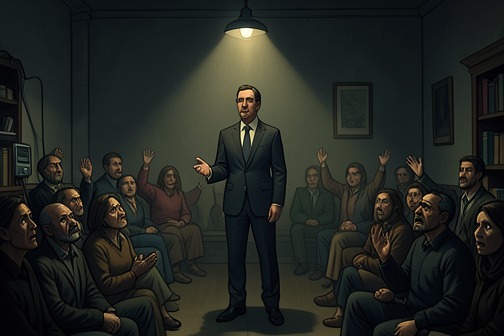
[Mussolini's 3 January 1925 speech](entity:event-recall-event-mussolini-s-3-january-1-caa29c5326b1) was a turning point in the [Matteotti crisis](entity:event-recall-event-matteotti-crisis-b7594083c424). Facing a chamber that had not formally accused him, [Benito Mussolini](entity:character-recall-character-benito-mussolini-0330d40d2c3f) invoked the law that permitted such an accusation and then declared himself responsible for the violence associated with fascism. The performance transformed an apparent moment of political vulnerability into an assertion of authority: the chamber fell silent, no one stood to bring charges, and Mussolini ended by promising that the situation would be clarified throughout the provinces within forty-eight hours.
## Crisis at [Montecitorio](entity:location-recall-location-montecitorio-884403622079)
The speech took place in the [Italian Chamber of Deputies](entity:organization-recall-organization-eb950b89e958) amid uncertainty over whether Mussolini would resign. Rumors had circulated for two days, while public demonstrations against fascism rose and then subsided as reports proved unfounded. The political atmosphere had become a rapid alternation of expectation and retreat; the question was not simply what Mussolini would say, but whether his premiership could survive the crisis.
A few minutes after three in the afternoon, Mussolini entered by his usual door on the right, accompanied by deputies Di Giorgio, Federzoni, and Ciano. He appeared grim, according to a reporter for the Corriere della Sera. He dismissed the customary applause from his supporters with a gesture and took his place at the presidential bench. [Alfredo Rocco](entity:character-recall-character-alfredo-rocco-6de76b9f46d0), presiding over the chamber, gave him the floor. The sequence made the speech a parliamentary act, but its staging also presented a leader confronting his opponents from the institutional center of government.
The immediate background was the killing of [Giacomo Matteotti](entity:character-recall-character-giacomo-matteotti-b1b8c0b072bc) and the political responsibility it had placed on Mussolini's government. Earlier, Matteotti had risen to speak in the chamber after a long record of detailed parliamentary interventions; his May 1924 speech began under audible hostility. By January, the crisis had narrowed to the question of whether political opponents would convert their accusations into a formal proceeding. Mussolini addressed that choice directly rather than seeking to negotiate for a political vote.
## The challenge of Article 47
Mussolini took up the deputies' manual containing the kingdom's statute and directed attention to [Article 47 of the Statuto Albertino](entity:rule-recall-rule-47-7e4d07df1f61). The provision gave the [Chamber of Deputies](entity:organization-recall-organization-20acc842a4eb) the power to bring charges against the king's ministers and refer them to the Supreme Court of Justice. He asked whether anyone, inside or outside the chamber, wished to make use of it. The gesture placed the constitutional procedure itself at the center of the scene: the government leader publicly named a mechanism that could hold ministers to account, then waited for someone to activate it.
No one stood. The silence was consequential. Only Mussolini's supporters rose to applaud, leaving the formal challenge unanswered by his opponents. Rather than treat the absence of an accuser as a reason to retreat, he declared that he would make the charge against himself. This maneuver let him occupy both sides of the confrontation: he acknowledged the gravity of the accusation while controlling its terms and the response that followed.
## Responsibility and its limits
Mussolini said he accepted political, moral, and historical responsibility for what had happened. He conceded, conditionally, that if fascism amounted to coercive violence or had become a criminal band, then the blame belonged to him as its leader. Yet his formulation did not amount to a specific account of who had ordered Matteotti's killing. He denied having imagined or ordered that murder, distinguished his own endorsement of political violence from what he characterized as the killers' cowardice and blindness, and claimed respect for Matteotti as an adversary.
The speech thus joined admission to denial. Mussolini assumed broad responsibility for fascism while rejecting the most direct implication that he had ordered the particular crime. The distinction enabled him to appear as a strong leader willing to answer for the movement, without supplying the chamber with a clear confession about the chain of command. His appeal was not for a vote of confidence so much as an invitation to accept his version of the crisis—or to challenge him openly.
## Strength, silence, and the promised aftermath
After declaring responsibility, Mussolini presented strength as the only resolution to a struggle between opposing forces. He promised that the situation would be made clear in every province within forty-eight hours. The phrase carried an administrative sound, but its ambiguity gave it force: it left the chamber to consider what action might follow without specifying it. The session ended without discussion or a vote, and the assembly was to be summoned again by telegram.
The speech's political effect lay partly in this unresolved ending. The chamber had been offered a constitutional route to prosecution, but no deputy took it; it had then heard Mussolini assume responsibility without detailing a specific order, followed by a promise of action beyond the chamber. The institution remained in session, yet the exchange exposed how little parliamentary procedure could accomplish when its members did not act upon it.
That scene completed a longer movement visible in the book's account of fascist politics. The return of millions of veterans after the war had been framed as the arrival of a new political mass, while the old liberal order was described as exhausted. [Fascism](entity:concept-recall-concept-fascism-37baf0d2849a) later proclaimed that it would absorb liberalism through violence and claimed to embody the state itself. By January 1925, the parliamentary form persisted, but Mussolini's speech recast its central test as a personal confrontation resolved by strength. Its ending—silence, no vote, and an undefined promise of action—made the gap between constitutional language and effective political restraint unmistakable.